 How-to
How Long Does Bourbon Last After Opening?
Last Updated: November 16, 2026
Quick Summary
An opened bottle of bourbon typically holds good quality for six to twelve months, and often longer if you store it well. How long bourbon lasts after opening depends far more on fill level than the calendar, since air is the enemy and a fuller bottle has less of it. Bourbon will not spoil like milk, but flavor, aroma, and that bright edge fade long before the liquid becomes undrinkable.
- A full to 75% bottle keeps near-original flavor for 12+ months.
- A half-full bottle typically holds quality for 6-9 months.
- A quarter-full bottle shows noticeable flavor loss within 3-6 months.
- Store bottles upright so the whiskey never touches the cork for long.
- Bourbon in a decanter lasts weeks to a few months, not years.
Table of Contents
- How Long Does Bourbon Last After Opening? The Short Answer
- Does Bourbon Go Bad If Opened? Flavor Decline vs. Spoilage
- How Long Can Whiskey Last Opened in a Bottle? A Timeline by Fill Level
- Oxidation, Headspace, and Why the Last Pour Tastes Different
- How Long Does Bourbon Last in a Decanter?
- How to Store Opened Bourbon: A Step-by-Step Checklist
- How to Tell If Opened Bourbon Has Gone Bad
- Log Your Open Bottles and Track How They Age
- Frequently Asked Questions
How Long Does Bourbon Last After Opening? The Short Answer
An opened bottle of bourbon typically holds good quality for six to twelve months, and often longer if you store it well. That is the short answer to how long bourbon lasts after opening. The honest reply is that the clock starts the moment air touches the whiskey.
Bourbon is a distilled spirit, so it will not spoil like milk or meat. Higher proof helps here: the alcohol by volume does real work as a preservative. But "safe to drink" and "tasting its best" are two different things. Flavor, aroma, and that bright edge fade long before the liquid becomes undrinkable.
Below, we break down the timelines, the storage steps, and the signs that tell you a bottle has turned the corner.
Does Bourbon Go Bad If Opened? Flavor Decline vs. Spoilage
Opened bourbon does not go bad in the food-safety sense. It does go flat, dull, and stale over time. The distinction matters, because most people confuse flavor decline with spoilage.
Here is the split:
- Flavor decline: the whiskey tastes muted, loses its aroma, and picks up a flat or bitter note. This is normal and expected.
- Spoilage: rare, and usually tied to contamination, a failed cork, or long sun exposure. Signs include a sour smell or visible cloudiness.
A common mistake is pouring out a bottle that simply tastes tired. Give it ten minutes in the glass. If the aroma returns, the whiskey is fine, just older.
How Long Can Whiskey Last Opened in a Bottle? A Timeline by Fill Level
How long can whiskey last opened in a bottle? It depends far more on how much liquid is left than on the calendar. Air is the enemy, and a fuller bottle has less of it.
| Fill Level | Typical Window | What to Expect |
|---|---|---|
| Full to 75% | 12+ months | Minimal change, near-original flavor |
| Half-full | 6-9 months | Slight softening of aroma |
| Quarter-full | 3-6 months | Noticeable flavor loss, flatter finish |
| Nearly empty | 1-3 months | Stale taste, muted nose |
The pattern is simple. The more remaining liquid, the slower the decline. A nearly empty bottle is the one to finish first.
Why fill level drives the timeline. The empty space above the liquid, the headspace, is where oxygen sits and reacts. A full bottle has a small headspace and a small oxygen reservoir; a quarter-full bottle has a large one. Every pour enlarges that reservoir, so a bottle you open weekly loses its cushion of protection faster than one you touch twice a year.
How proof and closure shift the window. Higher-proof bourbon generally holds up better because alcohol itself is a preservative and the ratio of water to alcohol affects how quickly aroma compounds degrade. A tight screw cap or a well-seated cork slows air exchange; a loose stopper or a crumbling cork accelerates it.
What to do at each stage. When a bottle drops below half, start planning: finish it within the window, move the remainder to a smaller clean glass bottle to shrink the headspace, or accept that the last pours will be flatter and use them in cocktails.
Watch out: transferring bourbon to a smaller bottle only helps if that bottle is clean, dry, and tightly sealable. A rinsed-but-wet bottle or a loose stopper can introduce contamination or air exchange that defeats the purpose.
Oxidation, Headspace, and Why the Last Pour Tastes Different
Oxidation is the chemical reaction between whiskey and oxygen. It slowly changes the compounds that give bourbon its flavor and aroma. A little oxygen is fine, even helpful right after opening. Too much, over too long, dulls the spirit.
Headspace is the empty air gap between the liquid and the cap. The bigger the headspace, the more air exposure, and the faster oxidation runs. That is why the last pour from a bottle often tastes flatter than the first.
A few practical notes:
- Proof matters. Higher-proof whiskey generally holds up better than low-proof.
- Closure matters. An airtight seal from a good cork or screw cap slows air exchange.
- Environment matters. Heat and temperature fluctuations speed oxidation.
What most guides miss is that headspace grows every time you pour. A bottle you open weekly loses its cushion of protection faster than one you touch twice a year.
How Long Does Bourbon Last in a Decanter?
Bourbon in a decanter lasts weeks to a few months, not years. Decanters look great on a bar cart, but most have a loose stopper and a wide mouth, so air gets in fast. The wide surface area speeds oxidation.
If you love the look of a decanter, treat it as short-term display. Pour in what you plan to drink within a month or two. Keep the original bottle sealed and stored properly for the long haul. For anything you want to keep for a special occasion, leave it in its original bottle with a tight closure.
How to Store Opened Bourbon: A Step-by-Step Checklist
Good storage is the whole game. Follow these steps and you will get the most out of every opened bottle. Each step below includes the reason it matters, so you can adapt it to your space rather than treating it as a rigid rule.
- Keep it upright. Store bottles standing so the whiskey never touches the cork for long. A cork that stays wet with high-proof spirit can soften, crumble, or impart off-flavors over time; upright storage keeps the closure dry and intact.
- Seal it tight. Press the cork or screw cap firmly after every pour. A screw cap generally gives a more consistent seal than a cork, especially after repeated opening; if your cork feels loose or crumbles, replace it or move the remaining whiskey to a clean bottle with a secure closure.
- Pick a cool spot. Aim for a stable, cool place away from the stove or a sunny window. Heat speeds the chemical reactions that dull flavor, and a spot that swings warm and cool repeatedly is worse than a consistently cool one.
- Block the light. Keep bottles in a dark cabinet or box. Sunlight and strong artificial light degrade whiskey over time, and clear glass offers no protection, a dark shelf or the original carton is your best defense.
- Avoid temperature swings. Steady beats warm-then-cold every time. Repeated expansion and contraction can work at the closure and increase air exchange, so a stable cabinet beats a spot near a door or vent.
- Cut the headspace. For a bottle below half, pour the remainder into a smaller clean glass bottle. Less headspace means less oxygen in contact with the liquid. Make sure the smaller bottle is clean, dry, and tightly sealable before you transfer.
- Label the open date. A quick note on the bottle tells you how long it has been open. Pair it with a fill-level note so you can see how quickly the bottle is dropping and plan accordingly.
Closure and environment trade-offs. A screw cap is generally more reliable for long-term storage than a cork, but either can work if it seals well. In a humid environment, keep bottles upright and away from damp surfaces so the closure does not degrade; in a dry environment, the main risk is temperature fluctuation rather than humidity.
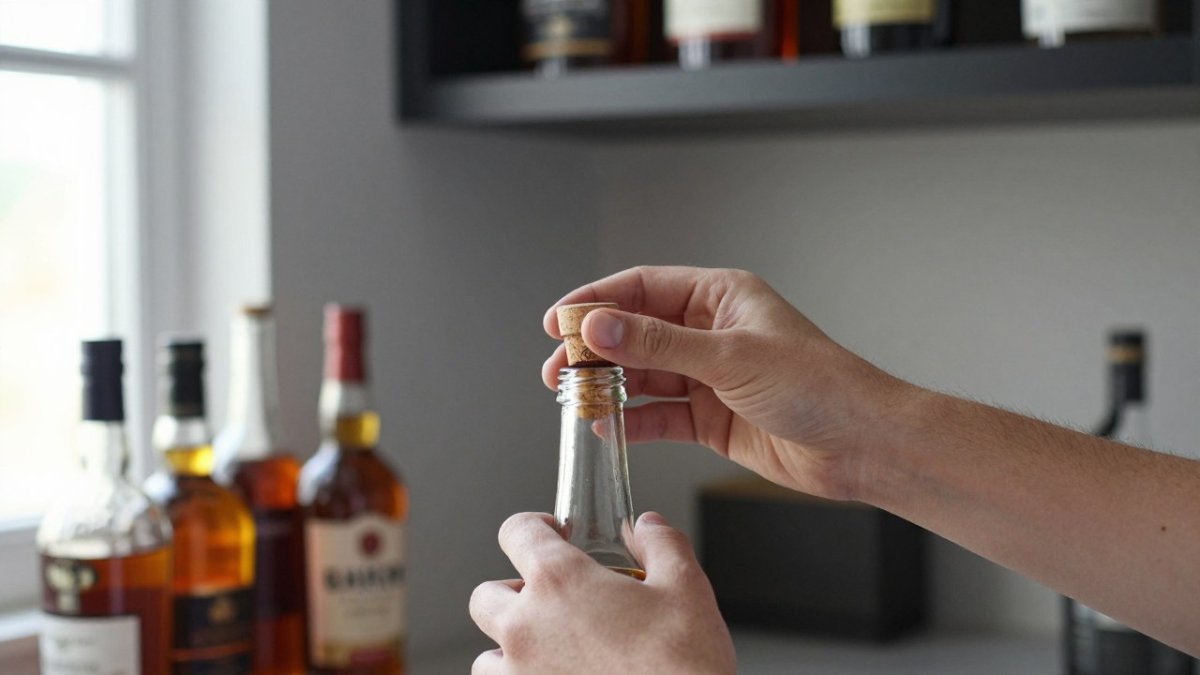
Watch out: a bottle that looks sealed may not be. If the cork crumbles or the cap threads are stripped, air is getting in regardless of how firmly you press, replace the closure or transfer the whiskey before the flavor fades.
For a deeper walkthrough, our guide on best practices for whiskey bottle storage that protect flavor covers the details. Temperature is its own topic, so see our whiskey storage temperature rules that protect your bottles for the specifics. And if sunlight is a concern in your space, read how to protect bourbon from sunlight damage.
How to Tell If Opened Bourbon Has Gone Bad
Most opened bourbon has not gone bad. It has gone quiet. Here is how to tell the difference.
- Smell it first. A dull, flat nose is normal aging. A sour or vinegary smell points to contamination.
- Taste a small pour. Muted flavor is fine. A sharp, off, or metallic taste is a warning sign.
- Check the color. Gradual darkening is normal. Cloudiness or floating particles are not.
- Inspect the closure. A crumbling or loose cork can let air and debris in.
If the whiskey smells and tastes clean but flat, it is still drinkable. Use it in a cocktail or a highball. If it smells sour or looks cloudy, dump it and move on.
Log Your Open Bottles and Track How They Age
The easiest way to stop guessing is to keep a simple log. Write down the open date, the fill level, and a quick tasting note every few weeks. That record tells you exactly when a bottle starts to fade.
A rotation system helps too. Drink the bottles that are lowest first. Our guide on how to manage bourbon bottle rotation shows you how to set one up. For a clean, organized record, see how to build a digital whiskey cellar log that actually works.
This is where Bourbon Tracker™ can help. Our free platform lets you log tasting notes and manage your whole collection without any download.
Your opened bottles are fading right now, and the ones you forget are the ones you lose. Bourbon Tracker™ gives you a free, no-download way to log every open date, record tasting notes, and keep your collection organized. The AI-powered recommendations help you spot which bottles to finish first, and community features let you share reviews with other enthusiasts. Get started with Bourbon Tracker™ and keep every pour tasting the way it should.
Frequently Asked Questions
Can you drink 20-year-old opened whiskey?
You can drink it, but it will not taste like it did when the bottle was first opened. The whiskey itself does not become unsafe, but two decades of air exposure in a partly empty bottle will have flattened the aroma and softened the flavor. If the fill level stayed high and the bottle was stored upright in a cool, dark place with a tight closure, it may still be enjoyable. Check for a stale smell or a sharp, off-putting taste before pouring a full glass.
How can you tell if opened bourbon has gone bad?
Look for sensory changes rather than a printed expiration date, since bourbon has none. A bottle that has declined will smell dull or dusty instead of sweet and oaky, and the taste will feel flat with the finish dropping off quickly. Real spoilage is rare but shows up as a sour, vinegary, or moldy note, or visible cloudiness or particles that were not there before. If the aroma turns your stomach, pour it out.
Does bourbon last longer if the bottle is unopened?
Yes. An unopened bottle keeps its character far longer because the seal limits air exposure and evaporation. Once you break that seal, oxidation and evaporation begin, and the pace depends on how much liquid remains and how the bottle is stored. That is why a sealed backup bottle is worth keeping if you love a particular release, and why it pays to track which bottles you have opened and when.
How should you store an opened bottle of bourbon?
Keep it upright, tightly sealed, and away from heat, sunlight, and temperature swings. A cool, dark cabinet works better than a countertop near the stove or a sunny windowsill. Push the cork in firmly or tighten the screw cap after every pour, and consider moving the last few ounces into a smaller bottle to reduce headspace. Avoid storing bourbon in the freezer or in a hot garage.