 How-to
Tax Implications of Selling Bourbon: Bottles, Barrels, Businesses
Last Updated: November 14, 2026
Quick Summary
The tax implications of selling bourbon depend on what you sell: a private bottle sale is generally a capital sale, a barrel interest depends on its structure and intent, and a business sale mixes ordinary and capital treatment. Know your cost basis, holding period, asset type, and selling costs before computing gain.
- Private bottle sales held over one year generally get long-term capital treatment; shorter holds get short-term, ordinary rates.
- Barrel cost basis includes the purchase price plus storage and aging fees paid during the hold.
- Selling a business requires allocating the price across inventory, equipment, and goodwill, each taxed differently.
- Keep purchase receipts, fee proof, sale records, holding-period notes, and contracts for every bottle, barrel, or asset sold.
- Check state alcohol control board rules and licensing before shipping across state lines or selling online.
Table of Contents
- Why the Tax Implications of Selling Bourbon Depend on What You're Selling
- Capital Gains Tax on Collectibles: How a Private Bottle Sale Is Taxed
- Taxes on Whiskey Barrels: Selling Barrel Interests and Barrel-Aged Spirits
- Alcohol Tax by State: Where Excise and Sales Taxes Hit Bourbon Sellers
- Selling a Bourbon Business: Business Assets, Inventory, and Sale Proceeds
- Tax Implications Examples: Worked Scenarios for Bottles, Barrels, and Business Assets
- Records, Reporting, and Legality: What to Keep Before You Sell
- Track Your Collection Before Tax Season Arrives
- Frequently Asked Questions
Why the Tax Implications of Selling Bourbon Depend on What You're Selling
The tax implications of selling bourbon change completely depending on what you actually sell. A single bottle from your shelf, a barrel interest, and a licensed business are three different tax events. This guide from Bourbon Tracker™ breaks down each one in plain terms.
Here's the core problem: most advice online mixes these three situations together. That leads collectors to report a simple bottle sale the same way a distillery reports inventory. The rules are not the same.
A private collector selling a bottle is usually making a capital sale. A barrel owner may be dealing with a different structure. A business sale brings inventory, business assets, and goodwill into play.
Below, we'll show you exactly how each path is taxed and what records to keep.
Three Seller Types, Three Different Tax Pictures
Tax treatment depends on intent and scale. The table below sums up the difference.
| Seller Type | What's Sold | Likely Tax Treatment | Key Records |
|---|---|---|---|
| Private collector | Personal bottles | Capital gain or loss | Purchase price, dates, receipts |
| Barrel interest holder | Barrel or aged spirits | Depends on structure and intent | Contract, cost basis, sale terms |
| Business owner | Assets, inventory, goodwill | Mixed ordinary and capital | Full books, inventory counts |
Most collectors fall into the first row. The rest of this guide shows how each row works in practice.
Capital Gains Tax on Collectibles: How a Private Bottle Sale Is Taxed
A private bottle sale is generally treated as the sale of a capital asset. That means you compare your sale price to your cost basis to find your taxable gain. Bourbon bottles held for investment can fall under collectibles rules.
Capital gain is the profit from selling an asset for more than you paid. Cost basis is your original purchase price plus any costs to acquire the bottle.
The holding period matters. Assets held longer than one year get long-term treatment. Shorter holds get short-term treatment.
For collectibles, the long-term federal capital gains rate is generally higher than the standard long-term rate on stocks. Confirm the current rate with a tax professional or the IRS capital gains guidance before you file.
Capital Gain vs. Ordinary Income: Which Rate Applies
The rate depends on your intent and how long you held the bottle. How you classify a profit depends on your intent and how long you held the bottle. A professional can help you determine the correct treatment.
A common mistake is assuming every bottle sale is tax-free because it's a hobby. That is not safe. Profit from selling collectibles can be taxable even when selling is not your main business.
Use this simple test:
- Held over one year, bought for personal use → likely long-term capital
- Held under one year → likely short-term, taxed at ordinary rates
- Bought mainly to resell at a profit → possibly ordinary income
When in doubt, keep every receipt. Good records let you prove your basis and holding period. Our guide on how to track bourbon collection value walks through the recordkeeping side.
Taxes on Whiskey Barrels: Selling Barrel Interests and Barrel-Aged Spirits
Selling a barrel interest is not the same as selling a bottle. A barrel interest is a contract right, and its tax treatment depends on how it's structured. Some buyers hold barrels as investments and later sell the interest or the aged spirits.
The seller needs to know their cost basis in the barrel. That includes the purchase price and any storage or aging fees paid. Sale proceeds minus basis gives the gain.
Watch out: mixing an investment barrel sale with a business sale on one tax return without separating the two can create reporting errors. Keep barrel transactions in their own records.
For the bigger picture on holding barrels as investments, see our guide to managing a whiskey collection for investment.
Alcohol Tax by State: Where Excise and Sales Taxes Hit Bourbon Sellers
Alcohol tax by state is where sellers get surprised, but the surprise is usually about which tax applies to whom. Three different tax layers can touch a bourbon transaction, and most of them are not aimed at a private collector selling a personal bottle.
A common pattern is a seller who checks their home-state rules, completes the sale, and then discovers the destination state prohibits direct shipment of spirits. That is a legal problem, not a tax problem, and no tax filing fixes it.
For the federal side, the Alcohol and Tobacco Tax and Trade Bureau publishes the permit and excise-tax rules. For state rules, the state alcohol control board or department of revenue is the authoritative source, and the rules change; confirm the current requirements before any transaction.
Selling a Bourbon Business: Business Assets, Inventory, and Sale Proceeds
Selling a bourbon business is a different world. Here, the sale includes business assets, inventory, equipment, and possibly goodwill. Each part can be taxed differently.
The sale of a business is often allocated across categories such as inventory and equipment, and each allocation can affect your tax liability.
A common mistake is treating the whole sale as one capital gain. That can overstate or understate what you owe. Work with a tax professional to allocate net proceeds correctly across asset classes.
Good books make this far easier. Clean inventory counts, purchase records, and asset lists let your accountant split the sale properly.
Tax Implications Examples: Worked Scenarios for Bottles, Barrels, and Business Assets
Concrete examples make the rules easier to follow. The numbers below are illustrative, not tax advice; substitute your own figures and confirm rates with a tax professional.
Bottle scenario (private collector, long-term hold). You bought a bottle for $400 and held it for several years. You sell it for $2,500 through a consignment platform that charges a 10% seller's fee.
- Sale price: $2,500
- Selling fee: $250
- Net proceeds: $2,250
- Cost basis: $400
- Taxable gain: $1,850
Because the bottle was held over one year and bought for personal use or investment rather than resale, the gain is generally long-term capital gain. If the bottle is treated as a collectible, the long-term federal rate is generally higher than the standard long-term rate on stocks; confirm the current rate with a tax professional or the IRS capital gains guidance. The after-tax proceeds depend on that rate plus any state income tax.
Bottle scenario (short-term flip). Same bottle, but you bought it for $400 and sold it four months later for $2,500 with the same $250 fee. Net proceeds are $2,250 and the gain is $1,850, but because the holding period is one year or less, the gain is short-term and taxed at ordinary income rates.
Barrel scenario. You bought a barrel interest for $6,000 and paid $1,200 in storage and aging fees over the hold. You later sell the interest for $9,500 with no selling costs.
- Sale price: $9,500
- Cost basis: $6,000 + $1,200 = $7,200
- Taxable gain: $2,300
The character of that gain depends on how the interest is structured and your intent. A tax professional can confirm the treatment for your situation. Keep the barrel contract, the fee records, and the sale terms in their own file so the transaction is not commingled with other activity.
Business scenario. You sell a small retail shop. The total price is allocated across inventory, equipment, and goodwill. Inventory is generally treated as ordinary income when sold; equipment may qualify for capital treatment; goodwill is typically a capital asset. The allocation is not cosmetic: it changes the rate applied to each slice of the price. A common mistake is treating the whole sale as one capital gain, which can overstate or understate what you owe. Work with a tax professional to allocate net proceeds correctly across asset classes.
The pattern in all three. Know your basis, know your holding period, know what kind of asset you sold, and subtract selling costs before you compute the gain. The same four inputs drive every scenario above; only the character of the gain changes the rate.
Records, Reporting, and Legality: What to Keep Before You Sell
Records are the backbone of any sale. Without them, you cannot prove your basis, and you may pay more tax than you owe.
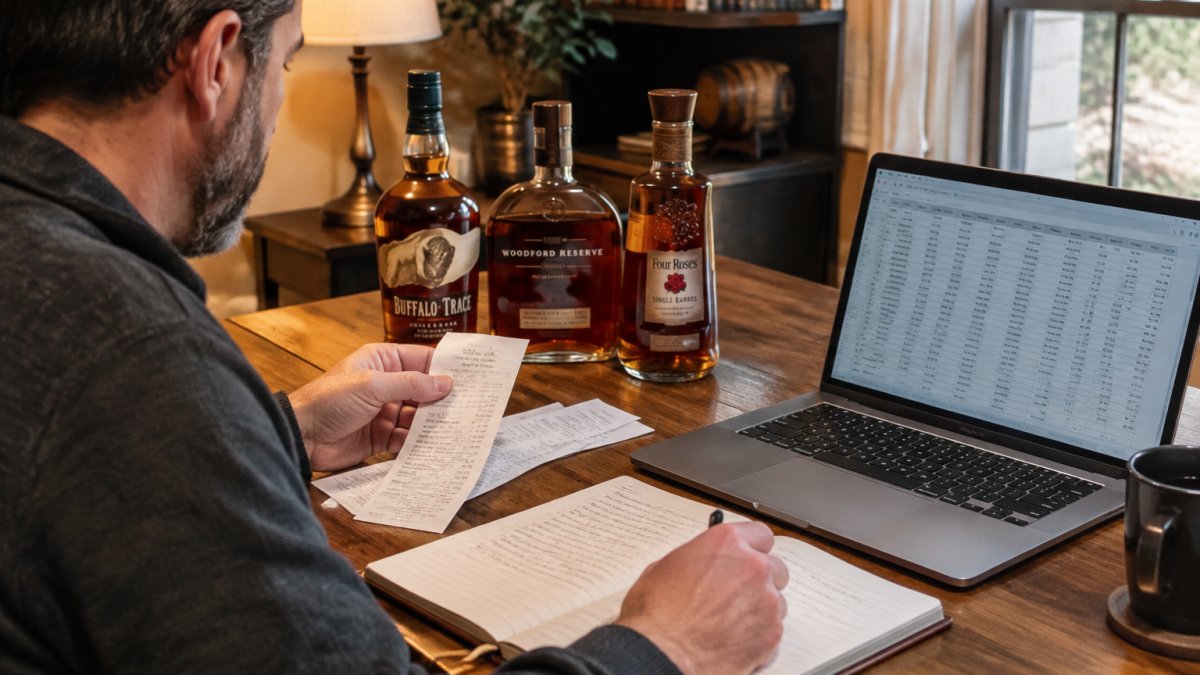
Keep these for every bottle, barrel, or asset you sell:
- Purchase receipts showing price and date
- Proof of any fees paid, like storage or shipping
- Sale records showing the final price
- Notes on the holding period
- Contracts for barrel interests or business sales
On legality, check licensing rules before selling online or shipping across state lines. Private sales of personal bottles can be different from business sales and shipping, which may have stricter rules. Check current requirements before you sell.
A solid inventory system makes tax season far less painful. Our guide on managing whiskey bottle inventory shows how to set one up. For the practical steps on cashing out a collection, read how to liquidate a bourbon collection.
Track Your Collection Before Tax Season Arrives
Good records make tax season easier for collectors.
That's where Bourbon Tracker™ helps. Our free platform lets you log every bottle with purchase details and tasting notes in one place.
Start now, before you sell anything. A clean record today saves hours of guesswork later.
Selling bourbon comes with real tax decisions, and the right answer depends on what you're selling. Bourbon Tracker™ gives you the organized records that make those decisions simpler, with AI label scanning, market value tracking, and a release calendar for BTAC and Pappy drops. Get started with Bourbon Tracker™ and keep your collection and its value in one clear place.
Frequently Asked Questions
Is it legal to resell bourbon as a private collector?
Selling a bottle from your personal collection is generally legal, but reselling alcohol as a business may require a license. The line usually falls on intent and volume: an occasional private sale differs from buying to flip. Shipping alcohol across state lines adds another layer, since destination-state rules and carrier policies apply. Check current rules before listing bottles online, and keep purchase records so you can show a personal collection rather than inventory.
How are profits from selling a bourbon collection taxed?
How profit from selling bottles is taxed depends on your holding period and intent. Confirm the treatment for your situation with a tax professional.
Do state alcohol taxes apply when a private collector sells bourbon?
Tax and licensing rules for alcohol sales can vary by location, and shipping destination rules can differ. Confirm both the tax and licensing rules for your location and the buyer's location before completing a sale.
What records should I keep when selling bourbon?
Keep the original purchase receipt or price, the sale price, the date of both, platform fees, and any shipping costs. That gives you cost basis, holding period, and net proceeds, the three numbers that decide your taxable gain. Store photos of the bottle and label, plus any listing or message thread confirming the sale. If you sell barrels or business assets, add contracts and allocation records. Good records make reporting straightforward.