 how-to
How to Identify Whiskey Tasting Notes: A Step-by-Step Guide
Last Updated: October 23, 2026
Quick Summary
To identify whiskey tasting notes, start by nosing the whiskey to catch initial and layered aromas, then take small sips to notice flavors your palate detects, and finally observe the finish that lingers after swallowing. Learning to distinguish fruity, floral, sweet, spicy, smoky, and woody flavor families helps you recognize patterns and build your tasting vocabulary faster.
- Use a tulip-shaped glass in a quiet, well-lit space free of strong smells to accurately nose whiskey.
- Nose the same whiskey three or four times over a few minutes, as each pass reveals different layered aromas.
- Take small sips about a teaspoon in size and let the whiskey coat your mouth for 2-3 seconds before swallowing.
- Separate aromas, tastes, and trigeminal sensations in your notes to avoid confusing physical sensations with actual flavors.
- Calibrate your vocabulary by smelling reference items like vanilla extract, caramel candy, and citrus peel alongside the whiskey.
Table of Contents
- How to Prepare for a Whiskey Tasting
- How to Nose Whiskey and Pick Up Aromas
- Understanding Common Whiskey Flavor Notes
- Tasting Whiskey: The Palate and Finish
- Using a Whiskey Tasting Wheel to Identify Flavors
- How to Write Whiskey Tasting Notes
- Factors That Affect Your Tasting Experience
- Frequently Asked Questions
How to Prepare for a Whiskey Tasting
Preparing to identify whiskey tasting notes starts before the glass hits your lips, environment, palate, and glassware matter.
Choose a quiet, well-lit space to see the whiskey's color and clarity, and avoid strong smells, perfume, food, candles, that interfere with your nose.
Eat a small snack beforehand and avoid spicy foods or mint for at least 30 minutes before tasting.
Gather your supplies:
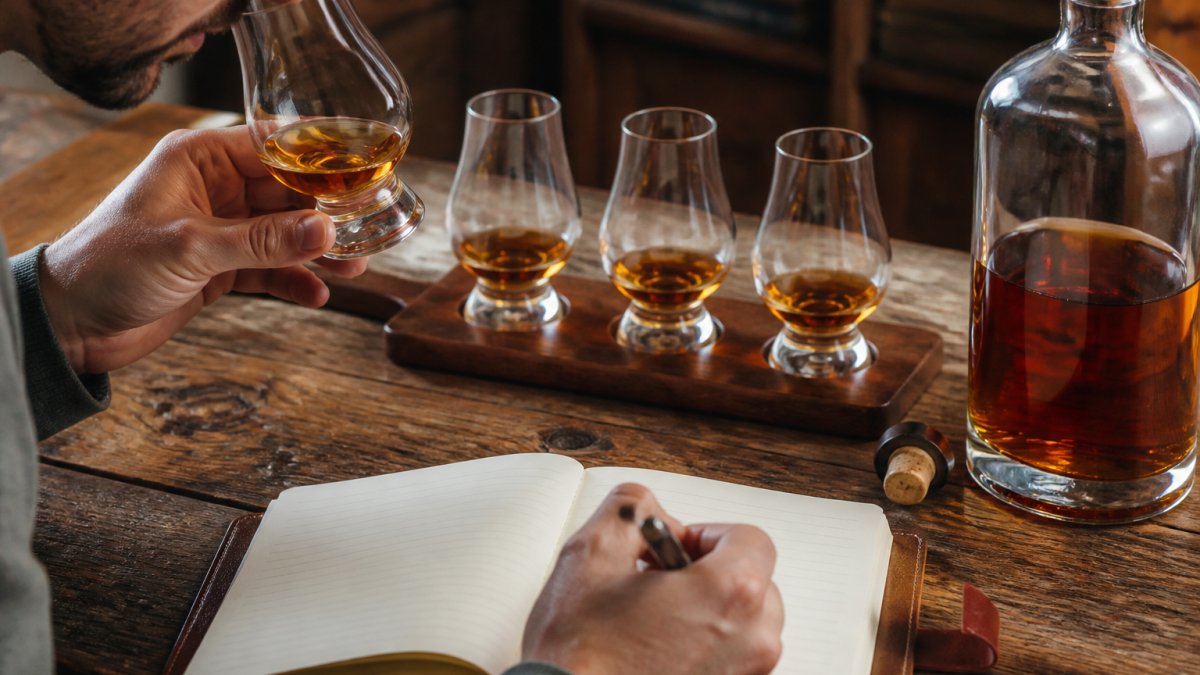
- Tulip-shaped glasses (they concentrate aromas)
- Water for palate cleansing between tastings
- A notebook or build a whiskey tasting journal to record your impressions
Plan for 15-20 minutes per whiskey. This isn't a race.
How to Nose Whiskey and Pick Up Aromas
Nosing whiskey is where most people start learning to identify whiskey tasting notes, your nose catches subtle differences your palate might miss.
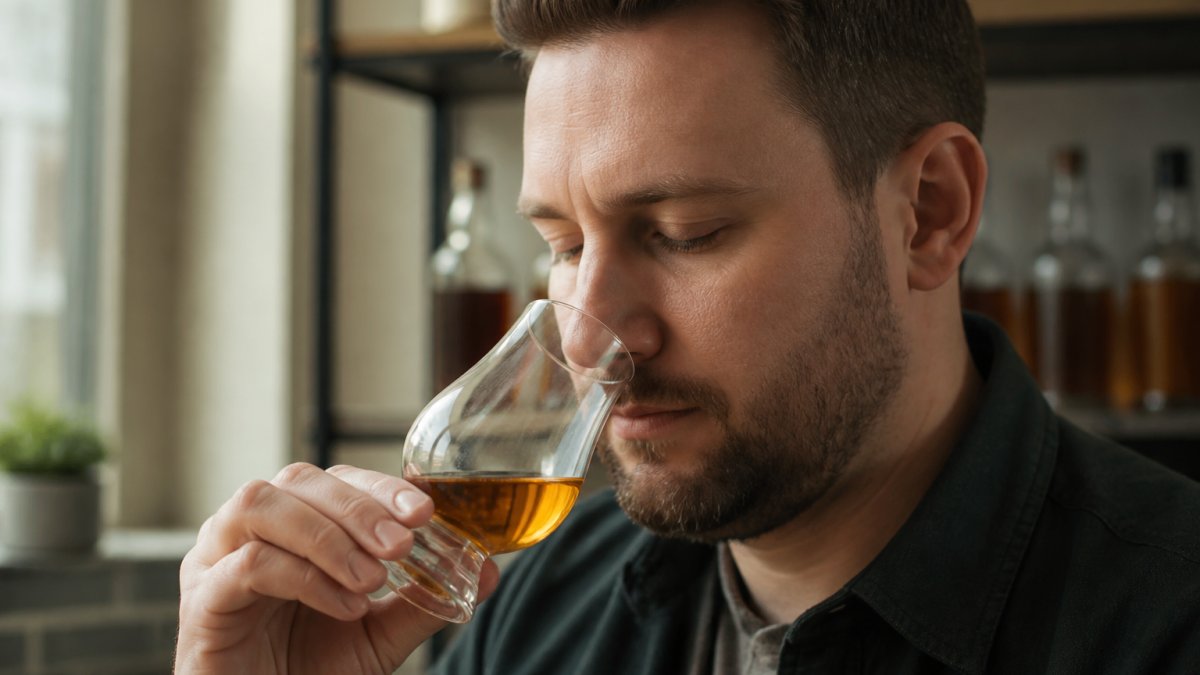
Pour about an ounce into your glass. Hold it at eye level and observe the color first. Then bring it to your nose.
The First Impression: Initial Aromas
Take a quick sniff from a few inches away. What hits you first is your initial impression.
Don't go nose-first into the glass. That burns your nostrils. Keep distance. Let the aromas come to you.
Common first impressions include:
- Alcohol vapor (sharp, hot)
- Oak or wood
- Vanilla or caramel sweetness
Write down what you notice immediately. First impressions fade fast.
Deeper Nosing: Developing Your Palate
Now bring the glass near your nose and take slower, deliberate sniffs to pick up layered aromas.
Swirl gently to release volatile compounds, wait a few seconds, then nose again.
You'll often find different aromas emerge:
- Spice notes (cinnamon, pepper, clove)
- Smoky or peaty character
- Leather or tobacco
Nose the same whiskey three or four times over a few minutes, each pass reveals something new.
Understanding Common Whiskey Flavor Notes
Whiskey flavor notes fall into recognizable families. Learning them helps you identify whiskey tasting notes faster.
These categories overlap, a bourbon might show fruity AND spicy notes. That's normal.
Fruity, Floral, and Sweet Flavors
Fruity notes are among the easiest to spot. Look for:
- Apple or pear (common in lighter whiskeys)
- Citrus (lemon, orange zest)
- Stone fruit (apricot, peach, plum)
Floral notes add elegance. You might notice:
- Rose or violet
- Honeysuckle
- Lavender
Sweet notes often come from barrel aging or grain choice:
- Vanilla (very common)
- Caramel or toffee
- Honey
For a deeper dive into fruity notes, check out our guide on how to identify fruity notes in bourbon.
Spicy, Smoky, and Woody Notes
Spicy notes come from rye content or barrel char:
- Black pepper or white pepper
- Cinnamon or nutmeg
- Clove
Smoky notes signal peat or heavy barrel char:
- Smoke or ash
- Charred wood
- Leather
Woody notes develop from barrel aging:
- Oak (the most common)
- Cedar
- Sandalwood
When you nose a whiskey, you're usually finding notes from multiple families at once.
Whiskey flavors fall into recognizable families that help you identify tasting notes faster.
| Flavor Family | Examples | Source or Character |
|---|---|---|
| Fruity | Apple, pear, citrus, stone fruit, berries | Common in lighter whiskeys |
| Floral | Rose, violet, honeysuckle, lavender, orchid | Adds elegance to profile |
| Sweet | Vanilla, caramel, toffee, honey, molasses | From barrel aging or grain |
| Spicy | Black pepper, cinnamon, clove, ginger, chili | From rye content or barrel char |
| Smoky | Smoke, ash, charred wood, leather, tobacco | From peat or heavy barrel char |
| Woody | Oak, cedar, sandalwood, walnut, pine | Develops from barrel aging |
Tasting Whiskey: The Palate and Finish
Your palate picks up flavors your nose missed, this is where you truly identify whiskey tasting notes.
Taking Small Sips and Coating Your Mouth
Don't gulp. Take a small sip, about a teaspoon. Let it coat your mouth before swallowing.
Here's the technique:
- Sip a small amount
- Let it sit on your tongue for 2-3 seconds
- Move it around your mouth (some people gently chew)
- Notice the flavors developing
- Swallow slowly
The flavors change as the whiskey warms in your mouth. You'll taste things you didn't smell.
Many tasters add a few drops of water to open flavors and reduce burn. Try it both ways.
Noticing Texture and Mouthfeel
Pay attention to how the whiskey feels, not just tastes.
Is it:
- Thin or full-bodied?
- Smooth or rough?
- Oily or watery?
Full-bodied whiskeys coat your mouth longer; light whiskeys feel thin and crisp. Texture comes from alcohol content, barrel aging, and grain.
Identifying the Finish
The finish is what lingers after you swallow. Some whiskeys fade fast. Others stick around.
Notice:
- How long does the flavor last? (seconds, minutes)
- What tastes remain? (sweet, spicy, smoky, woody)
- Is the finish pleasant or harsh?
A long, pleasant finish often signals quality, but short finishes aren't bad, just different.
Using a Whiskey Tasting Wheel to Identify Flavors
The wheel has a center hub of broad categories (fruity, spicy, sweet, woody) with spokes branching into specific flavors.
How to use it:
- Nose the whiskey and pick a broad category
- Follow the spokes to narrower options
- Find the flavor that matches what you're experiencing
Start broad and don't hunt for the perfect word, if it tastes fruity but you're unsure which fruit, "fruity" is a valid note.
For a structured approach to using wheels, explore our beginner's guide to whiskey flavor wheels.
Calibrating Your Vocabulary with Reference Aromas
The wheel gives you words. Reference aromas give those words meaning. Build a small calibration kit of everyday items and smell them alongside the whiskey before you commit to a note:
- Vanilla, a split vanilla bean or pure vanilla extract on a cotton ball
- Caramel/toffee, a soft caramel candy
- Oak, a fresh piece of untreated oak or a toasted stave
Smell the reference, then the whiskey, then the reference again, two or three passes usually make a note stick, after which the whiskey itself becomes the reference.
Controlled Comparisons: The Fastest Way to Sharpen the Wheel
A wheel is most useful when you compare two pours under identical conditions:
- Use the same glass shape for both pours.
- Pour the same volume, about half an ounce each.
- Taste at the same temperature and in the same room.
- Nose and taste pour A, write notes, then repeat with pour B.
- Go back to A and see whether your first note still holds.
Choose pairs that isolate one variable: two bourbons of similar proof but different mash bills, or the same whiskey at two ages. When the only difference is the variable you chose, the wheel becomes a diagnostic tool, a higher-rye mash bill pushes the spicy spoke, while a wheated mash bill leans toward the sweet and soft-fruit spokes.
Blind Tasting and Expectation Bias
Labels, price, age statements, and brand reputation change what you perceive, a taster who knows a bottle cost $150 will often find more complexity than the same liquid unmarked.
A simple blind exercise:
- Pour two whiskeys into identical glasses and label them only A and B.
- Have someone else set them out, or shuffle them yourself and cover the labels.
- Run the full nose, palate, and finish routine on each.
- Write your notes before you look at the labels.
- Reveal, then compare your notes to what you expected.
The gap between your blind notes and your labeled notes is your bias, measured. Repeat the exercise monthly and the gap tends to shrink.
How to Write Whiskey Tasting Notes
Writing notes forces you to slow down and think about what you're tasting, building your palate faster than just sipping.
Building Your Note-Taking Template
A simple template keeps you organized. Here's a structure that works:
Whiskey Name & Details:
- Name, distillery, age statement
- Alcohol by volume (ABV)
- Price (optional)
Appearance:
- Color (pale gold, amber, deep brown)
- Clarity (clear, hazy, oily)
Nose:
- First impression (quick sniff)
- Secondary aromas (after swirling)
- Overall aroma profile
Palate:
- Flavor notes (fruity, spicy, sweet, etc.)
- Mouthfeel (texture, body)
- Alcohol burn (none, mild, strong)
Finish:
- Length (short, medium, long)
- Lingering flavors
- Overall impression
Rating (optional):
- 1-10 scale or simple categories (like it, love it, pass)
Keep it simple. You don't need paragraphs. Bullet points work fine.
For a complete system, build a whiskey tasting journal to track your notes over time.
Distinguishing Aroma from Taste and Trigeminal Sensations
Here's where most tasters get confused: what you smell isn't always what you taste.
Your nose detects aroma molecules; your tongue detects taste (sweet, salty, sour, bitter, umami). Different senses.
You might smell apple but taste caramel. Both are real. Write both down.
Trigeminal sensations add another layer. These are physical sensations, not true tastes:
- Heat or burn from alcohol
- Cooling from menthol
- Prickling from carbonation or spice
When you write notes, separate these three:
- Aromas: "apple, vanilla, oak"
- Tastes: "caramel, honey, slight bitterness"
- Sensations: "warm alcohol, drying finish"
This clarity keeps you from confusing sensations with flavors.
Factors That Affect Your Tasting Experience
Your environment and methodology change what you taste. Understanding these factors helps you taste more accurately and explains why two people can nose the same pour and disagree.
Glassware, Water, Temperature, and Tasting Order
Water: A few drops can open flavors and reduce burn, but the effect depends on proof.
Temperature: Room temperature keeps comparisons fair. Cold whiskey numbs the palate and suppresses aroma; warm whiskey emphasizes burn and flattens delicate notes.
Tasting order: Start with lighter whiskeys and work toward fuller, smokier ones.
Distinguishing Aroma, Taste, and Trigeminal Sensations
Most confusion in tasting notes comes from mixing three senses into one description.
- Aroma is detected by the nose. Vanilla, citrus, oak, and smoke are aromas.
- Taste is detected by the tongue: sweet, salty, sour, bitter, and umami. Whiskey rarely shows much salt or umami, but sweetness and bitterness are common.
- Trigeminal sensations are physical, not true tastes: alcohol heat, the cooling of menthol, the prickling of spice, and the drying, grippy feeling of tannins.
When you write notes, separate the three: "apple, vanilla, oak" are aromas; "caramel, honey, slight bitterness" are tastes; "warm alcohol, drying finish" are sensations. This keeps you from calling alcohol burn a "flavor" and helps you compare notes with other tasters.
Responsible Tasting and Alcohol Safety
Tasting whiskey is not the same as drinking whiskey. A measured half-ounce pour per whiskey is enough to evaluate nose, palate, and finish. If tasting several pours, spit after each and rinse with water. Hydrate, eat something bland, and never drive after a tasting, plan a designated driver or ride home before you pour the first glass.
Controlled Comparisons and Blind Tasting
Comparing whiskeys side-by-side reveals differences you'd miss alone. Set up a flight of 3-4 whiskeys at similar proofs and ages, use identical glasses, and pour equal volumes.
Blind tasting removes bias, when you don't know the price or brand, you taste more objectively.
For a full guide on structured tastings, check out how to host a bourbon blind tasting at home.
Frequently Asked Questions
How do you identify tasting notes in whiskey without getting overwhelmed?
Start by nosing the whiskey from a distance, then bring the glass closer to catch secondary aromas. Take small sips and let the liquid coat your mouth for a few seconds before swallowing. Focus on one flavor category at a time, fruity, floral, spicy, or woody, rather than trying to name every note at once. Using a tasting wheel helps you narrow down flavors by category. Most people develop this skill over several tastings, so don't expect to identify complex notes immediately.
What's the difference between aroma and taste when tasting whiskey?
Aroma is what you smell through your nose when nosing the whiskey, fruity, floral, or smoky scents. Taste is what your taste buds detect on your palate when you sip, sweetness, bitterness, spice. Trigeminal sensations are the burning or warming feeling alcohol creates, which is separate from flavor. When writing tasting notes, distinguish these three: note the nose separately from the palate and finish, and don't confuse the alcohol burn with actual flavor.
How do you use a whiskey tasting wheel to identify flavor notes?
A tasting wheel organizes flavors into categories: fruity, floral, sweet, spicy, smoky, and woody. Start at the center and work outward toward specific flavors. When nosing, ask yourself which main category you detect, then narrow down to subcategories. For example, if you sense something fruity, is it citrus, stone fruit, or dried fruit? The wheel prevents random guessing and trains your palate to recognize patterns. Keep the wheel nearby during tastings to build consistency in your descriptions.
Should you add water to whiskey when tasting it?
Adding a few drops of water can open up whiskey's aromas and flavors by reducing alcohol burn, which can mask subtle notes. Many tasters add water gradually and taste at different dilutions to discover how flavors change. Start with neat whiskey to get the full strength, then add small amounts of water and re-nose and re-taste. This controlled comparison helps you identify which notes come through at different alcohol levels and deepens your understanding of the whiskey's flavor profile.
Learning to identify whiskey tasting notes takes practice. Your palate develops gradually. The more you taste, the more you notice.
At Bourbon Tracker™, we help you track every bottle and organize your tasting notes in one place. Our platform lets you log your impressions, build your collection, and discover new whiskeys through AI-powered recommendations tailored to your palate. Track My Collection and start documenting your tasting journey today.