 how-to
How to Identify Fruity Notes in Bourbon
Table of Contents
- Understanding Fruity Notes in Bourbon
- The Bourbon Flavor Wheel and Fruit Categories
- How to Taste Bourbon Whiskey: A Step-by-Step Method
- Common Bourbon Tasting Notes and How to Spot Them
- Training Your Palate to Detect Fruity Notes
- Factors That Shape Fruity Profiles in Bourbon
- Organizing and Tracking Your Tasting Notes
- Frequently Asked Questions
Last Updated: September 20, 2026
Understanding Fruity Notes in Bourbon
Fruity notes in bourbon are flavor compounds created during distillation and aging that make the spirit taste like fruits such as cherries, apples, or tropical flavors. These flavors aren't added, they develop naturally through the distillation process, yeast activity, and time spent in the barrel. When you learn how to identify fruity notes in bourbon, you unlock a whole new way to appreciate what's in your glass.
Identifying fruity notes is one of the most rewarding skills a bourbon drinker can develop, transforming tasting from casual sipping into structured exploration.
What Creates Fruity Flavors in Bourbon
Fruity notes come from esters (volatile compounds formed during fermentation) and yeast strains (pubmed.ncbi.nlm.nih.gov). Different yeast strains produce different esters, which is why the same grain bill tastes different across distilleries.
Grain choice shapes fruit profiles: corn-heavy bourbons develop tropical notes, rye-forward bourbons show citrus zest, and wheat bourbons display orchard fruit characteristics.
Time in the barrel compounds these flavors. Wood sugars caramelize and oxidize, creating new aromatic compounds that layer on top of the original fermentation esters. The longer the bourbon ages, the more complex these fruit notes become.
Why Fruit Notes Vary Across Bottles
Two bourbons from different distilleries, or different batches from the same distillery, can taste completely different because every variable changes the outcome.
Warehouse temperature affects maturation speed: hot warehouses produce bold, concentrated fruit flavors; cool warehouses develop subtle ones. Barrel char level also matters, heavily charred barrels pull different flavors than lightly charred ones.
Proof matters too. Higher-proof bourbons tend to show brighter, more aggressive fruit notes. Lower-proof spirits often taste rounder and softer.
The Bourbon Flavor Wheel and Fruit Categories
The bourbon flavor wheel organizes fruity notes into three families, stone fruit, orchard fruit, and tropical fruit, each revealing something different about how the bourbon was made.
Stone Fruit, Orchard Fruit, and Tropical Fruit Families
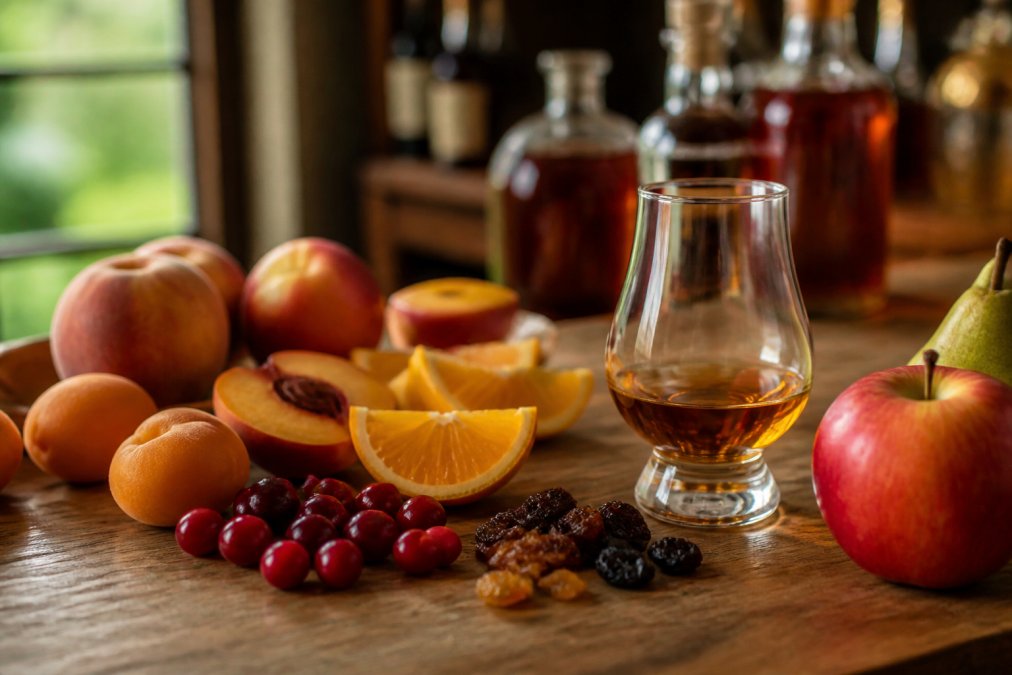
Stone fruit (cherry, apricot, peach, plum) appears in wheated bourbons and warm-aged spirits. These notes feel dense and concentrated, lingering after you swallow.
Orchard fruit (apple, pear, fig) appears in rye-forward bourbons and cool-climate spirits. These taste crisper and lighter, vanishing quickly from your mouth.
Tropical fruit (pineapple, mango, banana, coconut) appears in longer-aged or high-corn bourbons. These notes feel bright and pop on your nose before hitting your palate.
Identifying the fruit family helps predict the finish: stone fruits signal heavier, spicier finishes; tropical fruits signal sweeter, smoother ones.
Citrus Zest and Other Bright Notes
Citrus zest (lemon, lime, grapefruit, tangerine) appears in high-rye and younger bourbons, signaling oxidation and adding complexity.
Herbal and floral hints often accompany fruity notes and alter perception, vanilla sweetens cherry, pepper sharpens citrus zest.

How to Taste Bourbon Whiskey: A Step-by-Step Method
Tasting bourbon properly takes practice, but the method is straightforward and builds consistent fruit-note identification.
Step 1: Nosing and Olfactory Preparation
Pour about an ounce into a tulip or Glencairn glass. Bring it to your nose and breathe gently, your olfactory system picks up aromatic compounds more easily with steady breathing than sharp inhalation.
On your first nosing, note the dominant smell.
Step 2: The Initial Sip and Mouthfeel
Take a small sip and let it coat your mouth. Mouthfeel (oily vs. thin, heavy vs. light) reveals proof and aging: thick, oily suggests longer aging or higher proof; lighter suggests younger bourbon or lower proof.
Step 3: Identifying Specific Fruit Notes
On your next sip, focus on fruit. Start broad (cherry or apple? tropical or familiar?) then narrow down. If you taste cherry, is it dark or bright? Don't worry about naming the exact fruit, describing it as "something like cherry but not quite" is valid as your palate develops.
Step 4: Evaluating the Finish
Common Bourbon Tasting Notes and How to Spot Them
Learning the signature fruit profiles helps you recognize them faster. These are the fruits you'll encounter most often.
Cherry, Apricot, and Stone Fruit Indicators
Cherry is the most common fruity note. Dark cherry appears in older, warm-aged bourbons; bright cherry in younger or cool-aged spirits. The sweetness level reveals age and warehouse conditions.
Apple, Pear, and Orchard Fruit Signals
Apple is the most recognizable orchard fruit: green apple (crisp, tart) suggests younger bourbon or high rye; red apple (sweet, round) suggests wheated bourbon or longer aging. Pear notes (delicate, floral, juicy) appear in cool-warehouse or moderately-aged bourbons. Fig notes (rich, wine-like) suggest significant aging and complex wood interaction.
Tropical Notes: Pineapple, Mango, and Fig
Pineapple (bright, tropical) appears in high-corn bourbons aged in warm warehouses. Mango (creamy, intensely sweet) suggests significant barrel time and high proof. Coconut signals vanilla interaction amplifying fruit creaminess. Tropical fruits overall indicate warm maturation, long aging, or high-corn mash bills.
Training Your Palate to Detect Fruity Notes
Your palate isn't fixed. It develops through practice. The more you taste, the better you get at spotting subtle notes.
Building Olfactory Memory
Build olfactory memory by smelling actual fruits, apricots, stone fruits, tropical fruits, so your brain can match bourbon notes to real fruit memories. Before tasting, spend 10 minutes smelling the fruits you expect to find; your palate will be primed to spot notes faster.
Interactive Tasting Exercises
Taste bourbons side by side to make differences obvious, wheated vs. rye-forward, or the same bourbon at different proofs. Write down what you taste without worrying about being "right." Over time, your descriptions become more specific and accurate.
Avoiding False Fruit Notes
Distinguish real fruit notes (sweet, juicy) from false ones (woody, spicy, drying). Vanilla, caramel, and baking spices come from the barrel, not fermentation. Tannins create dryness without sweetness. Learning this distinction takes practice.
Factors That Shape Fruity Profiles in Bourbon
The fruit notes in your glass aren't random. They're the result of specific production choices. Understanding these factors helps you predict what you'll taste.
Mash Bill and Yeast Strain Influence
The mash bill, the grain recipe, is the foundation. Bourbon must be at least 51% corn, but the rest varies. High-corn bourbons (70%+ corn) develop tropical fruit notes. They taste sweeter and rounder.
Aging, Maturation, and Cask Influence
Time in the barrel transforms the bourbon. Young bourbon tastes sharp and grain-forward. Aged bourbon tastes smooth and complex. Fruit notes intensify and multiply with time.
Proof and Oxidation Effects
Proof affects how your palate perceives fruit notes. Higher-proof bourbons taste more intense and fruity. The alcohol carries aromatic compounds to your nose more effectively. Lower-proof bourbons taste softer and rounder.
Organizing and Tracking Your Tasting Notes
As you develop your palate, you'll taste dozens of bourbons. Without a system, you'll forget what you tasted and why you liked it.
Frequently Asked Questions
How do I pick out notes in bourbon if I'm just starting out?
Start by nosing the glass for 10-15 seconds to let aromatic compounds reach your olfactory receptors. Focus on one fruit family at a time, stone fruit, orchard fruit, or tropical fruit. Don't rush; take small sips, let the bourbon coat your palate, and notice the mouthfeel and finish. Use reference scents (fresh apricots, green apples, or dried cherries) to build olfactory memory. Most beginners identify fruity notes more clearly after 3-5 tastings of the same bourbon.
What's the difference between stone fruit and orchard fruit notes in bourbon?
Stone fruit, cherry, apricot, plum, has a deeper, sometimes darker sweetness and appears earlier in the nosing phase. Orchard fruit, apple, pear, fig, tends to be brighter and crisper, often lingering in the finish. Stone fruit is typically associated with wheated bourbons and longer aging, while orchard notes emerge from specific yeast strains and distillation methods. Learning to distinguish them sharpens your sensory analysis and helps you predict which bourbons will appeal to your palate.
Does the age of the bourbon affect how fruity it tastes?
Yes. Younger bourbons (4-6 years) often display bright, fresh fruit notes like citrus zest and green apple. As bourbon ages, the cask influence deepens fruity profiles into dried fruit, stone fruit, and tropical notes. Oxidation and maturation create more complex esters and aromatic compounds over time. A 10-year bourbon typically has richer, more layered fruit flavors than a 4-year release, though personal preference varies, some tasters prefer the sharp fruit brightness of younger spirits.
How can I avoid mistaking non-fruit flavors for fruity notes?
False fruit notes often come from baking spices, vanilla, caramel, or tannins that mimic sweetness. Vanilla can feel fruity but tastes distinctly creamy; caramel feels smooth but lacks the tartness of actual fruit. Tannins create a drying sensation unrelated to fruit. Reference tasting, comparing the same bourbon against known fruit-forward bourbons, helps you distinguish real fruity esters from spice or sweetness. Keep a tasting journal to track which notes repeat across multiple bourbons, confirming they're genuine fruit flavors rather than one-off impressions.