 how-to
Whiskey Bottle Labeling and Dating: How to Read Clues
Last Updated: November 5, 2026
Quick Summary
A whiskey bottle usually carries three different dates or ages: distillation, bottling and bottle age, which may each differ. Dating one accurately means reading several clues on the front, back and neck labels, the closure, the glass and any tax stamp, then weighing them to reach a confidence level.
- Keep distillation date, bottling date and bottle age separate, since confusing them gives wrong answers.
- An age statement gives the youngest whiskey's minimum age, not the bottling date.
- Strong clues include a government warning in known wording and a matching printed carton.
- Closures, tax stamps and glass seams are medium or weak clues, so never date a bottle from one feature.
- Record what you cannot determine and report a date range with a confidence level, not a single date.
Table of Contents
- Why Whiskey Bottle Dates Are Harder to Pin Down Than You Think
- How to Read a Whiskey Label: Front, Back and Neck
- Whiskey Bottle Date Code Lookup: Barcodes, Lot Numbers and Stamps
- How to Date an Old Whiskey Bottle Using Closures, Glass and Packaging
- A Timeline of Label and Packaging Changes
- Antique Whiskey Bottle Identification: A Step-by-Step Workflow
- Start Tracking Your Bottles Once You Have Identified Them
- Frequently Asked Questions
Why Whiskey Bottle Dates Are Harder to Pin Down Than You Think
Dating a whiskey bottle is rarely as simple as finding one printed year. Collectors often make the same mistake: they assume the date on the label tells them when the whiskey was made. Often it does not.
A bottle can hold whiskey distilled years before bottling. Age statements mislead, and labels were redesigned for reasons unrelated to the bourbon inside. A careful reader needs several clues, not one.
Here is the core idea. A whiskey bottle usually carries three different dates or ages:
- Distillation date: when the spirit was made
- Bottling date: when it was put into the bottle
- Bottle age: how old the glass or closure is, which may be older or newer than the liquid
Keep these apart in your head. Confusing them is the fastest way to get a wrong answer.
Some bottles carry a vintage marking, but many do not. Others were refilled, relabeled or sold after decades in storage. That is why a confidence level matters more than a single "correct" date: each clue is evidence that narrows the range.
The rest of this guide shows you which clues to check and how to weigh them.
How to Read a Whiskey Label: Front, Back and Neck
Most of the useful information is printed on three areas: the front label, the back label and the neck label or neck tag. Each one tells a different part of the story.
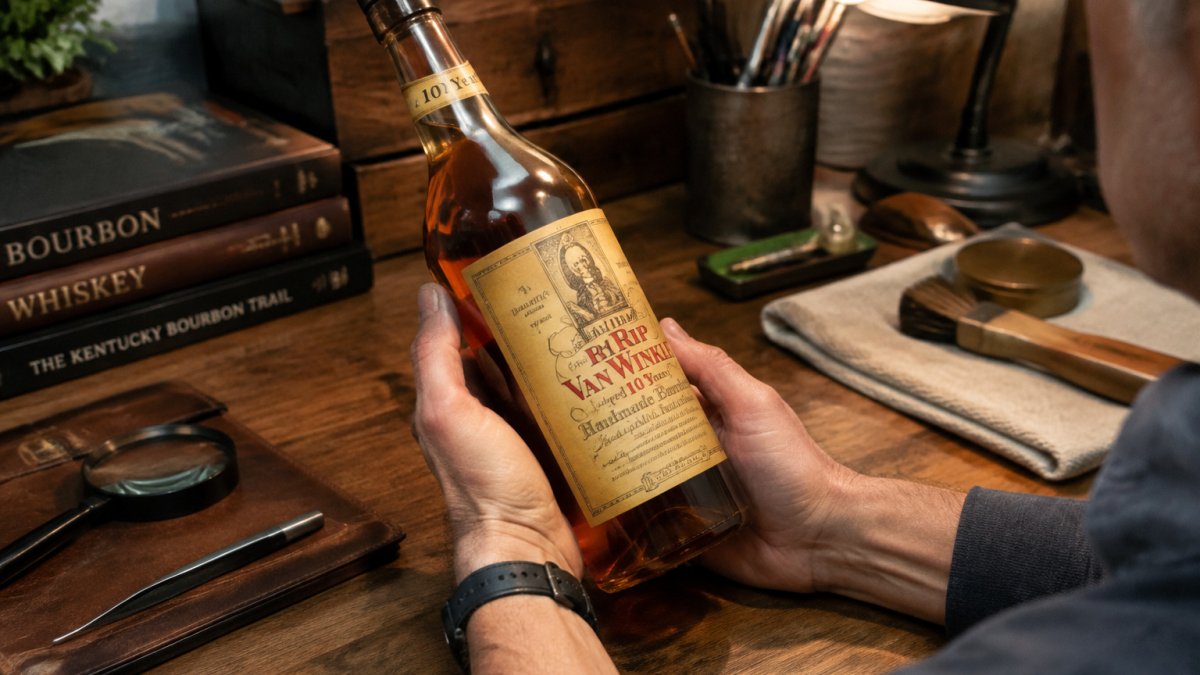
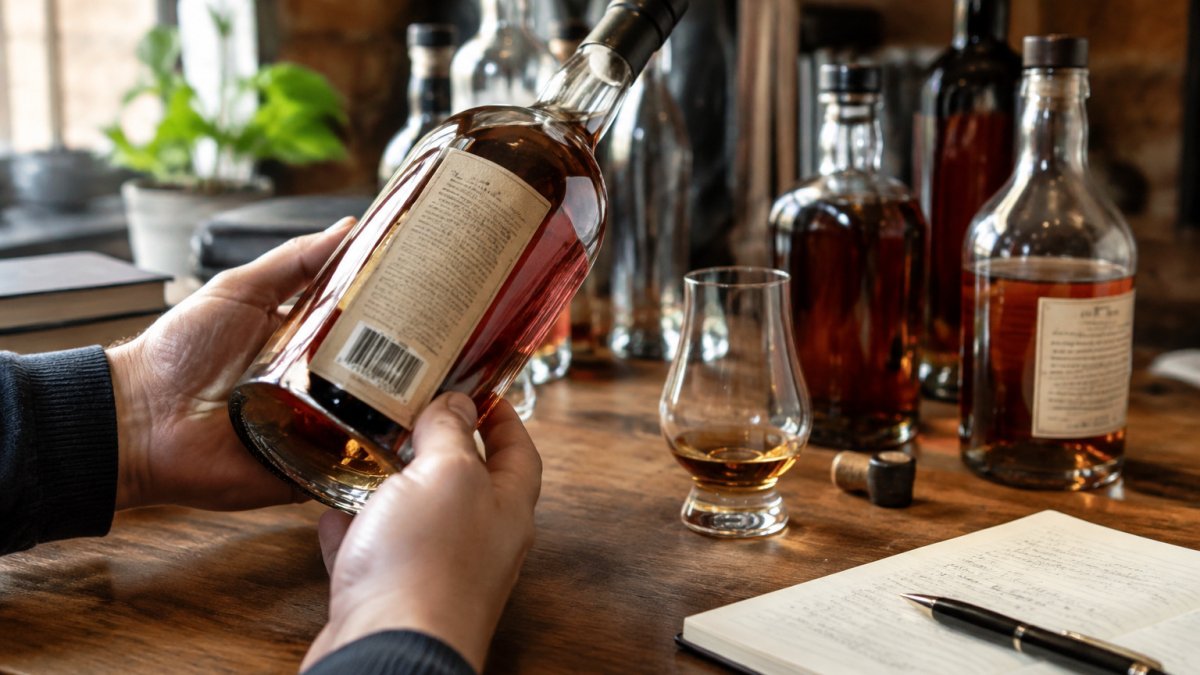
The front label usually shows the brand, product type and often the proof. The back label holds the fine print, including producer, bottling details and government warnings. The neck label, when present, can show a batch name, barrel number or small date.
Check each area and write down what you find. Taking photos of all sides helps you compare later.
Class, Type, Proof and Net Contents
The class and type tell you what kind of spirit it is, such as straight bourbon, rye whiskey or Tennessee whiskey. In the United States, these terms follow federal standards, so they are a reliable starting point.
Proof is the alcohol strength, and alcohol by volume (ABV) is the same measure as a percentage.
Net contents show the volume of the bottle. Older bottles may list fluid ounces, while newer ones usually list milliliters. Changes in the required measurement can hint at when a bottle was produced, so note which units appear.
Interpreting Age Statements
An age statement tells you how long the youngest whiskey in the bottle was aged. It does not describe the oldest whiskey, and it does not tell you the bottling date.
If a label says "aged 8 years," the youngest whiskey in that blend was at least eight years old. Older whiskey may be included. Also, a bottle without an age statement is not necessarily young or low quality. Many bourbons simply do not state an age.
Use the age statement to estimate the distillation window. Subtract the stated age from the bottling year, if you know it, to find the earliest possible distillation date for the youngest component.
Whiskey Bottle Date Code Lookup: Barcodes, Lot Numbers and Stamps
Many bottles include codes that can help you narrow a date. These are rarely simple, and they vary by producer and era.
Check these places:
- Lot or batch numbers printed on the label, neck or base
- Barcodes, which may show a manufacturer code but usually not a date
- Embossed or stamped codes on the glass, often on the base or shoulder
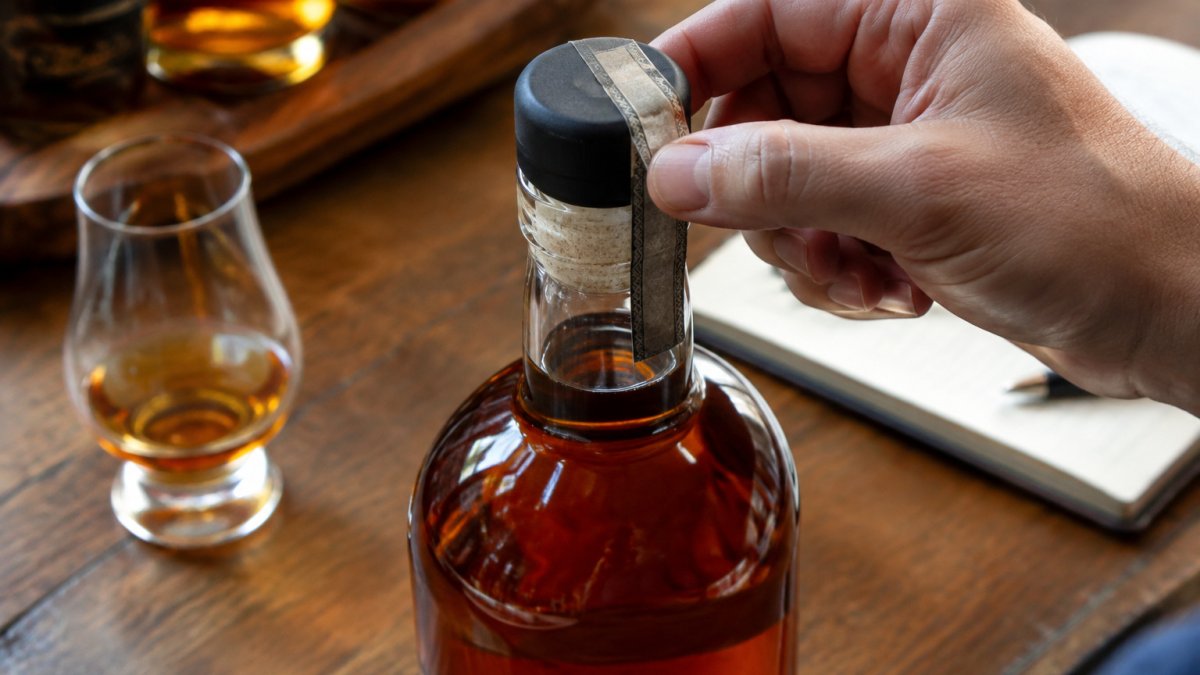
- Tax stamps or strip stamps over the closure, which can show when duty was paid
A tax stamp is one of the more useful clues. United States tax stamp designs changed over the years, so a stamp style can point to a general period. Use it as supporting evidence, not proof on its own.
Be careful with online lookup tools. Producers often do not publish their code systems, so a lookup may be guesswork. Compare any result against several independent clues before trusting it.
Also note that a barcode alone rarely reveals a date. It mostly tells you the product's identity and the retailer system that scanned it.
How to Date an Old Whiskey Bottle Using Closures, Glass and Packaging
Physical features of the bottle itself can help you place it in a period. Take a close look at the parts that are hard to fake.
Closures. Cork, synthetic stopper, metal screw cap and plastic cap all appeared at different times. A screw cap points to a later period than a traditional cork, but producers sometimes kept older closures for decades. Use the closure as one clue among several.
Glass. Look for mold seams, embossing, color and bubbles. Seams that run all the way to the top of the bottle often indicate older glass made with molds. Modern bottles usually have smoother, more uniform glass. Embossed text on the base can name the glassmaker or show a mold number.
Packaging. Boxes, cartons, neck tags and paper labels all changed style over time. A printed carton with a specific logo or wording can be dated more confidently than the bottle alone, especially if it lists a date or a regulatory warning added in a known year.
Remember that original packaging is not the same as original contents. Bottles are sometimes refilled, and boxes are sometimes swapped. A matching carton and bottle strengthen your case, but they do not guarantee authenticity.
A Timeline of Label and Packaging Changes
Most dating guides give a vague sequence: old labels, then rules, then warnings, then barcodes. That is not enough to place a bottle in a decade. What follows is a dated reference frame built around federal rules and common packaging shifts in the United States. Treat each entry as a filter, not a verdict: a bottle carrying a required statement cannot predate the rule that required it, but the absence of a statement does not always prove an earlier date, because labels were sometimes used until supplies ran out.
Watch out: a replacement closure or a relabeled bottle can make a modern bottle look older, or an older bottle look newer, so never date a bottle from a single feature. Use the timeline to eliminate impossible periods first, then weigh the remaining clues against each other.
The article's reference frame pairs each label or packaging feature with the kind of evidence it provides, so you can eliminate impossible periods before weighing the rest.
| Clue | What it tells you | Strength |
|---|---|---|
| Government warning wording | Bottle cannot predate the rule requiring it | Strong |
| Class and type statement | Fits federal standards in use since a known rule | Strong |
| Matching printed carton | Can be dated more confidently than bottle alone | Strong |
| Closure style | Points to a general period, but replacements occur | Medium |
| Net contents units | Fluid ounces suggest earlier, milliliters later | Medium |
| Tax stamp design | Points to a general period, not proof alone | Medium |
| Glass mold seams | Older mold-made glass often has seams to the top | Weak |
| Bottle shape and glass color | General hints only | Weak |
Antique Whiskey Bottle Identification: A Step-by-Step Workflow
A list of clues is not a method.
Step 1: Record the basics from the front label. Write down the brand, product name, class and type, proof or ABV, and net contents exactly as printed.
Step 2: Read the back label word for word. Copy the producer statement, bottling details, and any government warning exactly. The warning wording is one of the strongest single clues available, because the required text changed at known points.
Step 3: Check the neck, shoulder, and base. Record lot numbers, batch numbers, barrel numbers, and any embossed or stamped codes on the glass.
Step 4: Examine the closure and any tax stamp. Identify whether the closure is cork, synthetic, metal screw cap, or plastic. Note whether a tax strip or stamp is present and describe its design.
Step 5: Inspect the glass. Look for mold seams, color, bubbles, and embossing. Seams that run to the top of the bottle often indicate older mold-made glass, while smoother, more uniform glass is typical of modern production.
Step 6: Compare packaging if you have it. A carton, neck tag, or box that matches the bottle strengthens the case. A carton with a printed date or a known warning wording can be dated more confidently than the bottle alone.
Step 7: List every clue and the period it suggests. Put each clue on its own line with the range it points to.
Step 8: Assign a confidence level using an evidence hierarchy. Strong evidence includes a government warning in a known wording, a class and type statement that only existed after a known rule, and a matching carton with a printed date.
Step 9: Record what you could not determine. Write down the unknowns explicitly. An honest note that the bottling date is unknown is more useful than a confident wrong answer, and it protects you if you later sell or insure the bottle.
Step 10: Know the limits of the method. Dating methods narrow ranges; they rarely prove a single date. Closures get replaced, labels get swapped, and bottles get refilled.
Watch out: when two strong clues conflict, do not pick the one you prefer. Re-examine the bottle for a missed detail, and if the conflict remains, report the range and the conflict rather than forcing a single date.
Start Tracking Your Bottles Once You Have Identified Them
Once you have a date range and a confidence level for each bottle, the next job is keeping those details organized. Bourbon Tracker™ is free to use and needs no download. You can log your bottles, store your label notes and tasting notes, and build a wishlist in one place.
Our AI-powered recommendations can also suggest new bottles based on the tasting notes you save. Track My Collection and see how your bottles look when they are all in one spot.
Frequently Asked Questions
How can you tell how old a whiskey bottle is?
Start with the label, closure and glass. Look for a bottling code, lot number or barcode, and check whether the label design matches known periods for that brand. Closures such as cork, screw cap or plastic stopper can narrow the range, and glass embossing or mold seams may offer clues. Treat each clue as a range rather than an exact date, and compare your findings against the brand's published history or a reputable collector reference before drawing conclusions.
Does the age statement tell you when whiskey was bottled?
No. An age statement, such as 'aged 12 years', tells you the age of the youngest whiskey in the bottle, not when the bottle was filled. Bottling can happen years after the barrel was filled, so a 12-year-old bottle may have been bottled much later. To find a bottling date, look for a lot or bottle code, and remember that bottle age and whiskey age are separate measurements.
Where is the bottling date on a whiskey bottle?
Bottling dates are not always printed in plain text. Many U.S. producers use lot or batch codes stamped on the back label, neck, bottom of the bottle or cap. These codes often need to be matched against the producer's own records or a collector database. If you cannot find a code, the closure type, label design and proof statement can still help you narrow the likely period.
Can a bottle number identify when a whiskey was made?
Sometimes, but only if the number is a documented lot or batch code for that brand. Many numbers on bottles are simply serial or inventory marks with no date meaning. Before relying on a number, confirm it against a producer record or reputable collector reference, and be cautious with altered or refilled bottles, which can carry misleading codes.