 how-to
How to Build a Whiskey Tasting Journal
Table of Contents
- Choose Your Format: Paper, Printable, or Digital
- Set Up Your Whiskey Tasting Notes Template
- Record Bottle Identity and Purchase Details
- How to Write Whiskey Tasting Notes
- Whiskey Tasting Notes Examples and a Completed Entry
- Use a Whiskey Tasting Journal App to Track and Compare
- Rate and Score Your Whiskeys Consistently
- Maintain Your Journal and Build the Habit
- Frequently Asked Questions
Last Updated: October 6, 2026
Choose Your Format: Paper, Printable, or Digital
Building a whiskey tasting journal starts with picking the right format. Your choice shapes how you organize notes, search past entries, and compare whiskeys over time.
Paper journals for tactile collectors
Paper works best if you love the ritual of writing by hand.
The downside: paper doesn't scale. Searching for "spicy rye from 2023" means flipping through the whole journal, with no filtering by flavor or price.
Paper shines if you taste whiskey as a ritual, not a data collection exercise.
Printable templates for flexibility
Printable templates split the difference: the tactile experience of handwriting, but organized your way.
This works for collectors with 20-100 bottles.
Printable templates are ideal if you want structure without committing to a full digital system.
Digital platforms for searchability and sharing
Digital platforms solve the scaling problem. Log a tasting note once and the system handles organization, filtering, and comparison automatically.
The trade-off is losing the tactile experience, but for most collectors the organizational power of digital far outweighs that loss.
Digital platforms also unlock community features, sharing notes with friends, seeing what others are tasting, getting recommendations based on your palate. That's where tools like Bourbon Tracker™ excel.
Set Up Your Whiskey Tasting Notes Template
A good tasting journal template captures what matters without overwhelming you: enough structure to stay consistent, but not so much that logging a bottle becomes a chore.
Essential fields to include
Start with these core fields in your whiskey tasting journal template:
- Bottle details: Distillery, brand name, age statement (or NAS if non-age-stated), ABV or proof
- Purchase info: Date purchased, price paid, retailer
- Tasting date and location: When and where you tasted it, ambient temperature if relevant
- Appearance: Color, clarity, viscosity (legs on the glass)
- Aroma/Nose: What you smell, fruit, spice, oak, vanilla, etc.
- Palate: Flavor on your tongue, texture, body (light, medium, full)
- Finish: How long the flavor lasts, what lingers
- Overall rating or score: A number, stars, or simple rating (good/great/exceptional)
- Tags or categories: Rye, bourbon, single malt, peated, etc. (helps with filtering later)
- Notes: Personal thoughts, comparisons to other whiskeys, would-you-buy-again
Don't feel pressured to fill every field. Some collectors skip appearance when tasting blind, or price for inherited bottles. The template should work for you.
Organizing for quick reference
Structure entries so you can scan them fast: bottle info at the top, tasting impressions in the middle, rating and tags at the bottom.
Digital platforms organize this automatically. If printing templates, leave white space between sections so your eye moves quickly.
Record Bottle Identity and Purchase Details
Before you taste a whiskey, log the bottle itself. This anchors your entry and makes the bottle easy to find later.
What bottle information matters most
Start with the essentials:
- Distillery name: Where the whiskey was made
- Brand name: The label you see on the shelf
- Type: Bourbon, rye, single malt, blended, etc.
- Age statement: How old the whiskey is (or "NAS" for non-age-stated)
- Proof or ABV: The alcohol content, matters more than most people think
- Cask type: Bourbon barrel, sherry cask, ex-wine cask, etc. (affects flavor significantly)
- Bottler: The distillery itself, or an independent bottler
- Purchase date: When you bought it
- Price paid: Helps you track value over time
- Retailer or source: Where you found it
These details reveal patterns: maybe sherry cask whiskeys consistently score higher for you, or independent bottlers outperform official releases. That's valuable data.
How to Write Whiskey Tasting Notes
This is where the journal becomes useful. Good tasting notes capture what you actually taste, not what you think you should.
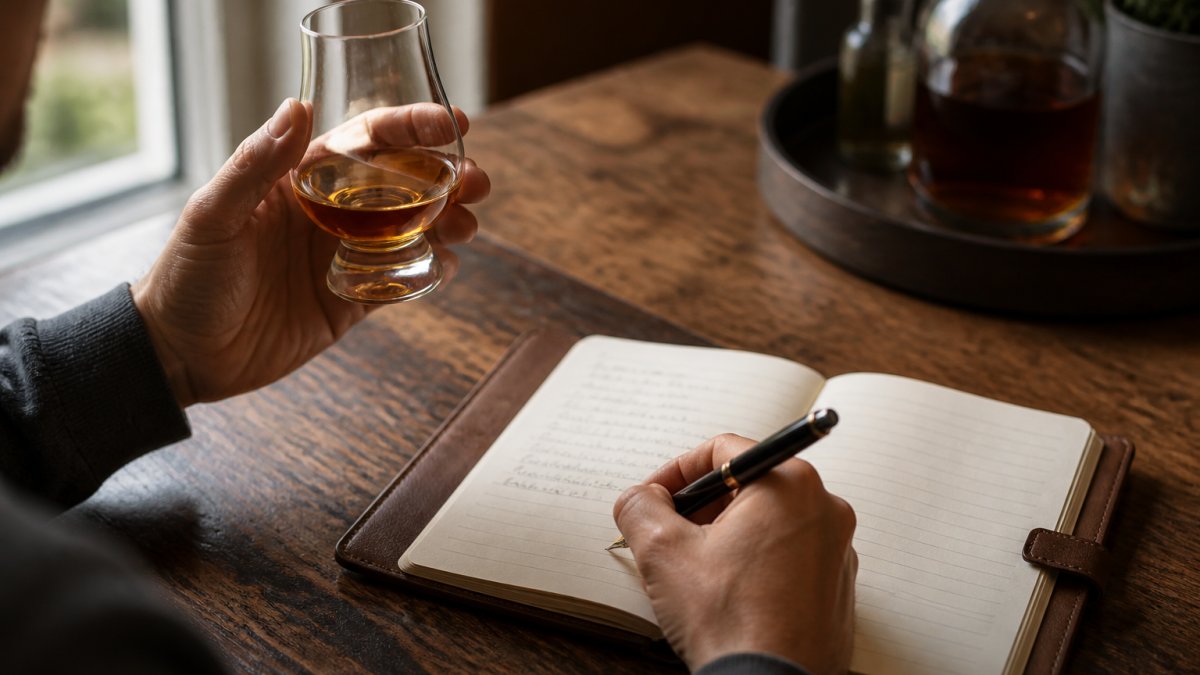
Capturing aroma and nose impressions
Pour the whiskey, let it sit, and smell without overthinking. Write down what you notice first: fruit? spice? oak? vanilla? alcohol burn?
Don't force it. If it smells like apple but the label says "dried apricot," write "apple." Your palate is the authority.
Common aroma descriptors:
- Fruit: apple, pear, cherry, orange, peach, plum, raisin
- Spice: cinnamon, pepper, nutmeg, clove, ginger
- Oak and wood: oak, cedar, pine, sawdust, vanilla
- Grain: corn, wheat, rye, grain alcohol, bread
- Other: caramel, honey, chocolate, tobacco, leather, floral
Spend 10-15 seconds on the nose. A few words per category is enough.
Describing palate and flavor without expert jargon
Take a small sip and let it sit on your tongue before swallowing. What's the first flavor you notice? The second? Does it change as it warms?
Write what you taste: "tastes like cinnamon toast" beats "complex spice profile with subtle grain undertones."
Common palate descriptors:
- Sweet: honey, caramel, vanilla, brown sugar, fruit
- Spicy: pepper, cinnamon, clove, ginger, heat
- Woody: oak, cedar, leather, tobacco
- Savory: grain, bread, salt, smoke
- Texture: smooth, oily, thin, creamy, dry
Also note the body, how it feels in your mouth. Light (like water), medium (like whole milk), or full (like cream)?
Recording finish and aftertaste
Swallow and note what lingers. How long does the flavor stay, and what's the last thing you taste?
A short finish fades in seconds; a long finish lingers 30+ seconds. Neither is better. Does the spice intensify, sweetness fade, or oak come forward?
Whiskey Tasting Notes Examples and a Completed Entry
Here's what a real tasting journal entry looks like, start to finish.
Example completed entry:
Bottle Details
- Distillery: Buffalo Trace
- Brand: Buffalo Trace Kentucky Straight Bourbon
- Type: Bourbon
- Age: 8 years
- Proof: 90
- Cask: American oak
- Purchase Date: September 2026
- Price: $28
- Retailer: Local liquor store Recording these specific bottle details consistently serves as the most effective way to build a journaling habit that transforms casual sipping into a deeper appreciation of craft.
Tasting Details
- Date: September 15, 2026
- Location: Home, room temperature
- Color: Amber, clear
- Aroma: Vanilla, caramel, slight oak, hint of apple
- Palate: Sweet vanilla up front, cinnamon and pepper in the middle, oak comes through at the end. Medium body, smooth texture.
- Finish: Long finish, oak and spice linger for about 20 seconds. Slight dryness at the end.
- Overall Rating: 7.5/10
- Tags: Bourbon, wheated, approachable, good value
- Notes: Great entry-level bourbon. Smooth enough to drink neat, but also works well in cocktails. Would definitely buy again at this price point.
Simple, honest, and useful. Six months from now, you'll remember exactly how that whiskey tasted.
Use a Whiskey Tasting Journal App to Track and Compare
Once you've logged 10-15 whiskeys, the power of a digital whiskey tasting journal emerges: filtering, searching, and comparing that paper can't match.
Why a digital platform beats spreadsheets
A spreadsheet works for 20 bottles. By 50 bottles, you're scrolling endlessly. By 100, it's unusable.
Bourbon Tracker™ takes this further. The platform learns your palate over time and suggests new bottles you're likely to enjoy.
Filtering, tagging, and organizing your entries
Good tagging is the backbone of a searchable whiskey tasting journal. Use consistent tags so you can find what you're looking for.
Useful tag categories:
- Type: Bourbon, rye, single malt, blended, Irish, Scotch
- Flavor profile: Spicy, fruity, sweet, smoky, oaky
- Price range: Under $30, $30-50, $50-75, $75+
- Cask type: Bourbon barrel, sherry, ex-wine, new charred
- Age: NAS, 4-6 years, 7-10 years, 10+ years
- Status: Own it, want to try, wouldn't buy again, favorite
Once you've tagged 20-30 whiskeys, you can filter by any combination. Show me all the spicy ryes under $50 that I rated 8+. Show me all the sherry cask whiskeys.
That's when the whiskey tasting journal becomes a tool, not just a notebook.
Comparing notes over time and across bottles
The real magic happens when you compare. Taste a new bourbon, then pull up two similar entries and compare aroma, palate, and ratings side by side.
Over time you'll spot patterns: maybe you rate wheated bourbons lower than high-rye, or prefer sherry cask finishes. These insights drive smarter buying decisions.
You can also compare notes with other tasters. Bourbon Tracker™ shows how others described the same whiskey.
Rate and Score Your Whiskeys Consistently
A rating system lets you compare whiskeys objectively (or as objectively as taste allows). Without it, you're relying on unreliable memory.
Building a repeatable scoring system
The simplest system is 1-10 or 1-5 stars, but structure adds consistency.
Consider breaking your score into categories:
- Flavor (40%): How good does it taste?
- Value (30%): Is it worth the price?
- Finish (20%): How long and pleasant is the aftertaste?
- Overall experience (10%): Would you buy it again?
Score each category on a 1-10 scale, then weight them. This forces you to think about what matters to you, not just gut feeling.
Example: a $60 single malt might score 9/10 on flavor but 6/10 on value, while a $25 bourbon scores 7/10 on flavor but 9/10 on value. Both are good, for different reasons.
Responsible tasting and palate management
Your palate gets tired. After 5-6 whiskeys, your mouth goes numb to subtle flavors and you stop tasting accurately.
Taste no more than 3-4 whiskeys per session, spaced 15-20 minutes apart. Small sips are enough.
Cleanse your palate between tastings with water, unsalted crackers, or apple slices. Avoid coffee or anything strongly flavored.
Take notes right after tasting, while the flavor is fresh. Waiting until the end means forgetting details.
For a whiskey tasting journal spanning months or years, consistency matters more than perfection. Taste under similar conditions, same time of day, room temperature, and palate state, so ratings stay comparable.
Maintain Your Journal and Build the Habit
A whiskey tasting journal is only useful if you actually use it. The best journal is the one you keep returning to.
Regular updates and consistency
Log a tasting the same day. Details fade fast, and a quick entry takes 5 minutes. No poetry required.
Set a rhythm that works for you. Some collectors taste weekly, others several times a week, and some months nothing.
With a digital platform like Bourbon Tracker™, updates sync automatically.
Backing up and organizing your data
With paper, photograph completed entries and store them in a cloud folder. One spilled drink shouldn't destroy months of work.
With a spreadsheet, export regularly and save backups in multiple places.
With a dedicated app, make sure it offers data export.
Bourbon Tracker™ lets you export your entire collection anytime. Your data is yours.
Review your journal quarterly. Which distilleries do you keep buying from? Which flavor profiles score highest? Which bottles do you regret?
*Building a whiskey tasting journal transforms how you experience bourbon.
*Start with the format that fits your life, add the fields that matter, and log one whiskey at a time.
*At Bourbon Tracker™, we've built a free platform specifically for this.
Frequently Asked Questions
What should you write in a whiskey tasting journal?
A complete entry includes bottle identity (distillery, age statement, proof, bottler), purchase details (date, price, location), tasting conditions (time, location, glassware), and sensory notes. Record aroma, palate, finish, and aftertaste separately. Add a personal rating, flavor tags, and comparison notes. This structure lets you track patterns across your collection and revisit impressions months or years later.
How do you describe the aroma and flavor of whiskey without expert vocabulary?
Start with simple comparisons: does the nose remind you of vanilla, caramel, fruit, or spice? On the palate, note if it's smooth or spicy, sweet or dry. Use everyday words: fruity, woody, peppery, buttery. A tasting wheel helps organize these impressions, but honest personal notes work just as well. Avoid jargon, write what you actually smell and taste, not what you think you should taste.
Is a whiskey tasting journal app better than paper or printable formats?
Digital platforms offer searchability, automatic backups, and the ability to filter and compare notes across your entire collection. Apps let you tag bottles by flavor profile, distillery, or price range, making it easy to find similar whiskeys. Paper journals feel personal and require no setup, but they're harder to search. Printable templates split the difference, organized but portable. Choose based on your collection size and how often you compare notes.
How often should you update your whiskey tasting journal?
Log an entry immediately after tasting, while impressions are fresh. If you revisit a bottle months later, add a new entry to track how your palate or the whiskey itself (oxidation, barrel influence) may have changed. Consistency matters more than frequency. Even occasional updates build a valuable reference over time, especially if you compare notes across similar bottles or revisit favorites.