 how-to
How to Build Your Whiskey Tasting Profile
Table of Contents
- What a Whiskey Tasting Profile Actually Is
- Whiskey Nosing and Tasting Techniques
- Understanding Common Whiskey Flavor Descriptors
- Using a Whiskey Tasting Notes Template
- Building Your Personal Tasting Flight
- Tracking Your Profile Over Time
- Frequently Asked Questions
Last Updated: August 31, 2026
What a Whiskey Tasting Profile Actually Is
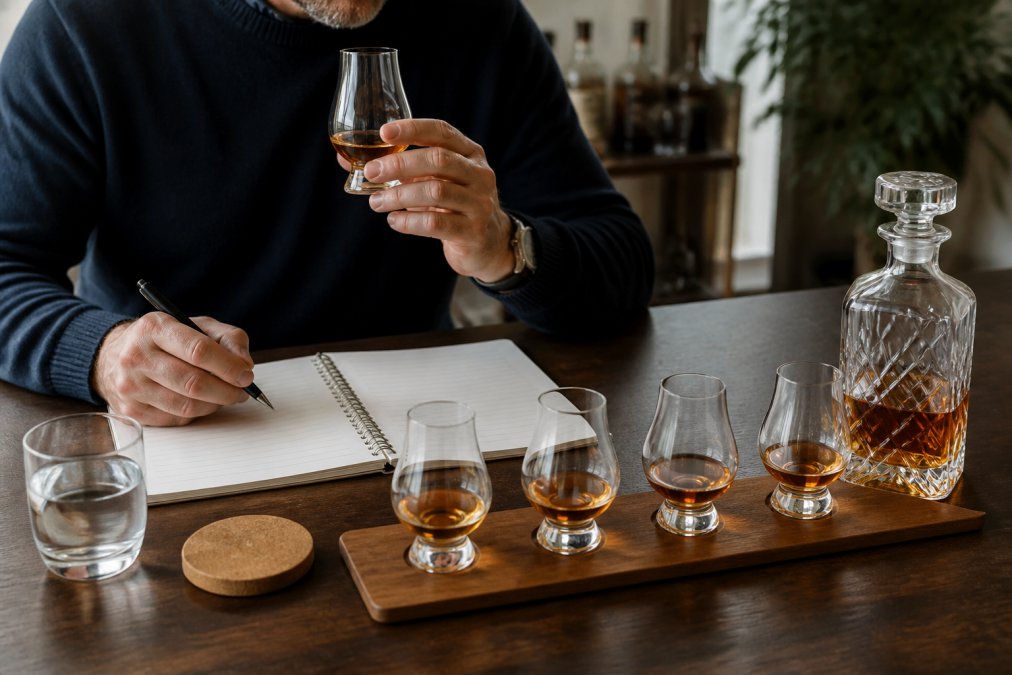
A whiskey tasting profile is a personalized record of how you perceive different whiskeys based on their sensory characteristics. It's the foundation for understanding your palate preferences, tracking flavor patterns, and discovering new whiskeys that align with what you actually enjoy drinking.
Your whiskey tasting profile becomes a reference point, helping you articulate what you're looking for when exploring unfamiliar distilleries. Instead of saying "I like bourbon," you can describe the specific flavor profiles, maturation styles, and proof levels that consistently deliver satisfaction.
A tasting profile isn't static. As you document more bottles and refine your palate, your profile evolves. You begin recognizing patterns, maybe you consistently prefer whiskeys aged in ex-bourbon casks over those finished in wine barrels, or you notice that higher ABV expressions suit your taste better. These insights guide smarter purchasing decisions and deepen your appreciation for the craft.
Whiskey Nosing and Tasting Techniques
Nosing, the practice of inhaling and analyzing a whiskey's aroma, is where serious tasting begins. Your sense of smell drives 80 percent of what you perceive as taste (peer-reviewed research). The olfactory receptors in your nasal cavity detect volatile compounds that your taste buds alone cannot register.
The Nosing Process
Pour roughly one ounce into a Glencairn glass or similar tulip-shaped vessel, which concentrates aromatic compounds toward the rim. Hold the glass at eye level and observe the color and viscosity. The "legs" or "tears" that cling to the sides hint at alcohol content and mouthfeel.
Bring the glass to your nose and inhale gently for two to three seconds (sca.coffee). Step back and let your nose reset for 10 to 15 seconds, your sensory receptors adapt quickly to repeated stimulation, so breaks preserve your ability to detect subtle notes. On your second nosing, spend five to ten seconds identifying secondary aromas. Many whiskeys reveal different layers as they open up. A bourbon might present vanilla and caramel on the first nosing, then reveal oak spice, leather, or tobacco on the second.
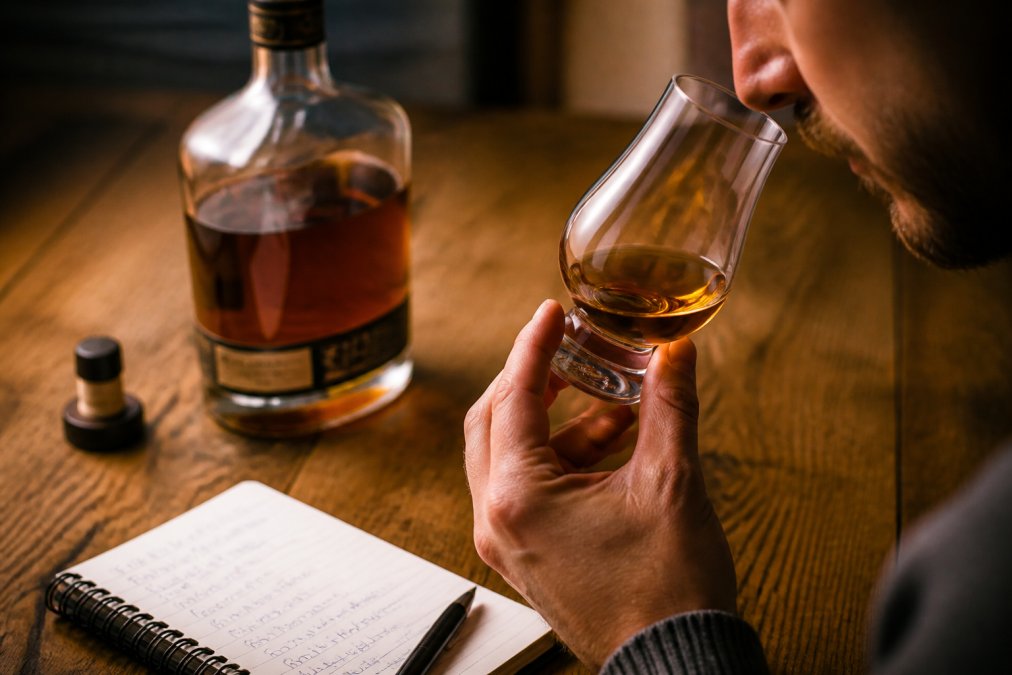
A common mistake is trying to name every aroma immediately. Instead, note the general character: fruity, floral, spicy, smoky, woody, or sweet. Then narrow down. Is the fruitiness stone fruit like peach, or dried fruit like raisin? This specificity builds a useful whiskey tasting profile. Vague notes like "nice" or "complex" don't help you recognize patterns across bottles.
Proper Tasting and Palate Cleansing
After nosing, take a small sip and let the whiskey coat your mouth for a few seconds. As you hold it, breathe gently through your nose. This retronasal olfaction reveals flavors that nosing alone cannot detect. The mouthfeel, the texture and weight of the liquid, also matters. Swallow slowly and note the finish, the lingering flavors that remain after swallowing.
Between samples, palate cleanse with room-temperature water. A sip clears your palate without introducing competing flavors. Give yourself 30 to 60 seconds of active cleansing, then another 30 seconds of rest before the next whiskey.
Palate fatigue is real. After tasting four or five whiskeys, your sensory receptors become less responsive. Professional tastings typically involve no more than five or six samples in a single session (wset.co.uk). Space your tasting sessions across different days rather than trying to evaluate your entire collection at once.
Understanding Common Whiskey Flavor Descriptors
Whiskey flavor descriptors are precision tools that help standardize how people communicate about their experience. When you learn to identify and use these terms consistently, you create a whiskey tasting profile that's meaningful and searchable.
Fruity notes appear across whiskey categories. Stone fruits like peach and apricot often emerge from bourbon aged in ex-bourbon casks. Dried fruits like raisin and date typically appear in whiskeys with longer maturation or sherry cask influence. When you detect fruitiness, ask: is it fresh or dried, bright or deep?
Vanilla and caramel are the most recognizable bourbon notes, coming from charred oak barrels. The char creates caramelized wood sugars that dissolve into the spirit. Vanilla intensity varies based on barrel char level and time in wood.
Spice encompasses several distinct flavors. Cinnamon and nutmeg emerge from oak tannins and alcohol warmth. Black pepper, clove, and anise suggest higher proof or specific barrel treatments. Note whether spice is warm and inviting or sharp and aggressive.
Smoky and peaty notes define certain whiskey categories. Peat smoke comes from peat-fired kilns during malting, primarily in Scotch whisky production. It tastes like campfire, iodine, or leather. If you detect smoke, determine whether it's a pleasant backdrop or overwhelming. Your whiskey tasting profile should note your tolerance for peat.
Woody and oaky notes indicate time in barrel and barrel type. New oak imparts aggressive wood tannins and vanilla. Refill barrels contribute subtler oak character. Understanding your preference for oak intensity helps you navigate different age statements and cask types.
Using a Whiskey Tasting Notes Template
A structured template transforms casual tasting into systematic documentation. Your whiskey tasting notes template should capture: appearance, nose, palate, finish, and personal impression.
Start with the basics: distillery, expression name, age statement, proof, and cask type. These details help you identify patterns in your preferences.
For appearance, note the color. Whiskey ranges from pale gold to deep amber. Color hints at the barrel's influence on the spirit.
The nosing section should capture your olfactory experience in layers. Primary aromas (first nosing), secondary aromas (second nosing), and tertiary aromas (after several minutes) each deserve separate notation. Use specific descriptors: "dried apricot and fig" is more useful than "fruity."
For palate notes, describe the initial taste, mouthfeel, and any development. Does it start sweet and turn spicy? Does it feel oily or thin?
The finish deserves its own section. How long does it linger? What flavors emerge? A long, evolving finish often indicates complexity.
Finally, add a personal impression section. Would you buy this bottle again? Does it fit a particular mood or occasion? This subjective layer transforms a technical tasting note into a useful guide for future purchases.
Building Your Personal Tasting Flight
A tasting flight, a curated selection of whiskeys arranged for comparative tasting, accelerates your whiskey tasting profile development. Flights force direct comparisons, which sharpen your palate and reveal preferences you might not notice in isolation.
Structure your flight around a theme. A proof-focused flight compares whiskeys at different ABV levels. A cask-type flight compares the same distillery's expression aged in different barrels. An age-statement flight moves chronologically through a distillery's offerings. A region-focused flight compares bourbon, rye, and Scotch.
Arrange your glasses in logical order. For a proof flight, move from lowest to highest ABV. For an age flight, progress from youngest to oldest. This ordering helps your palate adjust gradually.
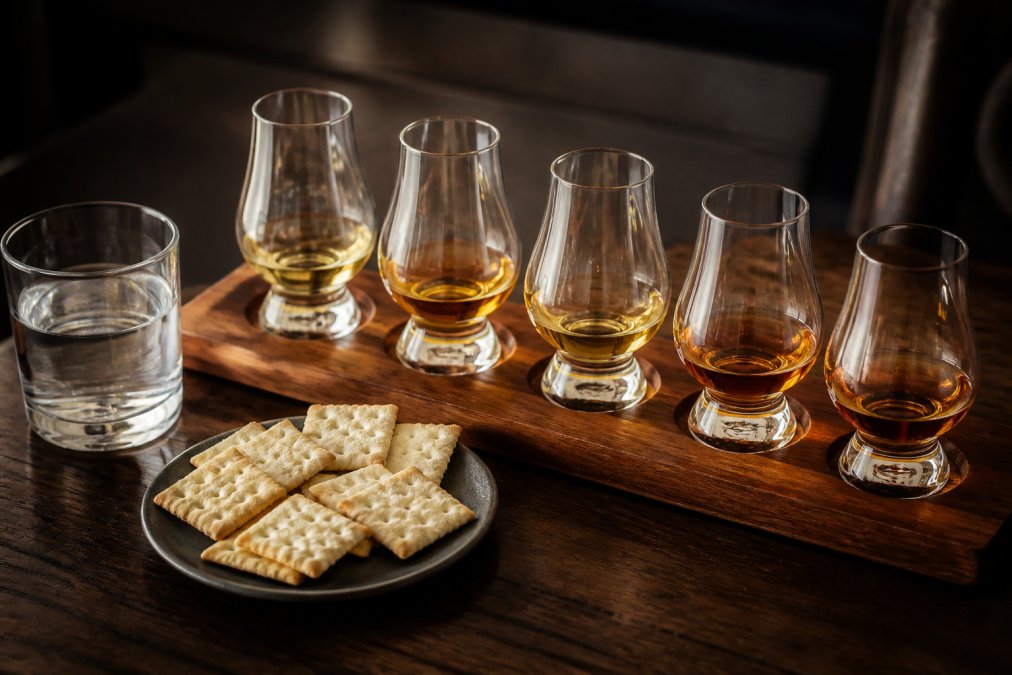
Taste in order without skipping around. Cleanse between each sample. A flight of four to six whiskeys is ideal without inducing palate fatigue. If comparing more whiskeys, schedule multiple sessions on different days.
Document comparative observations carefully: "Sample 2 was noticeably more spicy than Sample 1" or "Sample 4's finish lingered longer than the others." These comparative notes are invaluable for identifying patterns in your preferences.
Tracking Your Profile Over Time
Your whiskey tasting profile evolves as your palate develops and your preferences shift. Regular tracking reveals these changes and helps you understand how your appreciation deepens.
Set a consistent schedule for tasting and documentation. Consistency matters more than frequency. Regular tasting trains your palate to recognize subtle differences and builds a larger dataset of your preferences.
Use Bourbon Tracker™ to organize your tasting notes digitally. A centralized platform lets you search your history, spot patterns, and build a searchable record of your whiskey tasting profile. When standing in a liquor store deciding between unfamiliar bottles, you can reference your documented preferences and make confident choices.
Review your notes periodically. Every 20 or 30 tastings, revisit earlier entries. You'll notice your palate has shifted. Whiskeys you initially disliked might appeal to you now. This evolution reflects genuine palate development.
Share your whiskey tasting profile selectively. The bourbon community thrives on shared knowledge. Bourbon Tracker™'s community features let you share your profile with other enthusiasts, receive recommendations tailored to your documented preferences, and discover new bottles through AI-powered suggestions based on your tasting history.
Track not just the whiskeys you love but also the ones that don't work for you. Your whiskey tasting profile is only as useful as its completeness. Knowing which flavor profiles, proof levels, and cask types you consistently avoid helps you make faster decisions and avoid costly mistakes.
Building a comprehensive whiskey tasting profile transforms how you experience bourbon and whiskey. It moves you beyond casual sipping into intentional exploration. Learning to nose properly, understanding flavor descriptors, documenting systematically, and tracking your evolving preferences develops your palate and deepens your appreciation for the craft. Bourbon Tracker™ makes this journey seamless by providing a centralized platform to log your tasting notes, organize your collection, and receive AI-powered recommendations based on your documented whiskey tasting profile. Start with your next tasting session. Document what you experience. Over time, your profile becomes a personal guide to discovering whiskeys you'll genuinely love.
Frequently Asked Questions
Q: What is the difference between nosing and tasting whiskey?
A: Nosing uses your olfactory receptors to detect aroma and volatile compounds before the whiskey touches your palate. Tasting involves taking a small sip, coating your mouth, and identifying flavors and mouthfeel. Both are essential to building a complete whiskey tasting profile. Nosing typically reveals fruity, floral, and spice notes, while tasting captures the finish and how flavors develop on your palate.
Q: How do I identify specific flavor notes in bourbon?
A: Use a flavor wheel as your reference guide, it breaks down whiskey tastes into categories like fruity, spicy, smoky, and vanilla. Start with broad categories, then narrow down. For example, if you detect fruit, ask whether it's citrus, stone fruit, or berry. Compare notes to whiskeys you've already tasted. Over time, your sensory receptors become trained to recognize these descriptors more quickly and accurately.
Q: Should I add water to my whiskey when building a profile?
A: Yes. Adding a few drops of water opens up the whiskey's aroma profile and softens the alcohol burn, making subtle flavors more detectable. Many tasters nose the whiskey neat first, then add water and nose again to compare. Water dilution doesn't change the whiskey, it simply helps your palate perceive more complexity. Most professionals use a ratio of 3-4 parts whiskey to 1 part water.
Q: How can I keep track of my whiskey tasting notes effectively?
A: Use a structured whiskey tasting notes template with fields for bottle name, ABV, cask type, nosing observations, tasting notes, finish, and overall rating. Record your impressions immediately after tasting while they're fresh. A digital platform like Bourbon Tracker™ lets you organize notes by flavor profile, maturation style, and cask type, making it easy to spot patterns in your preferences and build a comprehensive personal tasting profile over time.
This article was written using GrandRanker
Frequently Asked Questions
Q: What is the difference between nosing and tasting whiskey?
A: Nosing uses your olfactory receptors to detect aroma and volatile compounds before the whiskey touches your palate. Tasting involves taking a small sip, coating your mouth, and identifying flavors and mouthfeel. Both are essential to building a complete whiskey tasting profile. Nosing typically reveals fruity, floral, and spice notes, while tasting captures the finish and how flavors develop on your palate.
Q: How do I identify specific flavor notes in bourbon?
A: Use a flavor wheel as your reference guide—it breaks down whiskey tastes into categories like fruity, spicy, smoky, and vanilla. Start with broad categories, then narrow down. For example, if you detect fruit, ask whether it's citrus, stone fruit, or berry. Compare notes to whiskeys you've already tasted. Over time, your sensory receptors become trained to recognize these descriptors more quickly and accurately.
Q: Should I add water to my whiskey when building a profile?
A: Yes. Adding a few drops of water opens up the whiskey's aroma profile and softens the alcohol burn, making subtle flavors more detectable. Many tasters nose the whiskey neat first, then add water and nose again to compare. Water dilution doesn't change the whiskey—it simply helps your palate perceive more complexity. Most professionals use a ratio of 3-4 parts whiskey to 1 part water.
Q: How can I keep track of my whiskey tasting notes effectively?
A: Use a structured whiskey tasting notes template with fields for bottle name, ABV, cask type, nosing observations, tasting notes, finish, and overall rating. Record your impressions immediately after tasting while they're fresh. A digital platform like Bourbon Tracker™ lets you organize notes by flavor profile, maturation style, and cask type, making it easy to spot patterns in your preferences and build a comprehensive personal tasting profile over time.