 listicle
Best Free Whiskey Tracker App 2026: Top 6 Web Apps
Table of Contents
- Quick Comparison Table
- Bourbon Tracker: Free Collection Management Without Downloads
- WhiskeyVault: AI Label Scanning and Tasting Insights
- WhiskeyMate: Community-Driven Discovery With 300,000 Spirits
- Bevvy and The Whiskey Companion: Market Data and Valuation
- How to Catalog Your Bourbon Collection Step by Step
- Building a Whiskey Inventory Spreadsheet Template Alternative
- Conclusion
Last Updated: August 18, 2026
Quick Comparison Table
| Web App | Free Tier | Best For | Standout Feature |
|---|---|---|---|
| Bourbon Tracker™ | Fully free | Collectors of all sizes | AI recommendations + community |
| WhiskeyVault | 7-day free trial | Tasting detail & discovery | AI label scanner |
| WhiskeyMate | Free with limits | Social collectors | 300K+ spirit database |
| Bevvy | Free | Quick identification | Image scanning technology |
| The Whiskey Companion | Free | Market valuation | Auction price tracking |
Managing a whiskey collection at scale demands a system that keeps pace with your growing inventory. Whether you're tracking 50 bottles or 500, the right whiskey tracker app transforms scattered notes and mental lists into organized, searchable data you can actually use.
This guide from Bourbon Tracker™ covers the best free and freemium platforms for managing your bourbon and whiskey collections in 2026. We've tested these against real collector needs: tracking tasting notes, discovering new releases, valuing your portfolio, and staying connected to the broader bourbon community.
Below, we'll walk through each platform's actual strengths and real limitations, help you catalog your collection step by step, and show you how to build a spreadsheet backup when you need one. The goal is simple: find the whiskey tracker app that fits how you actually collect.
Bourbon Tracker: Free Collection Management Without Downloads
Bourbon Tracker™ is the best choice for most collectors because it eliminates friction at every step. No app download required, just log in from any browser, and your collection syncs instantly across devices. For collectors juggling whiskey tracking across phone, tablet, and desktop, this matters more than you'd think.
The platform handles the core workflow without friction. Log a bottle using the bottle database, add your personal tasting notes and ratings, build a wishlist for bottles you're hunting, and receive AI-powered recommendations based on your palate. The AI recommendations engine learns from your ratings and tasting preferences, suggesting new releases and rare bottles that match your taste profile rather than just pushing whatever's trending.
What sets Bourbon Tracker™ apart is the community integration. You're not managing your collection in isolation, you can see what other collectors are adding, read their tasting notes, compare ratings on the same bottles, and get real-time signals on which new releases are generating buzz. For collectors over 150 bottles, this social layer prevents the common mistake of buying duplicates or missing standout releases everyone else discovered months ago.
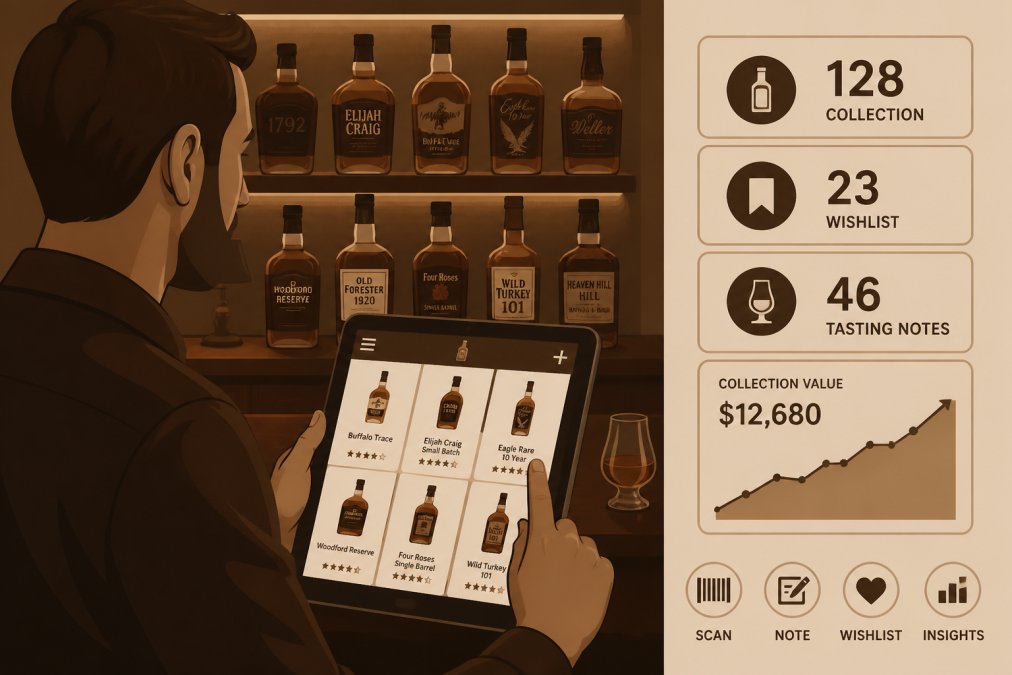
The platform handles large collections without slowdown. Many collectors worry that logging 150+ bottles will make the interface sluggish or crash during searches. Bourbon Tracker™ stays responsive at scale, searching your collection, filtering by type or proof, and sorting by rating all execute instantly even with 500+ bottles logged.
One honest limitation: the free tier includes everything. There's no premium upsell waiting to lock away features once you've invested time. That's the model, stay free, forever. The trade-off is that some advanced features (like detailed collection valuation based on secondary market data or batch-by-batch tracking for production variants) aren't available yet, but they're on the roadmap.
WhiskeyVault: AI Label Scanning and Tasting Insights
WhiskeyVault's defining feature is the AI label scanner. Point your phone camera at a bottle's label, and the app identifies it, pulls the full bottle profile, and auto-populates distillery, proof, age statement, and tasting notes into your collection. For collectors tired of typing bottle details manually, this saves real time.
The tasting journal goes deeper than most trackers. You can log aroma, palate, finish, and overall rating separately, then visualize your flavor preferences on a Flavor Radar chart. This becomes useful when you're trying to identify patterns in your palate, you might discover you consistently rate cask-strength bourbons higher than standard proof, or prefer wheated mashbills over rye-forward profiles.
The Release Radar feature tracks upcoming bottlings and new releases from distilleries you follow. For collectors who don't want to miss limited drops, this saves the hunt of checking distillery websites and auction sites separately. You get notifications when new releases are announced, giving you a head start on availability.
The freemium model offers a 7-day trial of WhiskeyVault Pro, then reverts to the free tier. Some advanced features, like the AI Whisky Mentor for personalized tasting guidance, live behind the subscription. The free tier still includes the label scanner and basic collection management, which covers the essentials for most users.
WhiskeyMate: Community-Driven Discovery With 300,000 Spirits
WhiskeyMate's database is the largest among these platforms, over 300,000 curated spirits. If you collect outside the bourbon category (scotch, rye, Japanese whisky, international spirits), this breadth matters. You're far more likely to find an obscure bottle in their database than competitors.
The AI companion called Fitz delivers personalized recommendations based on your collection and ratings. Unlike generic "trending bottles" lists, Fitz learns your specific preferences and suggests bottles that match your palate. For collectors who've been burned by bad recommendations elsewhere, this is worth testing.
The social features are the strongest in this group. You can share your collection with friends, compare tasting notes side-by-side, create collaborative wishlists, and see what other collectors with similar taste profiles are rating highly. If you're a socially engaged bourbon hobbyist, this community layer creates real value.
The free tier includes basic collection management and the database. Unlimited bottle storage and advanced AI capabilities require a Premium subscription at $4.99 per month. The pricing is transparent, you know the cost before committing.
The one drawback: the large database means less editorial curation. Not every entry is equally detailed. Some bottles have full tasting notes and production history; others have minimal information. If you value curated, expert-reviewed data, you might find gaps.
Bevvy and The Whiskey Companion: Market Data and Valuation
Bevvy takes a different approach, it's built for quick bottle identification and market intelligence. The image capturing software scans any whiskey bottle and returns the distillery profile, expert tasting notes, and current market pricing. For collectors interested in understanding what their bottles are worth, this is the fastest path to that data.
The database covers up to 200,000 whiskies. The focus is on accuracy and market data rather than personal collection management. You get expert tasting notes curated by whiskey professionals, not user-generated reviews. If you value authoritative tasting profiles over crowd-sourced ratings, this distinction matters.
Bevvy is available on iOS, Android, and web, so you can reference bottles from anywhere. The free tier includes the core features, scanning, bottle profiles, and tasting notes. No paywall surprises.
The Whiskey Companion approaches valuation from the auction side. It tracks prices across 20+ auction houses, lets you search live and upcoming auctions, and values your collection based on recent sales data. For serious collectors with high-value bottles, this auction-focused view is more useful than retail pricing alone.
Both platforms excel at answering one specific question: "What is this bottle worth right now?" If that's your primary need, either works. But if you want to log detailed tasting notes, build a wishlist, and get recommendations, they're less comprehensive than Bourbon Tracker™ or WhiskeyVault.
How to Catalog Your Bourbon Collection Step by Step
Cataloging your collection systematically prevents duplicates, helps you remember what you own, and creates a foundation for discovery. Here's the workflow that works:
Step 1: Gather Your Bottles (Time: 30 minutes) Pull every bottle from your shelves, cabinet, or storage area. Arrange them in a single location so you can photograph or scan them in sequence. This prevents logging the same bottle twice and ensures you don't miss any.
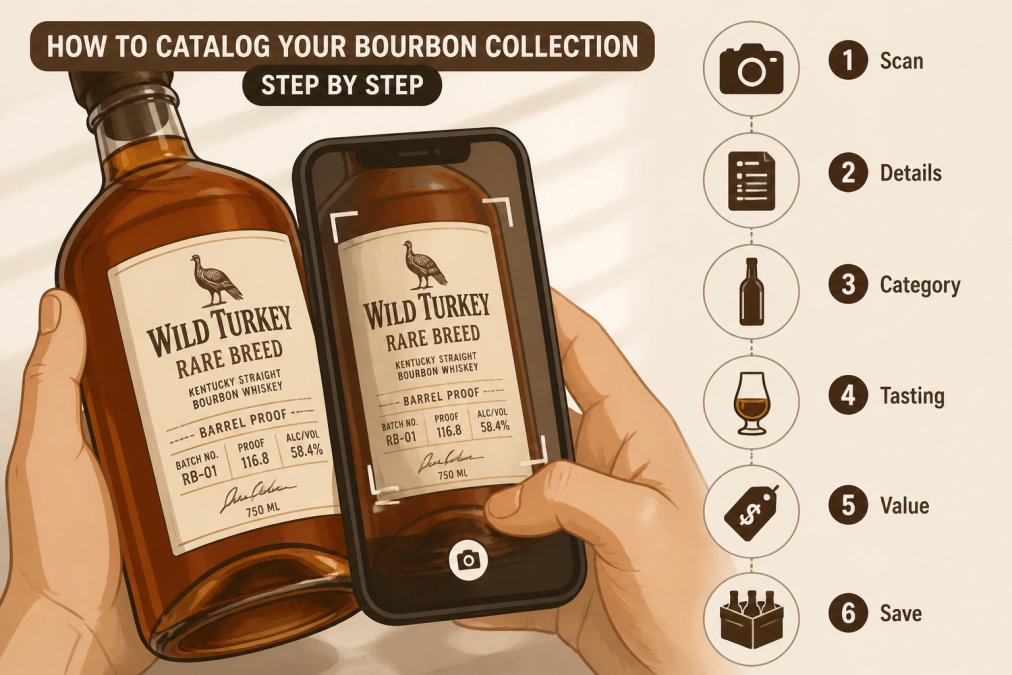
Step 2: Choose Your Tracking Method (Time: 10 minutes) Decide whether you're using Bourbon Tracker™, WhiskeyVault, WhiskeyMate, or another platform. Open the app or web interface and create your account. Most platforms use the same basic workflow: add bottle → log tasting notes → rate → save.
Step 3: Log Each Bottle (Time: 2-3 minutes per bottle) For each bottle, enter the distillery, brand, proof, and age statement. Most platforms offer a bottle database search, type "Maker's Mark" or "Buffalo Trace" and select from the list rather than typing details manually. This reduces errors and speeds up data entry.
Add a tasting note if you've already opened the bottle. If it's unopened, note that. Include the purchase date if you remember it, and the price you paid. This creates a historical record useful for valuation later.
Step 4: Rate and Tag (Time: 1 minute per bottle) Give each bottle a rating (most platforms use 1-5 stars or 1-10 scale). Tag bottles by category: bourbon, rye, wheated, cask-strength, limited edition, or whatever taxonomy makes sense for how you collect.
Step 5: Build Your Wishlist (Time: 5-10 minutes) As you catalog, add bottles you're hunting to your wishlist. Most platforms let you set price alerts, so you'll get notified when a bottle drops in price or becomes available.
Step 6: Review and Update Quarterly (Time: 15 minutes per quarter) Every three months, review your collection for bottles you've opened and drunk. Update tasting notes if your palate evolves. Add new purchases immediately after buying.
Building a Whiskey Inventory Spreadsheet Template Alternative
Some collectors prefer a spreadsheet backup or use a spreadsheet as their primary system. If you want to own your data completely and avoid any platform dependency, here's a template that covers the essentials:
Column Structure:
- Bottle Name: Distillery and brand (e.g., Buffalo Trace, Four Roses Small Batch)
- Type: Bourbon, Rye, Wheated, Cask Strength, Blended, Other
- Proof: Alcohol by volume (e.g., 90, 100, 120)
- Age Statement: Years aged (e.g., 4, 6, 10, NAS for no age statement)
- Tasting Notes: Aroma, palate, finish (e.g., "Vanilla, caramel, oak. Smooth finish.")
- Rating: 1-10 or 1-5 star scale
- Purchase Date: Month and year acquired
- Purchase Price: What you paid
- Current Value: Market price (check Bevvy or The Whiskey Companion)
- Opened: Yes/No
- Date Opened: When you first opened the bottle
- Remaining: Full, 3/4, 1/2, 1/4, Empty
- Wishlist: Yes/No
- Notes: Any additional details (gift, limited edition, special find)
Using the Spreadsheet: Sort by Type to see all bourbons, ryes, and other categories at a glance. Filter by Rating to identify your favorites. Use the Current Value column to calculate your total collection value. Update the Remaining column as you drink through bottles.
The spreadsheet approach trades convenience for control. You own the data entirely, no platform dependency, no subscription, no risk of a service shutting down. The trade-off is that you don't get AI recommendations, community features, or automatic price updates. It works best as a backup system alongside a web app, not as a replacement.
Conclusion
The best whiskey tracker app depends on what you prioritize. If you want AI recommendations, community features, and zero friction, Bourbon Tracker™ is the top choice, it's free, requires no download, and scales to collections of any size. If you value detailed tasting analysis and discovery features, WhiskeyVault's label scanner and flavor profiling are worth the 7-day trial. If you collect across multiple spirit categories and want the largest database, WhiskeyMate delivers. For pure market valuation and auction tracking, Bevvy and The Whiskey Companion excel.
Start with whichever platform matches your collection size and collecting style. Most offer free tiers, test them with your first 20 bottles before committing fully. You can always export your data and switch later if your needs change.
Frequently Asked Questions
Is there a free app for managing my whiskey collection?
Yes. Bourbon Tracker is completely free with no download required, you access it directly through your web browser. WhiskeyVault, WhiskeyMate, Bevvy, and The Whiskey Companion all offer free tiers. BourbonVault is free on iOS with optional in-app purchases. Each platform handles collection tracking differently, so choose based on whether you prioritize tasting notes, market valuation, community features, or simple inventory management.
What's the best free whiskey tracker app for a large collection over 150 bottles?
Bourbon Tracker and WhiskeyMate handle large collections without performance issues. Bourbon Tracker's cloud-based architecture scales easily, while WhiskeyMate's unlimited bottle storage (in Premium) and extensive 300,000-spirit database work well for serious collectors. Bevvy's image scanning also speeds up entry of large batches. Test the free tier with 20-30 bottles first to confirm the interface feels intuitive for your workflow.
How do I know if an AI whiskey recommendation engine is actually good?
Look for transparency in how recommendations work. WhiskeyMate's AI companion (Fitz) learns from your tasting notes and ratings over time, the more you log, the better it gets. Bourbon Tracker's AI suggestions are based on your palate profile and community data. Start by rating bottles you've already tried; if the recommendations match your known preferences, the algorithm is working. Avoid platforms that don't explain their recommendation logic.
Can I export my whiskey collection data to a spreadsheet?
Most platforms allow data export, though the process varies. Bevvy and The Whiskey Companion make data accessible through their web interfaces. Bourbon Tracker supports data portability. Check each app's settings or help documentation for export options before committing all your tasting notes and collection details. Some platforms charge for export features, so verify this matches your needs.
How private is my collection data if I use a web-based whiskey tracker?
Privacy levels differ by platform. BourbonVault stores data locally on your device with no account required, offering maximum privacy. Bourbon Tracker uses encrypted cloud storage and lets you control visibility of your wishlist and tasting notes. WhiskeyMate and WhiskeyVault have privacy settings for your profile. Always review a platform's privacy policy and data-sharing terms before logging sensitive information like your entire collection value or personal tasting preferences.
Track your collection with Bourbon Tracker™ and stop losing track of what you own. The platform gives you AI-powered recommendations tailored to your palate, community features to discover new releases, and organized tasting notes that actually stay organized. Get started free, no credit card, no download required.
This article was written using GrandRanker