 How-to
Bourbon Tasting Journal: How to Build One That Works
Last Updated: November 12, 2026
Quick Summary
Build a bourbon tasting journal by recording bottle data, sensory notes, and a rating for every pour you taste. Use a consistent template covering appearance, nose, palate, and finish, then rate on a 1-10 scale after writing your notes. Log every pour, even quick ones, and review old entries monthly to spot patterns.
- A paper notebook wins on feel and focus, while a digital tracker wins on search, backup, and comparison.
- Record bottle data before you pour, including proof, age statement, mash bill, and barrel or batch number.
- Write the nose before you sip, every time, and keep entries short with three strong notes.
- Rate after finishing your sensory notes so the number does not anchor what you write.
- Pick three reference bottles you know well and score them first as anchors for future pours.
Table of Contents
- Why a Bourbon Tasting Journal Beats Memory
- Choosing Your Format: Paper Notebook vs. Bourbon Tasting Journal App
- The Bourbon Tasting Notes Template to Copy
- How to Write Bourbon Tasting Notes Without Sounding Generic
- Whiskey Tasting Journal Examples: Three Entries Done Right
- Rating and Comparing Pours Fairly
- Building the Habit and Keeping Your Log Useful
- Start Logging Your Next Pour
- Frequently Asked Questions
Why a Bourbon Tasting Journal Beats Memory
A bourbon tasting journal is a written record of every pour you taste, capturing the bottle details, your sensory notes, and a rating you can compare later.
Think about the last pour that surprised you. Could you recall the nose six months later? Probably not.
A journal fixes that. It gives you a paper trail of personal preference instead of vague impressions.
- It records flavor notes while they are fresh
- It tracks bottles so you stop buying duplicates
- It builds real vocabulary for describing what you taste
The bigger point: a journal is not paperwork. It is the tool that makes your palate legible, even to yourself.
Choosing Your Format: Paper Notebook vs. Bourbon Tasting Journal App
Pick the format you will actually use. A paper notebook wins on feel and focus.
Here is how the two compare in practice.
| Feature | Paper Notebook | Digital Tracker |
|---|---|---|
| Cost | Low, one purchase | Often free to start |
| Speed of entry | Slow handwriting | Fast typing or scanning |
| Searching old entries | Manual flipping | Instant search |
| Backup | None | Cloud-synced |
| Photos of labels | Printed only | Built in |
| Sharing notes | None | Community features |
A common mistake is buying an expensive leather journal before you know your own note-taking rhythm. Start cheap. Upgrade once the habit sticks.
If you want a deeper walkthrough of setting one up from scratch, see our guide on how to build a whiskey tasting journal.
What a Digital Tracker Does That Paper Can't
Search changes everything. With a physical notebook, finding "that high-rye pour I loved last spring" means flipping pages. A digital log answers in seconds.
Digital trackers also handle scale. If your collection has grown large, a spreadsheet or a dedicated app keeps it manageable. Bourbon Tracker™ is free to use and requires no download, so you can log a bottle from your phone at the bar or the store.
The Bourbon Tasting Notes Template to Copy
Most guides tell you which fields to include. Here is a template you can actually copy, print, or paste into a spreadsheet and start using tonight.
Bottle data (record before you pour):
- Distillery and brand name
- Expression or release name
- Proof (and whether it is barrel proof, cask strength, or cut)
Sensory fields (record in this order):
- Appearance: color, viscosity, legs
- Nose: first impression in one word, then three to five specific notes
- Palate: flavor, mouthfeel, texture, heat
Optional fields for deeper logs:
- Water or ice trial: what changed after adding a few drops
- Food pairing: what you ate alongside it
- Setting: home, bar, tasting group, and who you tasted with
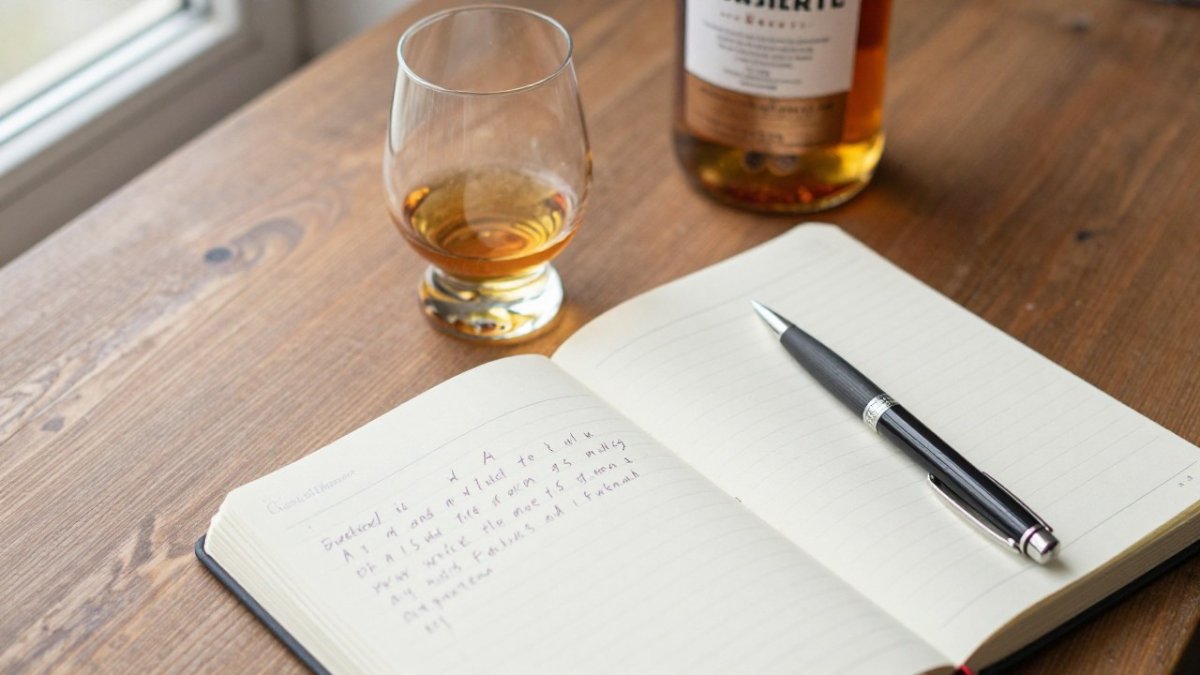
A Filled-In Example Entry
Here is the same template completed for a fictional but realistic pour, so you can see the level of specificity to aim for:
- Bottle: Example Distillery, Small Batch, 100 proof, NAS, traditional mash bill, batch 12, 750 mL, $49.99, opened March 2, tasted March 9
- Appearance: Deep amber, slow thick legs
- Nose: First word: caramel. Then vanilla, toasted oak, a little orange peel
- Palate: Sweet up front, coating texture, medium heat, cinnamon and dark cherry
That entry takes about two minutes to write and gives you everything you need to compare it to another pour six months from now.
Paper, Spreadsheet, or App: Making the Template Portable
The same fields work in any format. Print a stack of blank templates and keep them in a binder. Paste the fields into a spreadsheet with one row per pour so you can sort by distillery, proof, or rating.
Watch out: if you switch formats mid-journal, copy your old entries into the new one. A split log defeats the purpose of a comparable record.
Bottle Data Worth Recording
Bourbon-specific details matter. Proof, age statement, and batch number all change what is in the glass.
A single barrel pick from the same distillery can taste wildly different from the standard release. Record the barrel number. Record the proof.
Also note whether the bottle is a store pick, a limited release, or a standard shelf bottle. That detail shapes both your rating and your wishlist.
Sensory Fields: Appearance, Nose, Palate, Finish
Write in order, every time. Consistency is what makes a log useful.
Appearance: Note the color, from pale gold to deep amber.
Nose: Start with one word. Then build. Is it sweet, spicy, oaky, fruity?
Palate: Describe flavor, then mouthfeel. Is it thin or coating? Hot or smooth?
Finish: How long does it linger? Does it fade fast or stay warm?
How to Write Bourbon Tasting Notes Without Sounding Generic
Skip "smooth" and "harsh." Those words tell you nothing six months later. Good tasting notes are specific, honest, and written in your own words.
The trick is to describe what you actually sense, not what you think you should sense. If it smells like vanilla and sawdust, write that. If it tastes like cinnamon candy, say so.
A few habits that sharpen your notes:
- Write the nose before you sip, every time
- Use comparisons: "like burnt sugar" beats "sweet"
- Note the proof's effect on heat
- Add water and re-taste, then record the change
Building Aroma and Flavor Vocabulary
Vocabulary is a skill you build, not a gift you are born with. Start with broad families, then narrow.
Common aroma families in bourbon include vanilla, caramel, oak, baking spice, dark fruit, and grain. Within each, get more specific over time.
If you are starting from zero, our beginner's guide to whiskey flavor profiles walks through the core families. A practical flavor wheel guide also helps you name what you smell instead of guessing.
Whiskey Tasting Journal Examples: Three Entries Done Right
Here is what strong entries look like in practice.
Entry one, a wheated pour: Nose of vanilla and baked bread.
Entry two, a high-rye pour: Nose of rye spice, dill, and a little mint.
Entry three, a barrel-proof pick: Nose of caramel and toasted oak, strong ethanol.
See the pattern? Bottle data, four sensory fields, a score, and a verdict.
Rating and Comparing Pours Fairly
A rating only means something if you use the same scale every time. Most tasters drift without realizing it, giving high scores to whatever they tasted most recently. The fix is a written rubric plus a calibration routine, so a 7 in January means the same thing as a 7 in July.
The 1-10 rubric:
- 9-10: Exceptional, would seek out and replace
- 7-8: Very good, would buy again
- 5-6: Solid, enjoyable but not special
- 3-4: Fine, would not rebuy
When to Rate: Before or After Writing Notes
Rate after you finish the sensory notes, not before. Writing the nose, palate, and finish first forces you to describe what is actually in the glass. If you score first, the number anchors your notes and you start writing toward it.
A common pattern is to jot a provisional score, finish the notes, then adjust the score once. The adjustment is where you catch your own bias.
Calibrating Your Scale with Anchors
Pick three reference bottles you know well and score them first. One you love, one you like, one you do not. Use those as anchors for every future pour. Write the anchor scores on a card and keep it with your journal.
Re-taste your anchors every few months. Palates change. When your anchors shift, you know your scores need recalibrating, not just your mood.
Watch out: avoid using a rare or expensive bottle as an anchor, since it may become unrepeatable.
Accounting for Tasting Conditions
Two pours tasted under different conditions are not directly comparable. Record the conditions alongside the score so you can adjust later:
- Glass type (tumbler, copita, Glencairn-style)
- Time of day and whether you had eaten
- Whether you added water, and how many drops
- Whether you were tasting alone or in a group
When you compare two entries months apart, check the conditions first. A pour scored lower at the end of a long session may deserve a re-taste.
Blind Tasting to Cut Expectation Bias
Expectation bias is real (Implicit expectation modulates multisensory perception). A fancy label or a hyped release makes a pour taste better before you even sip. Blind tasting removes the label and leaves only the whiskey.
Pour two or three samples into unmarked glasses. Score them without knowing what they are. Compare your blind scores to your labeled ones. If a bottle you love scores poorly blind, that is useful information, not a failure.
If you want to run one at home, our guide on hosting a bourbon blind tasting covers the setup step by step.
Comparing Pours Across Months
To compare fairly, pull two entries with similar conditions and similar proof. Note the differences in your notes, not just the scores. A 7 and an 8 may taste closer than the numbers suggest, or further apart. The written notes are what let you tell the difference.
Building the Habit and Keeping Your Log Useful
A journal only works if you use it. The good news: it takes about two minutes per pour once your template is set.
Keep these habits:
- Log every pour, even the quick ones
- Write the nose before the first sip
- Take a photo of the label for reference
- Back up digital notes regularly
For digital logs, protect your data. Use a strong password, keep backups, and check who can see your notes. Searchable, backed-up entries are what make a log worth keeping for years.
Start Logging Your Next Pour
The hardest part of a tasting journal is the first entry. Do it tonight, with whatever bottle is already open.
Bourbon Tracker™ makes that first entry easy. Ready to begin? Track My Collection and turn tonight's pour into a record you will actually use.
Your palate is already telling you something about every bottle you open. The only question is whether you are writing it down.
Frequently Asked Questions
What should you include in a bourbon tasting journal?
Record the bottle name, distillery, proof, age statement, and batch number first. Then add appearance notes (color, viscosity), nose notes, palate notes with mouthfeel, and finish length. Close each entry with a rating on a consistent scale and a one-line verdict. Adding the date and whether you drank it neat or with water makes later comparisons far more useful.
Is a paper or digital bourbon tasting journal better?
Paper suits people who like writing by hand and want zero setup. A digital bourbon tasting journal app wins on searchability, backups, and comparing entries across months. If you have more than 50 bottles, digital organization saves real time. Many enthusiasts keep a paper notebook for tasting sessions and log the same notes into an app afterward so nothing gets lost.
How should you rate bourbon in a tasting journal?
Pick one scale and stay on it, such as 1-10 or a five-point system with half steps. Define what each number means before you start: for example, 5 is a solid everyday pour and 9 is something you would buy a backup bottle of. Re-taste a few reference bottles periodically to keep your scale calibrated, and note whether a score was given blind or with the label visible.
How often should you update a bourbon tasting journal?
Log every new bottle on the day you open it, and add a short follow-up note when the bottle has been open a few weeks, since flavors shift with air. Revisit older entries every few months to see how your palate has changed. A consistent habit of even one entry per pour beats occasional long sessions, because fresh notes are more accurate than reconstructed memories.