 how-to
Choosing the Right Bourbon for Beginners: 2026 Guide
Table of Contents
- Start With Flavor: How to Pick a Bourbon You'll Actually Enjoy
- The Best Bourbon for Beginners: 6 Bottles Worth Your First $30-$60
- Bourbon Proof Guide: Why 80-100 Proof Is the Beginner Sweet Spot
- How to Taste Bourbon: A Beginner's Step-by-Step Method
- Bourbon Tasting Notes for Beginners: What You're Actually Tasting
- Match the Bottle to the Occasion: Neat, Rocks, or Cocktail
- Build a Starter Flight and Track What You Taste
- Conclusion
- Frequently Asked Questions
Last Updated: October 17, 2026
Start With Flavor: How to Pick a Bourbon You'll Actually Enjoy
Choosing the right bourbon for beginners comes down to one question: what do you already like to drink? Bourbon is made primarily from corn, aged in new charred oak barrels, and bottled at a minimum of 80 proof. Lean toward wheated mash bills.
At Bourbon Tracker™, we've watched new drinkers make the same mistake: buying the most hyped bottle instead of the one that matches their palate.
A Simple Decision Tree for First-Time Buyers
Answer three questions and you'll land in the right bottle category:
- Do you take your coffee black or with sugar? Black → rye-forward and higher proof. With sugar → wheated and lower proof.
- Do you want to sip it straight or mix it? Straight → look for 90+ proof and an age statement. Mixing → 80-86 proof is plenty.
- What's your budget for bottle one? Under $30 → stick to flagship labels. $30-$60 → you can explore small batch and single barrel.
Most beginners should start with a wheated bourbon at 80-90 proof, the gentlest entry point, teaching you what "smooth" means before you chase heat.
The Best Bourbon for Beginners: 6 Bottles Worth Your First $30-$60
The best bourbon for beginners balances approachable flavor with enough character to keep you interested.
1. Maker's Mark (Wheated, 90 proof). The classic starting point.
**2.
**3.
**4.
5. Larceny (Wheated, 92 proof). A touch sweeter than Maker's Mark, with toffee and a soft finish.
6. Four Roses Small Batch (Rye-forward, 90 proof). Floral and fruity with a gentle spice.
Quick Comparison: Proof, Price, and Flavor at a Glance
| Bottle | Proof | Price | Flavor Lane | Best For |
|---|---|---|---|---|
| Maker's Mark | 90 | Low $30s | Wheated, soft | Absolute first bottle |
| Buffalo Trace | 90 | Mid $30s | Balanced, classic | Learning the baseline |
| Wild Turkey 101 | 101 | Mid $30s | Bold, spicy | Proof explorers |
| Elijah Craig Small Batch | 94 | Low $30s | Oaky, complex | Stepping up |
| Larceny | 92 | Low $30s | Sweet, toffee | Sweet-tooth drinkers |
| Four Roses Small Batch | 90 | Mid $30s | Floral, gentle | Cocktail and sipping |
Prices vary by state and retailer, so check your local store before you commit.
Bourbon Proof Guide: Why 80-100 Proof Is the Beginner Sweet Spot
Proof is twice the alcohol by volume, so 90 proof equals 45% ABV (Definitions). The 80-100 proof range is the beginner sweet spot: real flavor without overwhelming heat. Below 80 proof, bourbon tastes thin; above 100, alcohol can mask the caramel and vanilla a new drinker is trying to identify.
Here's the practical breakdown:
- 80-86 proof: Lightest and easiest. Good for cocktails, less rewarding neat.
- 90-94 proof: The sweet spot. Enough body to carry flavor, gentle enough to sip.
- 100-107 proof: Noticeably warmer. Great once you've trained your palate.
Why Proof Feels Hot: The Mechanism Behind the Burn
Ethanol is volatile; at higher concentrations it evaporates faster and hits the olfactory receptors and back of the throat harder. That's why a 101-proof pour reads as "hot" even when the flavors are sweet.
The useful variable is perceived proof, not label proof. A few drops of water lower the ethanol concentration at the surface, slowing evaporation and letting barrel-char and corn aromatics reach your nose first, which is why distillers add water at tastings.
A Repeatable Method for Taming the Heat
Instead of guessing, use a measured sequence and record what changes:
- Taste at full strength first. Take one small sip and note the heat level on a simple 1-5 scale. This is your baseline.
- Add three drops of room-temperature water. Swirl for five seconds, wait thirty seconds, and taste again. Note the new heat level and whether new aromas appeared.
- Add three more drops if needed. Repeat until the heat drops by at least one point on your scale or the flavor goes flat. Stop at the first sign of flatness; that's your personal dilution ceiling.
- Record the drop count. Over time you'll learn that, say, Wild Turkey 101 needs six drops while Elijah Craig Small Batch needs two. That record is more useful than any generic proof recommendation.
Ice, Water, and the Trade-Offs
Ice works too, but it dulls flavor as it melts. Use one large cube rather than several small ones, it melts slower and gives you more control. Water gives finer control drop by drop, making it the better training tool for beginners because it isolates the variable you're testing.
Proof Sensitivity Is Personal
Some new drinkers are genuinely more sensitive to ethanol burn, and that sensitivity changes with repetition. A pour that felt harsh in month one often reads as balanced by month three, not because the whiskey changed but because your threshold moved. If you consistently reach for water on 100+ proof bottles, your current lane is 90-94 proof; spend your next dollar there.
Treat proof as a dial, not a ranking. Buy one bottle in the 90-94 range and one at 100-101, then use the drop-count method to find where each one sits for you. That comparison teaches more about your palate than any single recommendation.
How to Taste Bourbon: A Beginner's Step-by-Step Method
Tasting bourbon is a four-step process: look, smell, sip, and finish. Do it in that order and you'll pull more detail out of a $35 bottle than most people get from a $200 one.
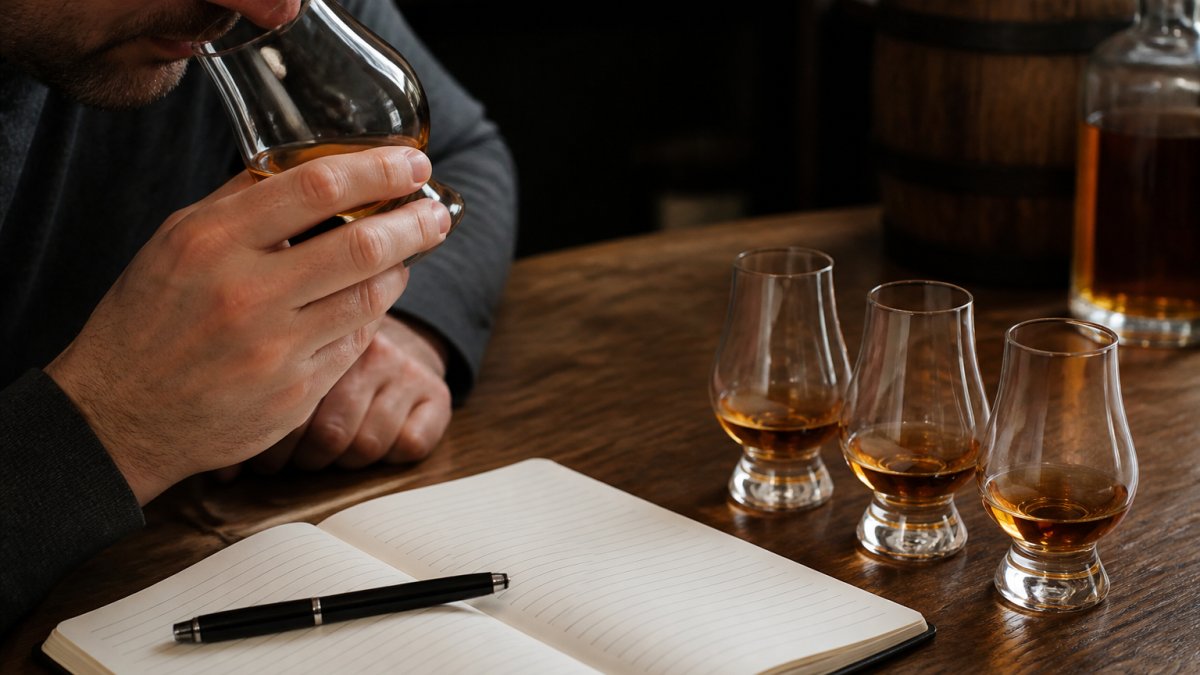
- Look. Tilt the glass against a white background. Note the color, from pale gold to deep amber. Color hints at age and barrel char, nothing more.
- Smell. Keep your nose just above the rim and take short sniffs, not one deep inhale. Long sniffs deaden your sense of smell. Look for caramel, vanilla, oak, and spice.
- Sip. Take a small sip and let it coat your tongue. Hold it for a few seconds. Note sweetness on the front, spice in the middle, and oak or tannin at the back.
- Finish. Swallow and count how long the flavor lingers. A long finish is a sign of quality; a short one isn't a dealbreaker at this price point.
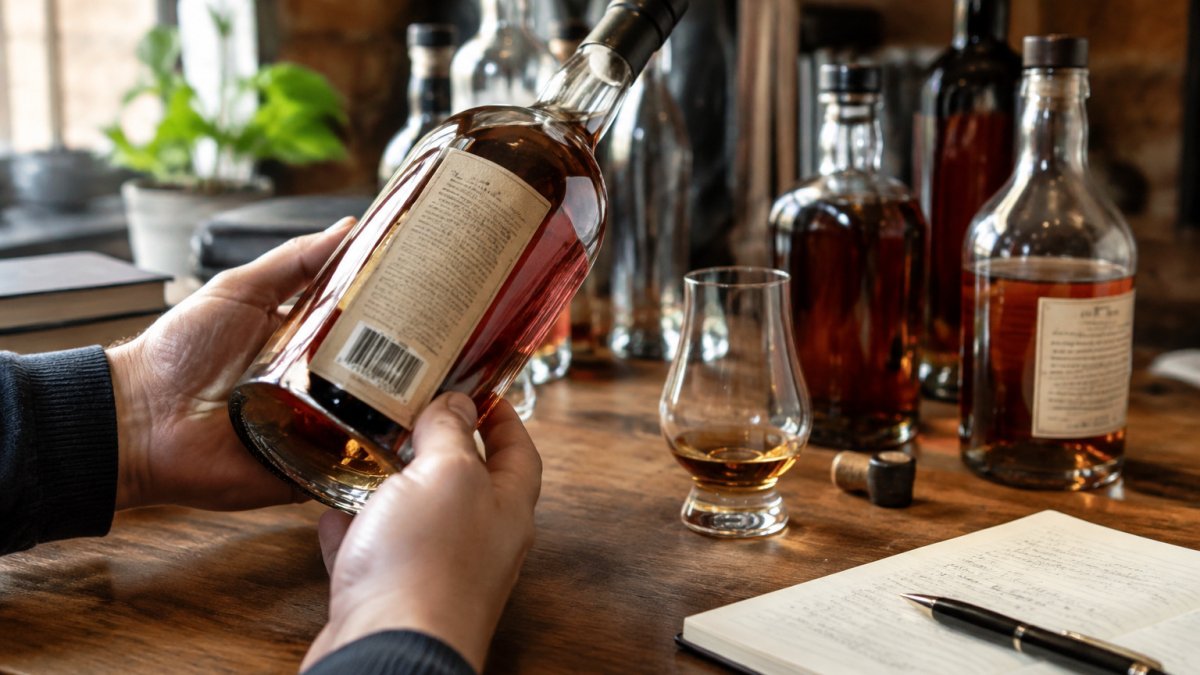
Write down what you notice each time. Even two words per bottle builds a record you can compare later.
Bourbon Tasting Notes for Beginners: What You're Actually Tasting
Bourbon tasting notes for beginners usually sound like a coffee menu, and there's a reason: compounds created during barrel char and aging genuinely resemble vanilla, caramel, and toasted oak.
- Caramel and vanilla come from the charred oak barrel, not added sugar.
- Oak shows up as a dry, slightly bitter note on the finish, especially in older bottles.
- Spice comes from rye in the mash bill. More rye means more pepper and cinnamon.
You don't need an expert nose. If it smells like vanilla, say vanilla. Accuracy matters less than consistency.
Match the Bottle to the Occasion: Neat, Rocks, or Cocktail
How you serve a bourbon changes which bottle you should buy. A $30 wheated bourbon is wasted in bourbon and cola, and a 101-proof rye is punishing neat for a new drinker. Match the bottle to the actual occasion, the same person often needs different bottles for a quiet Tuesday pour, a party, and a gift.
Sipping: Buy for Balance, Not Heat
For neat or lightly watered sipping, choose 90-94 proof with a wheated or balanced mash bill, Maker's Mark and Elijah Craig Small Batch both work. You want enough body to carry caramel and vanilla without ethanol dominating. If you sip most nights, this is the bottle to spend on.
Cocktails: Buy for Clean Profile and Value
An 80-86 proof bottle with a clean profile is ideal for an Old Fashioned or bourbon and cola. Sugar, bitters, and citrus mask subtle barrel notes, so paying for complexity you won't taste is wasted money, a solid flagship does the job, and its lower proof keeps the drink from turning harsh. These same charred oak staves that mellow a spirit often find a second life imparting deep, toasted character to bourbon barrel aged coffee.
Gifting: Buy for Story and Availability
A gift bottle should be widely recognized and easy to explain. Buffalo Trace and Maker's Mark are safe choices because the recipient likely knows them. Avoid allocated or hard-to-find releases unless you know the recipient wants them; a bottle they can't easily replace creates awkwardness.
Sharing: Buy for Contrast
When pouring for a group, contrast beats a single "best" bottle. A wheated and a rye-forward bottle side by side let guests compare and find their own lane, and two mid-$30s bottles teach more in one evening than one $70 bottle.
Buy for how you actually drink, not how you plan to drink. If nine out of ten pours end up in a glass with cola, spend your money on a solid mixing bottle and one nicer sipper.
A Quick Decision Framework
- Mostly neat: one 90-94 proof balanced or wheated bottle.
- Mostly cocktails: one 80-86 proof clean flagship.
- Gift: one widely recognized, easily replaced bottle.
Match the bottle to the occasion before you match it to a review score. The right bottle for a party is rarely the right bottle for a quiet pour, and knowing which you're buying for prevents the most common beginner regret.
Build a Starter Flight and Track What You Taste
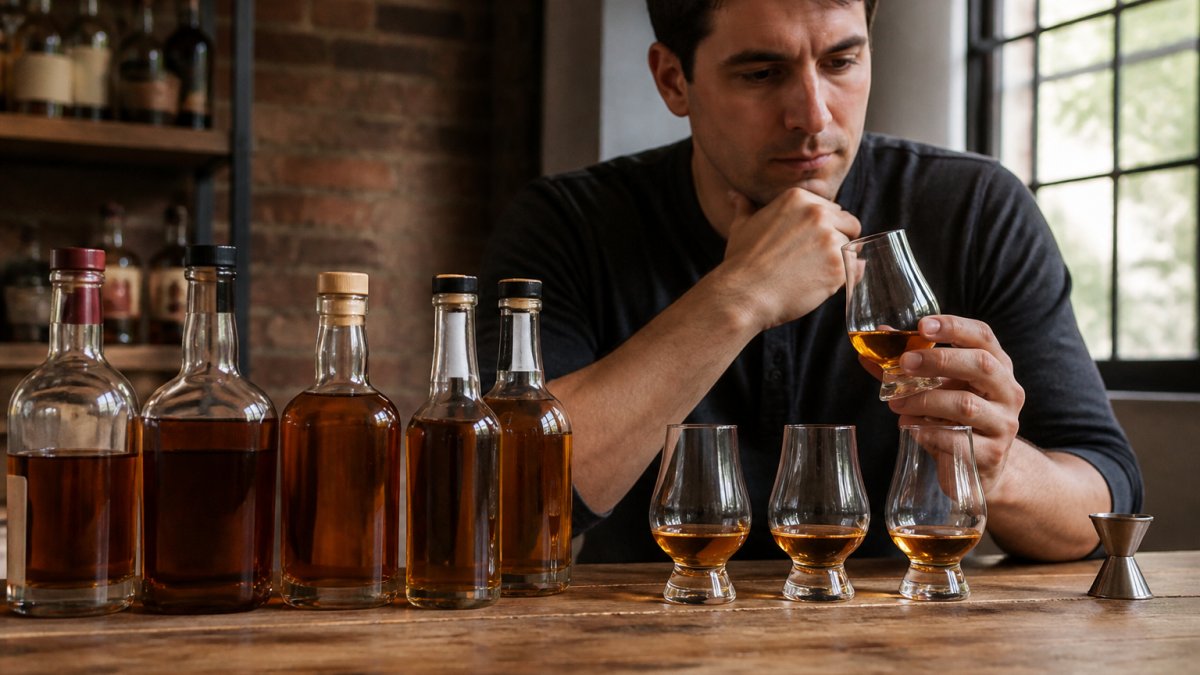
A tasting flight is three to five small pours tasted side by side, the fastest way to learn your palate. Build your first flight around contrast, not similarity.
Try this starter set: one wheated (Maker's Mark), one balanced (Buffalo Trace), and one high-proof rye-forward (Wild Turkey 101).
Then keep the record. Most beginners taste ten bottles over three months and remember none of it. Log the bottle, proof, price, and two or three tasting notes each time.
Revisit the same bottle every few months. Your palate changes faster than you expect, and a bourbon you found harsh in month one often becomes a favorite by month six. The notes you wrote back then are the proof.
Conclusion
The hardest part of choosing the right bourbon for beginners isn't finding a good bottle. It's resisting the hype long enough to figure out what you actually like.
That's the habit that turns a casual drinker into someone with a real palate, and it's the habit Bourbon Tracker™ was built for. Log every pour, build a wishlist, and let the AI recommendations point you toward bottles that match your taste instead of the shelf's best marketing.
Frequently Asked Questions
What is a good first bourbon for a beginner?
Look for a wheated or low-rye straight bourbon bottled between 80 and 90 proof, since those tend to taste smoother and cost less. Widely available options in the $30-$60 range include Maker's Mark, Buffalo Trace, and Elijah Craig Small Batch. Start with one bottle, taste it neat and with a splash of water, then note what you liked before buying a second. A free tracking tool like Bourbon Tracker helps you log those impressions so your next pick is based on your own palate instead of guesswork.
What bourbon proof is best for beginners?
Most new drinkers do best in the 80-100 proof range, which is 40-50% ABV. At that strength the alcohol heat stays in the background and the caramel, vanilla, and oak notes come through. Barrel-proof bottles at 115 proof and up can taste harsh until your palate adjusts. If a pour feels too hot, add a few drops of water or one ice cube; both lower the perceived burn without wiping out the flavor. Move up in proof gradually as your tolerance builds.
Should beginners drink bourbon neat, on the rocks, or in a cocktail?
Try all three with the same bottle and see which you prefer. Neat shows the full flavor profile, on the rocks softens the heat and brings out sweetness, and a bourbon and cola or an Old Fashioned is a fine way to start if neat pours feel too strong. There is no rule that you have to earn your way to neat. Many experienced drinkers still order their bourbon over ice. The goal is enjoying the glass, not passing a test.
How much should a beginner spend on a bottle of bourbon?
The $30-$60 range covers most of the best starter bottles, including flagship straight bourbons from well-known distilleries. You do not need to spend more than that to learn what you like; price climbs quickly for single barrel and age-stated releases that a new palate cannot fully appreciate yet. Buy two or three mid-priced bottles across different mash bills instead of one expensive one. That gives you a real comparison and a faster read on your own taste.