 Comparison
7 Bourbon Collection Tracking App Features That Matter
Last Updated: November 16, 2026
Quick Summary
A bourbon collection tracking app should record every bottle you own with details, photos, and purchase price, plus tasting notes, a wishlist, and bottle value estimates. The best bourbon collection tracking apps are free, let you export your data, and handle store picks and open bottles correctly.
- Log store picks, barrel numbers, release years, and fill level, since two bottles of one label can differ in value.
- Treat barcode scanning as a shortcut and confirm each match against the physical label by hand.
- Valuation should label its source and date, and widen into a range when completed sales are sparse.
- Mark bottles as sealed, open, or shared so your total collection value stays accurate.
- Pick one shelf and log ten bottles tonight to start the habit.
Table of Contents
- What a Bourbon Collection Tracking App Should Actually Do
- Bottle Cataloging: Details, Photos, and Barcode Scanning
- Why a Free Bourbon Collection Tracking App Beats a Paid One
- Bourbon Tasting Notes App: Ratings, Flavors, and Bottles Tried
- Bourbon Bottle Value Tracker: How Valuation Really Works
- Bourbon Wishlist App: Tracking What You Want to Find
- Privacy, Data Ownership, and Long-Term Support
- Start Cataloging Your Bottles in Bourbon Tracker
- Frequently Asked Questions
What a Bourbon Collection Tracking App Should Actually Do
A bourbon collection tracking app is a digital tool that records every bottle you own, what you paid, how it tastes, and what you still want to find, all in one searchable place. Bourbon Tracker™ is built around one idea: your collection should be easier to manage on your phone than on a paper list. The features below are the ones that separate a useful bourbon collection tracking app from a simple shelf inventory. Below, we walk through each feature, where apps cut corners, and what to demand before you trust one with years of purchase history.
Bottle Cataloging: Details, Photos, and Barcode Scanning
Cataloging is the core job, and most apps get the basics right: name, distillery, proof, age statement, and a photo of the bottle. The gap shows up in the details. A serious bottle catalog needs room for store picks, barrel numbers, release years, and fill level, because two bottles of the same label can be worth very different amounts.
A practical field list for a bourbon bottle record looks like this: brand, expression, distillery, proof, age statement, mash bill if known, release year, bottle size (750 mL, 1 L, 375 mL, 50 mL), store-pick or single-barrel designation, barrel number, warehouse and floor if printed, purchase date, purchase price, retailer, condition (sealed, open, fill level), and a photo of the front label plus any neck tag or sticker. Store picks are where generic apps break first, because the UPC is often identical to the standard release while the barrel, proof, and price are not.
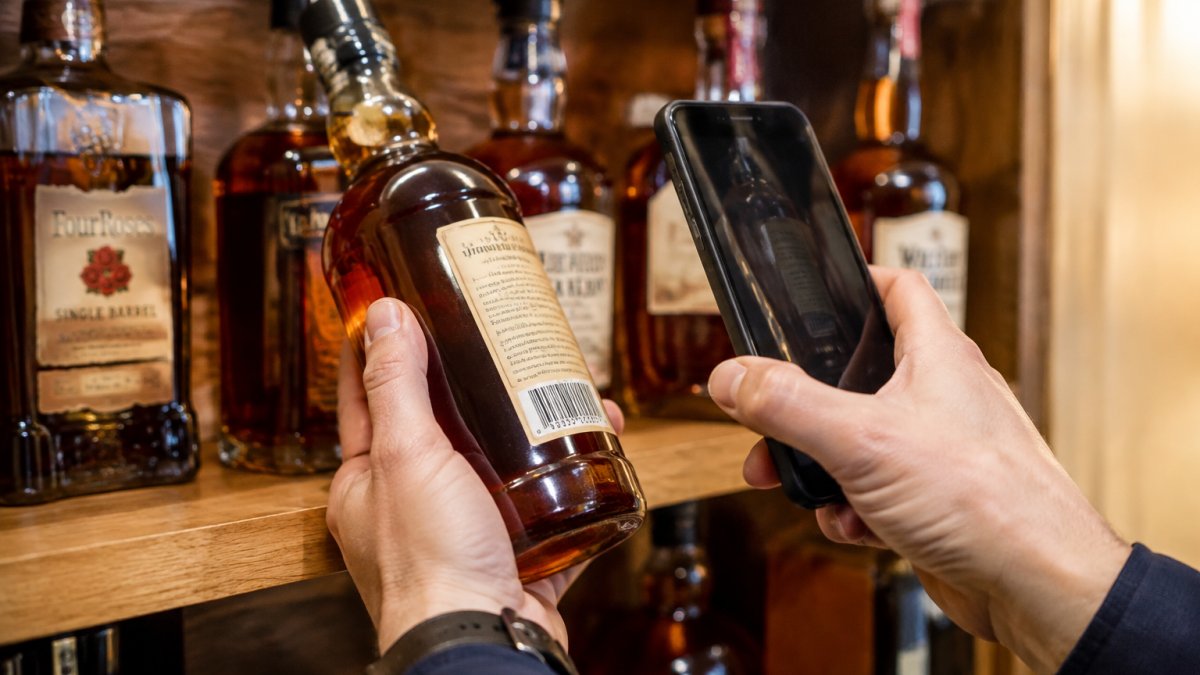
Barcode scanning and bottle recognition can speed up entry, but treat them as shortcuts, not truth. Labels change, store picks can share a UPC with the standard release, and older bottles often have no scannable code at all. A careful workflow is to confirm each match against the physical label and correct it by hand.
When Recognition Gets It Wrong
Manual entry matters for store picks, single barrels, and older bottles, so a bottle record should let you add the details that matter to you.
Why a Free Bourbon Collection Tracking App Beats a Paid One
Paid tiers usually charge for the things that make tracking worthwhile: unlimited bottles, price history, and wishlist size. A free bourbon collection tracking app that covers those basics removes the worst risk in this category, which is paying for a year, loading in 200 bottles, and watching the app shut down.
Our position is simple: the collection data is yours, so the tool should not hold it hostage behind a subscription. What most guides miss is that the real cost of a paid app is not the fee, it is the migration. When a paid app folds, you rebuild your entire bottle database by hand.
Bourbon Tasting Notes App: Ratings, Flavors, and Bottles Tried
A tasting notes app earns its place when it helps you remember what you thought, not just what you drank. The useful structure is a rating, a few flavor tags, and a short note in your own words. That record is what turns a spirits collection into something you can learn from.
- Tasting notes to log what you thought of each bottle
Pour tracking and fill level deserve their own mention. Logging pours can show which bottles get drained and which sit untouched. For a deeper look at tasting notes, see our guide to the best bourbon app for tasting notes.
Bourbon Bottle Value Tracker: How Valuation Really Works
| Bottle state | What valuation should reflect | Common mistake |
|---|---|---|
| Sealed, in box | Recent completed sales, box premium | Using asking prices |
| Sealed, no box | Completed sales, condition noted | Ignoring fill level |
| Open, mostly full | Discounted secondary value | Treating as sealed |
| Open, low fill | Drinking value only | Inflating the number |
Where the Numbers Come From
Most valuation features draw on one or more of four sources: retail shelf prices from licensed stores, secondary-market completed sales, auction results, and user-reported purchase prices. Each has a different meaning. Retail shelf prices tell you replacement cost at a store that has the bottle in stock, which for allocated releases is often no store at all. Secondary completed sales reflect what buyers actually paid in private transactions, which is closer to market value but harder to verify. Auction results are public and dated but include buyer's premium and reflect a specific sale event. User-reported prices are the least reliable because they are unverified and skew toward good deals people brag about.
A transparent app should label which source backs each estimate and show a date. An estimate with no date is stale by default. A common pattern is weekly or monthly refresh for actively traded bottles and much slower refresh for rare ones, because completed sales for a single allocated release may be sparse. When sales are sparse, the estimate should widen into a range rather than pretend to a single precise number.
Why an Estimate Is Not a Sale Price
An app estimate is a modeled midpoint, not a transaction. Realized sale prices differ because of condition, box and paperwork, fill level, provenance, buyer and seller fees, shipping, and timing. A bottle estimated at a given figure may sell for less after fees or more in a heated auction. Treat the estimate as a planning number and the completed sale as the truth. Watch out: if you use an app estimate as the declared value on an insurance schedule without checking recent completed sales, you may be over- or under-insured, and insurers generally want documentation rather than a single app figure.
Sealed, Open, and Shared Bottles
Your inventory workflow has to handle three states: sealed bottles you are holding, open bottles you are drinking, and bottles you share or trade with friends. A good app lets you mark state and adjusts value accordingly. Watch out: if you log an open bottle at sealed value, your total collection value becomes fiction, and that number is the one you would hand an insurer.
For a step-by-step walkthrough of documenting value for coverage, read our guide on how to value whiskey for insurance.
Bourbon Wishlist App: Tracking What You Want to Find
A wishlist is a shopping list with memory. The best bourbon wishlist app lets you save a bottle the moment you hear about it, note why you want it, and set a target price so you know a good deal when you see one at a liquor store.
- Save bottles to a personal wishlist to track what you want to find
If you want a practical system for building one, our guide on how to build a bourbon wishlist covers it end to end.
Privacy, Data Ownership, and Long-Term Support
Privacy and portability matter for any collection tool. Before you commit, check how your collection data is handled, whether you can export your records, and how the product is maintained.
Ask any app directly how you get your data out, and look for a clear way to report problems.
If you are still deciding how a digital log should work in practice, our guide to building a digital whiskey cellar log walks through the workflow.
Start Cataloging Your Bottles in Bourbon Tracker
The hard part of collection tracking is not picking an app, it is starting. Pick one shelf, log ten bottles tonight, and let the habit build from there. Bourbon Tracker™ is free, requires no download, and offers tasting notes, a personal wishlist, and AI-powered recommendations. When you are ready, learn how to use Bourbon Tracker and get your first bottles logged. Get started with Bourbon Tracker™ and turn a crowded shelf into a collection you can actually search, value, and enjoy.
Your shelf is only going to grow, and a paper list will not keep up with it. Bourbon Tracker™ keeps every bottle, pour, and wishlist entry in one place, with AI suggestions that learn from your own ratings and a community that shares the hunt. Get started with Bourbon Tracker™ and catalog your first ten bottles today.
Frequently Asked Questions
What features should a bourbon collection tracking app have?
At minimum, look for bottle cataloging with photos and manual entry, tasting notes with ratings, a wishlist, and some form of value tracking. Barcode scanning and AI recognition speed up entry but should never replace manual correction. Also check whether the app works in a browser without a download, how large a collection it handles, and whether you can export your data. A bourbon collection tracking app that locks your notes in with no export path is a risk if the product shuts down.
Is there a free bourbon collection tracking app?
Yes. Bourbon Tracker is free to use and requires no download. Free tools vary in what they include, so check the feature list before you invest hours of data entry.
Can bourbon apps track bottle values accurately?
A bourbon bottle value tracker gives an estimate, not an appraisal.
Can I save bourbon tasting notes and ratings without downloading an app?
Yes. Bourbon Tracker works without a download, so you can use it without installing anything.