 how-to
How to Value Whiskey for Insurance: A Step-by-Step Guide
Table of Contents
- Why Valuing Whiskey for Insurance Matters
- Understanding Replacement Cost vs. Market Value
- Step-by-Step Valuation Methodology for Your Collection
- How to Appraise Rare Bourbon
- Documenting Your Collection: Creating an Itemized Inventory
- Using Whiskey Inventory Tracking Tools to Organize Your Assets
- Scheduled Personal Property Endorsement: Protecting High-Value Bottles
- Common Mistakes to Avoid When Valuing Your Collection
- Frequently Asked Questions
Last Updated: October 3, 2026
Why Valuing Whiskey for Insurance Matters
Collectors often overlook a critical step: properly documenting and establishing value whiskey for insurance purposes. Without accurate valuation, you're underinsured. Standard homeowners insurance won't cover the full replacement cost of rare whiskeys. High-value collections need scheduled personal property coverage, a policy rider that protects specific items at their declared value.
The first step is knowing what your collection would cost to replace today in the current secondary market, not what you paid for it or hope to sell it for.
Before using any tracking tool, you need to establish what each bottle is actually worth. This guide walks you through that process.
Understanding Replacement Cost vs. Market Value
These two terms get confused constantly. They're different, and the distinction matters for insurance.
Replacement cost is what you'd pay to buy that exact bottle today if yours was destroyed, what your insurance company will reimburse. Market value is what someone would pay if you sold it now, often higher for limited releases or closed-distillery bottles.
Example: A closed-distillery bottle has a secondary market price of $600, but you could replace it for $450 from a retailer. Your insurance covers $450, not $600. Auction prices reflect competitive bidding, not replacement cost. For insurance, focus on replacement cost.
Step-by-Step Valuation Methodology for Your Collection
Valuing whiskey for insurance requires a systematic approach grounded in real secondary-market data. Follow this process for each bottle.
Step 1: Gather Bottle Information and Provenance
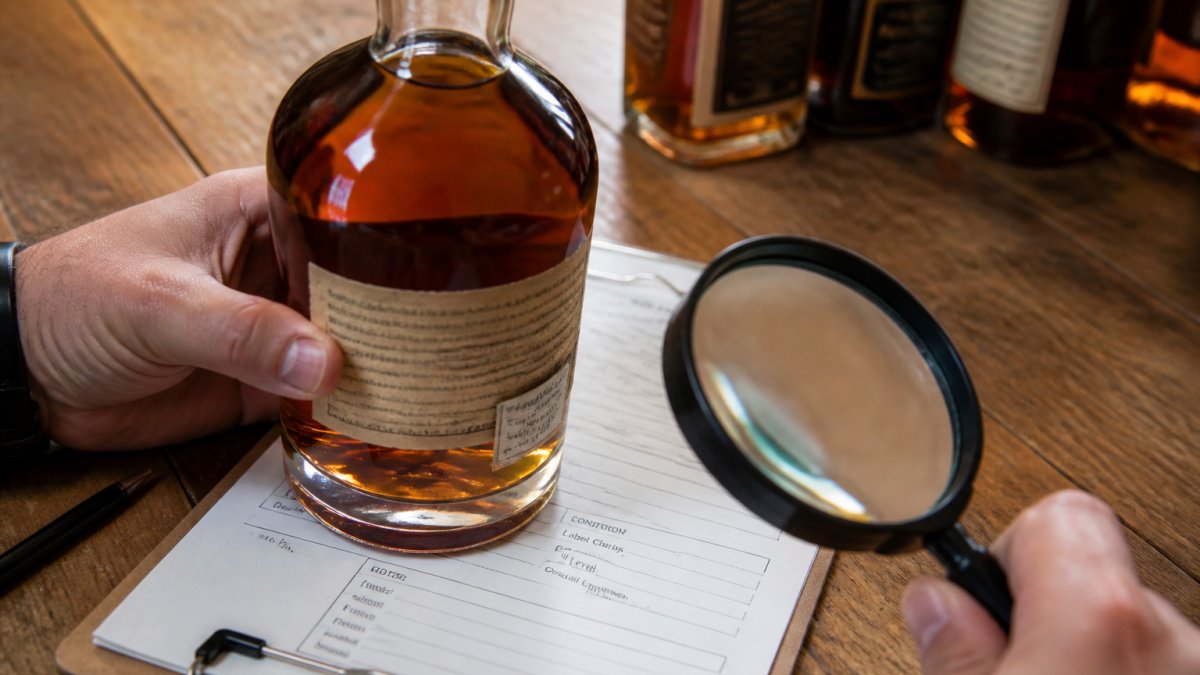
Write down: brand, distillery, age statement, proof, bottle size, vintage, special edition designation, and barrel type. Document where you bought it and keep receipts, insurance companies request proof of ownership. Take clear photos of front label, back label, and special markings, stored digitally.
Step 2: Research Current Secondary Market Prices Using Multiple Data Sources
Find actual replacement cost by triangulating across multiple sources:
Retail Pricing (Primary Source for Replacement Cost)
- Specialty whiskey retailers with online inventory
- Large-format retailers with current stock and prices
- Distillery direct-to-consumer sales if still in production
Retail pricing is your anchor. A bottle listed at $120 at a major retailer is insurable at $120, regardless of auction results.
Secondary Market Platforms
- Whiskey auction sites with realized prices from completed sales
- Bottle-trading platforms showing recent transactions
- Marketplace listings aggregating asking prices
Record the source URL, date accessed, and price for each listing.
How to Reconcile Conflicting Prices
- Retail vs. auction: Use retail price ($100), not auction results ($140), which reflect competitive bidding.
- Condition: Match your bottle's condition to comparable listings.
- Regional variation: Prices vary by state; document your regional source.
- Timing: Prioritize recent data over old listings.
Worked Example: Valuing a Specific Bottle
For a closed-distillery bottle (750ml, 90 proof): Find retail listing at $85, auction sales at $110/$125/$95, and secondary market asking prices at $100/$115/$90. Use the retail price ($85) as replacement cost. Document: "Replacement cost $85, based on [retailer name] listing dated [date], accessed [URL]."
Step 3: Factor in Bottle Condition and Storage
Condition dramatically affects value. Evaluate label condition (pristine = 100%, heavily damaged = 50-70%), fill level (each 10% drop reduces value 10-15%), seal integrity (opened bottles worth 40-60% of sealed price), storage conditions, and capsule/cork condition. Be honest, overvaluing damaged bottles creates claim problems. Document condition issues in writing.
How to Appraise Rare Bourbon
For rare bottles worth more than $500, consider hiring a professional appraiser. They verify authenticity, document condition, research current pricing, and provide a written report that insurance companies accept without question. If appraising yourself, focus on recent sales of identical bottles, bourbon prices shift with market demand.
Documenting Your Collection: Creating an Itemized Inventory
Insurance companies need proof. When you file a claim, an adjuster will ask how you owned the bottle, its condition, and how you determined its value. Without documentation, claims get delayed or denied.
The Itemized Inventory Spreadsheet
Create a spreadsheet inventory including: bottle name, brand, distillery, age statement, proof, bottle size, replacement cost, appraisal date and source, condition notes, storage location, and proof of ownership. Print a copy for your insurance documents and store a digital copy in cloud storage. This inventory is both your coverage setup and your proof of ownership.
Update your inventory annually, prices change, and you may add or remove bottles.
Proof-of-Ownership Documentation: What Adjusters Actually Require
Original Purchase Receipts
- Retailer receipts are the gold standard, showing bottle name, price, date, and retailer.
- Credit card or bank statements showing a purchase from that retailer are acceptable secondary proof.
- For inherited bottles or gifts, a written statement from the donor (signed and dated) serves as proof of transfer.
Photographic and Video Evidence
- Take clear, well-lit photos of each bottle from multiple angles: front label, back label, side profile, and top (showing the capsule and cork condition). Store these in a folder labeled with the bottle name and date taken.
- For high-value bottles (over $500), consider recording a short video walkthrough of your collection. Narrate as you show each bottle, stating the brand, age, and condition. This video is timestamped evidence of ownership and condition.
- Photos and videos should be stored in cloud storage with a backup copy on an external hard drive. If your house burns down, cloud storage survives.
Condition Assessment Documentation
- Write a brief condition report for each bottle, especially those with any damage or age-related wear. Example: "Label has minor fading on right edge, fill level 85%, capsule shows light corrosion, stored upright in climate-controlled cabinet."
- For bottles worth over $1,000, consider hiring a professional appraiser to create a formal condition report. This report becomes part of your claim file and speeds up adjuster review.
Valuation Documentation
- Keep a record of where you found the replacement cost for each bottle. Write down the retailer name, URL, date accessed, and price. This shows the adjuster how you arrived at your valuation.
- If you used multiple sources to triangulate a price, document all of them. Example: "Replacement cost $150, based on [Retailer A] listing $150 (dated 1/15/2026), [Retailer B] listing $155 (dated 1/14/2026), and [Auction Platform] recent sale $145 (dated 1/10/2026). Average: $150."
Organizing Evidence for Quick Claim Filing
If you need to file a claim, you'll be stressed and in a hurry. Organize your documentation now so you can hand it to your adjuster immediately.
Create a folder (physical or digital) labeled "Whiskey Collection Insurance Documentation" containing:
- Your itemized inventory spreadsheet (most recent version)
- A subfolder with photos of each bottle (labeled by bottle name)
- A subfolder with receipts and proof of purchase
- A subfolder with professional appraisals (if you have them)
- A document titled "Valuation Sources" listing where you found replacement costs
- A copy of your scheduled personal property endorsement (the insurance policy rider)
Store the digital version in cloud storage. Print a copy of the inventory and keep it in a binder with your insurance documents. If your house burns down, you'll have the digital backup; if your computer crashes, you'll have the printed copy.
Annual Documentation Review
Once a year, review your documentation:
- Update replacement costs for bottles that have appreciated or depreciated
- Add photos of new bottles you've acquired
- Remove bottles you've sold or consumed
- Check that all cloud storage backups are current
- Verify that your insurance agent has the most recent inventory
This annual review takes an hour and ensures your coverage stays accurate. It also ensures that if you file a claim, your documentation is current and complete.
Using Whiskey Inventory Tracking Tools to Organize Your Assets
Digital tracking makes valuation easier and keeps your collection organized.
Bourbon Tracker™ lets you log each bottle with tasting notes, ratings, and details.
The benefit of digital tracking is accessibility. You can update your collection from anywhere. You can search for specific bottles instantly. You can see your entire collection in one place.
For insurance purposes, export your tracked collection into a spreadsheet format that your insurance agent can review. Most tools allow you to export data.
Scheduled Personal Property Endorsement: Protecting High-Value Bottles
Once you've valued your collection, you need the right insurance coverage.
A scheduled personal property endorsement (also called a policy rider) is an add-on to your homeowners insurance. It specifically lists high-value items and their declared values. Instead of relying on your homeowners policy's general personal property limit, the endorsement covers your bottles at their specific appraised values.
Here's how it works:
- You provide your insurance agent with your itemized inventory and appraised values
- Your agent adds these items to a schedule attached to your homeowners policy
- The endorsement covers theft, breakage, fire, and other covered perils
- If a bottle is damaged or stolen, you receive the declared value you listed
The endorsement costs extra, but it's essential for collections worth more than a few thousand dollars. Your homeowners policy alone won't protect you adequately.
When you apply for the endorsement, your insurance agent may ask for:
- Proof of ownership (receipts, photos, appraisals)
- Detailed condition assessment
- Current market value documentation
- Storage location and security measures
Having this information ready speeds up the process.
Common Mistakes to Avoid When Valuing Your Collection
Most collectors make predictable errors when determining value whiskey for insurance coverage.
Don't anchor to purchase price. What you paid five years ago is irrelevant.
Don't use auction prices as your baseline. Auctions attract competitive bidding.
Don't overvalue bottles with condition issues.
Don't forget to update your valuation annually. Prices move. Your $150 bottle might be $200 next year.
Don't store documentation only on your computer. Back up your inventory, photos, and appraisals to cloud storage or email.
Don't assume your homeowners policy covers your collection. It doesn't, not fully.
Frequently Asked Questions
Do I need a professional appraisal for my bourbon collection?
Professional appraisals are highly recommended for collections exceeding $5,000 or containing rare, investment-grade bottles. A certified appraiser documents provenance, condition, and market value, which insurers require for scheduled personal property coverage. For smaller collections, detailed self-documentation with secondary market research may suffice, but an appraisal strengthens your claim if loss occurs.
What's the difference between replacement cost and actual cash value for spirits?
Replacement cost covers the full price to buy an identical bottle today, accounting for current market demand and rarity. Actual cash value subtracts depreciation, which doesn't apply well to collectible whiskey since rare bottles often appreciate. For insurance purposes, replacement cost is the standard for scheduled personal property coverage on valuable collections.
How often should I update the valuation of my whiskey collection?
Update valuations annually or whenever you add significant bottles. Rare bourbon prices fluctuate based on secondary market demand, auction results, and bottle condition. Notify your insurance agent of major updates to ensure your coverage limits reflect current asset value.
What documentation do I need to insure a whiskey collection?
Maintain an itemized list with bottle name, vintage, proof, purchase price, current market value, and acquisition date. Include photos of each bottle (label and fill level), receipts or proof of ownership, and any appraisal reports. Store this documentation separately from your collection. Most insurers require this proof of ownership before approving claims on high-value items.
Protecting your whiskey collection starts with knowing what you have and what it's worth. The process takes time, but it's the only way to ensure you're properly insured. Once you've valued your bottles and set up scheduled personal property coverage, use Bourbon Tracker™ to keep your collection organized and discover new bottles that match your taste. With proper documentation and the right insurance in place, your collection is protected.