 how-to
Organize Bourbon Tasting Notes: A 2026 Guide
Table of Contents
- Why Organizing Bourbon Tasting Notes Matters
- Paper vs. Spreadsheet vs. Digital App: Choosing Your System
- Building a Bourbon Tasting Notes Template
- Bourbon Tasting Notes Examples and What They Show
- Implementing a Bourbon Rating System
- Organizing by Style, Distillery, Proof, and Age
- Tagging, Searching, and Comparing Across Your Collection
- Keeping Your Tasting Notes Accurate and Consistent
- Frequently Asked Questions
Last Updated: October 10, 2026
Why Organizing Bourbon Tasting Notes Matters
Learning how to organize bourbon tasting notes separates casual drinkers from serious collectors. Without a system, you'll forget what you loved about a bottle, buy duplicates, and miss patterns in your palate.
The best way to organize bourbon tasting notes depends on how you work: pen and paper, spreadsheets, or digital apps like Bourbon Tracker™, which offer searchability and community features.
What matters most is consistency. A messy system you actually use beats a perfect system you abandon after two weeks.
Paper vs. Spreadsheet vs. Digital App: Choosing Your System
Your choice of system shapes what you'll capture and how easily you can find it later. Each approach has real trade-offs in setup, maintenance, and what you can do with your notes once they're recorded.
Paper Notebooks and Tasting Sheets
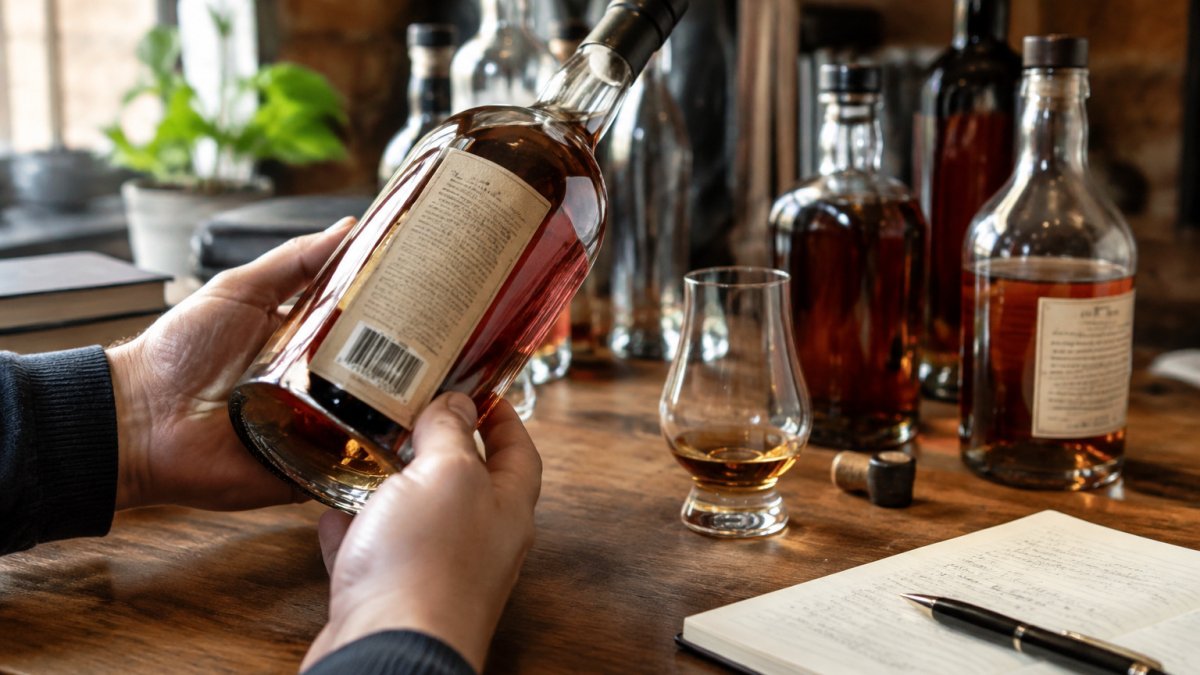
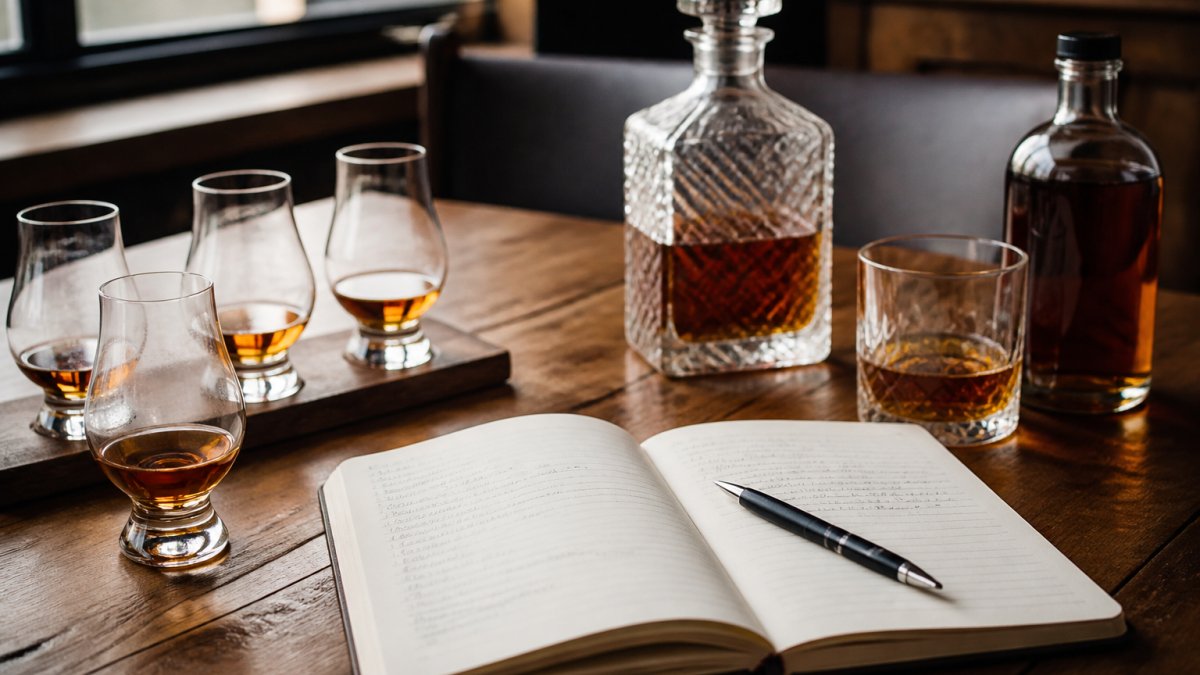
Writing by hand forces you to slow down and notice details you might miss typing, and keeps distractions away during a tasting.
Setup: Buy a notebook and create a simple template with fields for bottle name, date, nose, palate, finish, and rating (5 minutes). Workflow: Fill in each field by hand during or after tasting, and keep the notebook in one place.
Real trade-offs: No searchability (flip through pages to find a bottle), no backup (spilled drink = lost data), permanent handwriting (can't update old entries), and no way to compare bottles without manual cross-referencing.
Paper works best for: Tasting parties, collectors who prefer writing over screens, those building their first tasting habit, and collections under 20 bottles.
Spreadsheet-Based Tracking
A spreadsheet gives you searchability and analysis without app complexity. You can sort by proof, distillery, or rating, and use formulas to calculate averages.
Setup: Open Google Sheets or Excel and create columns for Bottle Name, Distillery, Proof, Age, Date Tasted, Price, Nose, Palate, Finish, Overall Rating, Style, and Notes (15-30 minutes).
Workflow: After each tasting, open the spreadsheet and fill in one row.
Real trade-offs: Requires upfront column decisions, searching is slower than apps, formulas take time to learn, manual data entry invites typos, and shared editing can cause conflicts.
Spreadsheet works best for: Collectors comfortable with Excel or Sheets, those wanting to analyze their own preferences, small teams sharing a list, and collections of 20-100 bottles.
Bourbon Collection Tracking App Solutions
Digital apps handle the heavy lifting: instant search, automatic organization by style, distillery, proof, or age, and no manual sorting.
Setup: Download an app, create an account, and fill in your profile using the built-in template (10-15 minutes). Data syncs to the cloud automatically.
Workflow: Open the app, tap "Add Tasting," fill in the fields (many apps have dropdown menus for common descriptors), and save. Search and filter happen instantly.
Real trade-offs: Depends on the app staying in business, learning curve for new interface, subscription fees ($2-$10/month or $20-$50/year), data privacy concerns, and limited customization.
Quick Comparison
| System | Setup Time | Searchability | Backup | Best Collection Size | Cost |
|---|---|---|---|---|---|
| Paper | 5 min | Manual (flip pages) | None | Under 20 | $5-$15 for notebook |
| Spreadsheet | 15-30 min | Sortable columns (filter/sort) | Manual (cloud save) | 20-100 | Free (Google Sheets, Excel) |
| Digital App | 10-15 min | Instant search & filter | Automatic | 50+ | Free-$50/year |
How to decide: Paper for under 15 bottles, spreadsheet for 20-100 bottles and pattern analysis, apps for 50+ bottles and instant multi-criteria search. Start simple and migrate later if needed.
Building a Bourbon Tasting Notes Template
A good template captures what matters without overwhelming you. The real power comes from using the same vocabulary and rating scale every time, so notes from six months ago remain meaningful.
Core Fields Every Template Needs
Start with: Bottle name, distillery, proof, age statement, date tasted, price paid, overall rating (1-10), and tasting context. These take 60 seconds to fill in and give you enough data to search and compare.
Capturing Aroma, Palate, and Finish with Consistent Vocabulary
The real detail comes in how the bourbon actually tastes. Break it into three parts:
Nose (aroma): What do you smell before tasting? Write down specific descriptors, not vague impressions.
Palate (taste): What flavors hit your tongue? Is it smooth or spicy? Sweet or dry?
Finish (aftertaste): What lingers after you swallow? Does it fade quickly or last?
Write short phrases, not essays. "Vanilla and caramel on the nose, spicy rye on the palate, long oak finish" tells you everything you need.
The consistency problem: Calling something "peppery" in one note and "spicy" in another makes comparison impossible. The solution: Create a personal flavor lexicon of 15-20 descriptors you'll use consistently. Here's a starter list:
Sweet notes: vanilla, caramel, honey, brown sugar, toffee, maple Spice: pepper, cinnamon, clove, rye spice, black pepper Fruit: apple, cherry, orange, stone fruit, dried fruit Wood: oak, cedar, walnut, charred wood Other: leather, tobacco, corn, grain, floral, herbal
Pick from this list when tasting. If a flavor doesn't fit, add it to your lexicon. When you search for "all bourbons with vanilla on the nose," you'll find every one because you used the same word every time.
Tasting Context: The Often-Missed Field
Where and how you taste a bourbon affects what you taste. Optional context fields include: glassware (Glencairn vs. rocks glass), dilution (neat or water), pour size, bottle condition (fresh or oxidized), and tasting environment. If a bourbon tastes different than your notes suggest, check the context, you might discover you always taste better in a Glencairn glass or that water opens up high-proof bourbons.
Calibrating Your Rating Scale
A rating system only works if you use it the same way every time. Define what each score means and write it down. Sample scale: 9-10 (top tier, buy again), 7-8 (very good, worth recommending), 5-6 (decent, okay for price), 3-4 (not for me), 1-2 (avoid).
The calibration trap: After 20 bourbons, your scale may drift.
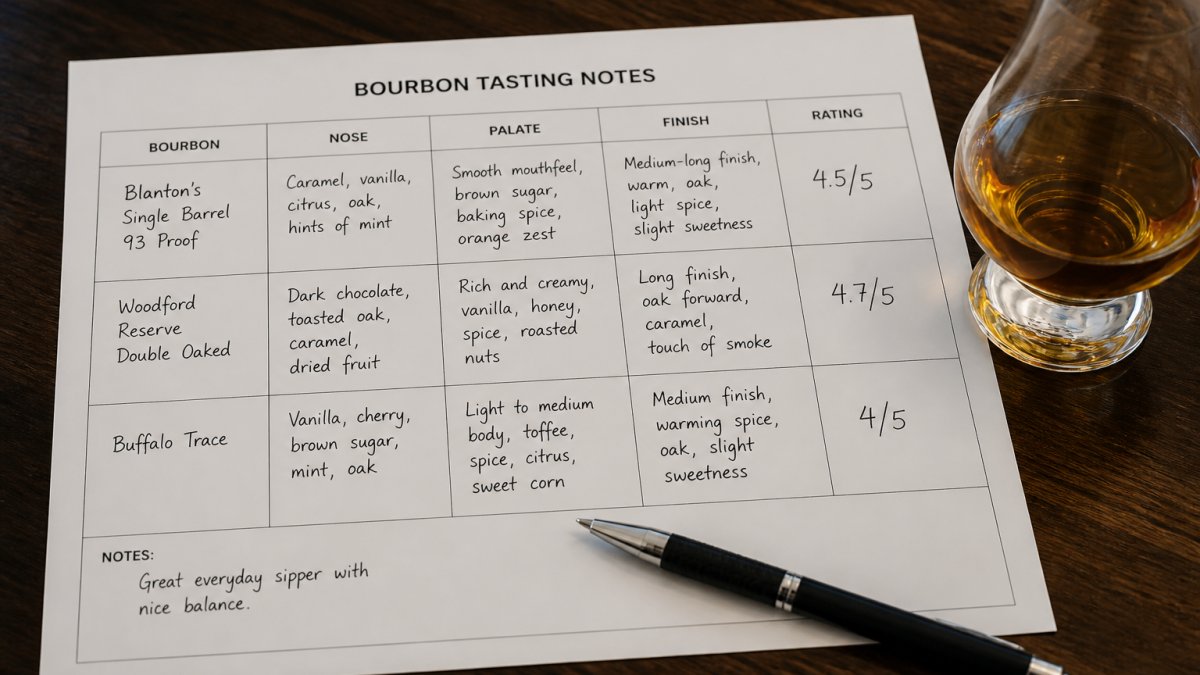
A Worked Example: How Consistency Works
Consistent vocabulary and context let you compare notes over time. Using the same descriptors (vanilla, caramel, apple, cherry, pepper, oak) and context (Glencairn, neat, home) across multiple tastings reveals patterns: Buffalo Trace is reliable, Four Roses offers more complexity at higher proof, and your palate prefers fruit-forward bourbons with spice.
Bourbon Tasting Notes Examples and What They Show
Real examples show what good notes look like and how they help you spot patterns.
Example 1: Buffalo Trace (90 proof, no age statement) Nose: Vanilla, caramel, light oak Palate: Sweet corn, smooth, medium spice Finish: Medium length, vanilla fade Rating: 7/10 Notes: Good everyday bourbon. Reliable flavor.
Comparing these two reveals what you actually prefer. The higher proof and age in the Four Roses created more complexity. If you consistently rate bourbons like that higher, you know to seek out higher-proof, age-stated bottles.
Implementing a Bourbon Rating System
A rating system lets you rank bottles and spot your favorites quickly. Consistency matters more than complexity.
Numeric Scoring and Star Ratings
Simple 1-10 scoring works. So does a 5-star system. Pick one and use it every time.
What each score means to you should stay consistent:
- 9-10: Top tier, buy again
- 7-8: Very good, worth the money
- 5-6: Decent, okay for the price
- 3-4: Not for me, probably won't repeat
- 1-2: Avoid
Write your definitions down so you remember them months later.
Flavor Profile and Aroma Categories
Tag each bourbon with its flavor family (fruity, spicy, sweet, woody), body (light, medium, full), and heat (smooth, medium spice, high spice). These tags let you search "Show me all fruity bourbons I rated 8+" and spot patterns in what you enjoy.
Organizing by Style, Distillery, Proof, and Age
Once you've captured tasting notes, organize them in ways that help you find and compare bottles.
Grouping by Bourbon Style and Category
Bourbon comes in distinct styles. Grouping by style makes it easy to explore what you like:
- High-rye bourbons, spicier, often more complex
- Wheated bourbons, smoother, sweeter, softer finish
- Single barrel, higher proof, more variation between bottles
- Bottled-in-bond, 100 proof minimum, at least 4 years old
- Small batch, blended from fewer barrels, consistent flavor
When you're in the mood for something spicy, you know exactly where to look.
Sorting by Distillery and Producer
Organizing by distillery shows which producers consistently match your palate. You might discover you prefer Wild Turkey's spice or Buffalo Trace's smoothness.
Tracking Proof, Age Statement, and Rarity
Proof shapes flavor (higher proof = bolder taste), and age statement shows barrel time. Note rarity for limited editions or hard-to-find bottles to decide whether to drink or hold.
Tagging, Searching, and Comparing Across Your Collection
With Bourbon Tracker™, tags let you find exactly what you want in seconds and reveal preferences (e.g., do high-rye bourbons consistently score higher?).
Keeping Your Tasting Notes Accurate and Consistent
Your notes only help if you trust them. Taste the same way every time (same glass, let bourbon sit a minute, drink water between tastings). Review old notes occasionally and update them as your palate develops. Back up your data (cloud storage for spreadsheets, automatic for apps). Update your rating system if it stops working (if everything falls between 6 and 8, adjust it). The best system is the one you'll actually use, start simple and add complexity only when needed.
Frequently Asked Questions
What should you include in bourbon tasting notes?
Your bourbon tasting notes should capture the bottle's identity (name, distillery, proof, age), your tasting observations (aroma, palate, finish), a personal rating, and context like the tasting date and food pairings. Include specific flavor descriptors rather than generic terms, for example, 'caramel and black pepper' instead of 'good taste.' Adding notes on bottle rarity, price, and whether you'd buy again helps when comparing across your collection.
How should you organize a bourbon tasting notes template?
Structure your bourbon tasting notes template with clear sections: header (bottle name, distillery, proof, age statement), sensory observations (nose/aroma, palate, finish), a rating scale (numeric or star-based), flavor tags, purchase and tasting date, and personal notes. Leave space for comparisons to other bourbons and shelf location. Whether you use paper or digital, consistency in field order makes it easy to review and compare notes later without confusion.
What's the difference between a bourbon rating system and tasting notes?
Tasting notes describe what you experience, specific flavors, aromas, and textures. A bourbon rating system assigns a score or rank based on your overall impression. Together, they work: your notes explain why you gave a bourbon a 7/10, while your rating lets you quickly sort and compare across your collection. Many collectors use numeric scores (1-10) or star systems alongside detailed flavor profiles to balance speed with depth.
How do I organize bourbon tasting notes if I have a large collection?
For large collections (100+ bottles), use a bourbon collection tracking app or spreadsheet with sortable columns for distillery, proof, age, style, and rating. Add tags for flavor profiles (spicy, sweet, smoky) and rarity level. Organize by style first (rye bourbon, wheated bourbon), then by distillery or proof within each category. Digital tools let you search and filter instantly, something paper notebooks can't match, making it feasible to manage and compare hundreds of entries without getting lost.
Organizing bourbon tasting notes transforms a casual hobby into something you can learn from. Whether you choose paper, spreadsheet, or digital tracking, the key is capturing what matters and reviewing it regularly. Bourbon Tracker™ makes this effortless with searchable notes, automatic organization by style and distillery, and AI recommendations based on your tasting history. Start tracking your collection today and discover patterns in your own palate that will guide your next purchases.