 how-to
Start Organizing Your Bourbon Collection Now
Table of Contents
- Why Organizing Your Bourbon Collection Matters
- Step 1: Assess Your Current Collection and Storage Space
- Step 2: Choose Your Organization Strategy
- Step 3: Implement Whiskey Storage Best Practices
- Step 4: How to Display Bourbon Bottles Effectively
- Step 5: Set Up the Best Bourbon Inventory App for Your Collection
- Step 6: Add Security and Valuation Tracking
- Common Mistakes to Avoid When Organizing Bourbon
Last Updated: August 13, 2026
Why Organizing Your Bourbon Collection Matters
A collection without structure is just a closet full of bottles. Once you move past casual drinking into collecting, you need a system to track what you own, remember what you've tasted, and make informed purchasing decisions. Organization protects your investment by maintaining proper storage conditions, makes your collection useful by enabling informed buying decisions, and connects you to the broader bourbon community through shared tasting data.
The good news: organizing a bourbon collection doesn't require expensive equipment or complicated spreadsheets. This guide walks you through building a system that works for your collection size, space, and collecting goals.
Step 1: Assess Your Current Collection and Storage Space
Count your bottles to determine your collection's scale. This changes your approach entirely, whether you're managing 10-15 bottles or 100+.
Evaluate your storage space and climate conditions. Temperature stability matters more than absolute temperature; a closet that stays between 60-70 degrees year-round is better than a room that fluctuates. Humidity should ideally stay between 30-50 percent. Extreme dryness shrinks corks and allows oxidation; excessive moisture damages labels and corrodes caps. Direct sunlight accelerates oxidation and alters flavor profiles.
Document your current system. Are bottles scattered across multiple locations? Do you have any record of tasting impressions? Understanding where you are now prevents building a system that doesn't fit your actual habits.
Step 2: Choose Your Organization Strategy
The best system matches how you actually think about and use your collection. Most collectors use one of three primary strategies, often combined.
Organize by Distillery
Grouping bottles by source distillery creates a natural taxonomy. This works well if you're a distillery enthusiast collecting across a brand's range to understand how different mash bills, ages, and proofs express the distillery's character. You see your distillery preferences at a glance but must hunt across multiple sections to find a specific proof or age.
Organize by Proof or Age Statement
This approach groups bottles by strength or age designation. All cask strength bottles together. All 4-year expressions in one area. This appeals to collectors who understand how proof and age fundamentally change the drinking experience. You gain immediate access to what you want to drink but fragment distilleries across multiple zones.
Organize by Tasting Profile
Some collectors organize by flavor characteristics: high rye vs. wheated, or by dominant tasting notes like fruit-forward or spice-heavy. This is the most subjective approach but often the most practical for daily drinking decisions. Your collection becomes a reference library for your palate, though tasting profiles are inherently subjective.
Most serious collectors use a hybrid approach: primary organization by distillery, secondary sorting by proof or age within each distillery section. This gives you the best of both worlds.
Step 3: Implement Whiskey Storage Best Practices
Physical storage conditions directly impact how your bourbon ages and preserves.
Vertical Storage and Sealed Bottles
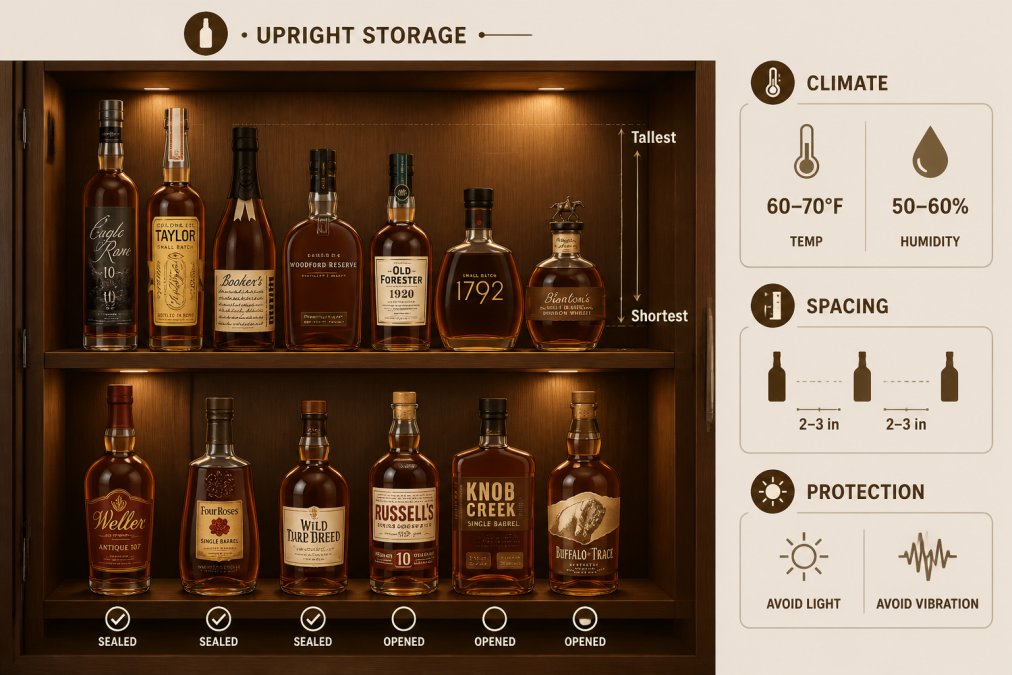
Store sealed bottles upright, not on their side. Bourbon doesn't benefit from cork contact with liquid; extended contact can degrade the cork and increase oxidation risk. Upright storage keeps the cork dry and minimizes air exposure. Use a storage rack designed for spirits to keep bottles stable and accessible.
Temperature, Humidity, and Light Control
Temperature stability matters more than absolute temperature. A closet that stays between 60-70 degrees year-round is better than a room that fluctuates between 50 and 80. Humidity should ideally stay between 30-50 percent. A basic hygrometer costs under $15 and takes the guesswork out of monitoring.
Light is the most underestimated factor. UV light degrades bourbon faster than time alone. Store bottles in a dark space or use UV-filtering glass doors on display cabinets. Position them away from windows and use warm lighting that doesn't include UV wavelengths.
Managing Open vs. Sealed Bottles
Sealed bottles can sit indefinitely if stored properly. Once you break the seal, oxidation begins immediately. Track which bottles are open and prioritize drinking them. Some collectors use a "first in, first out" rotation; others maintain a separate "open bottle section." For bottles you're not actively drinking, consider transferring small amounts to smaller bottles to minimize air exposure.
Step 4: How to Display Bourbon Bottles Effectively
Display and storage aren't the same thing. Storage prioritizes preservation; display prioritizes visibility and aesthetics while maintaining reasonable storage conditions.
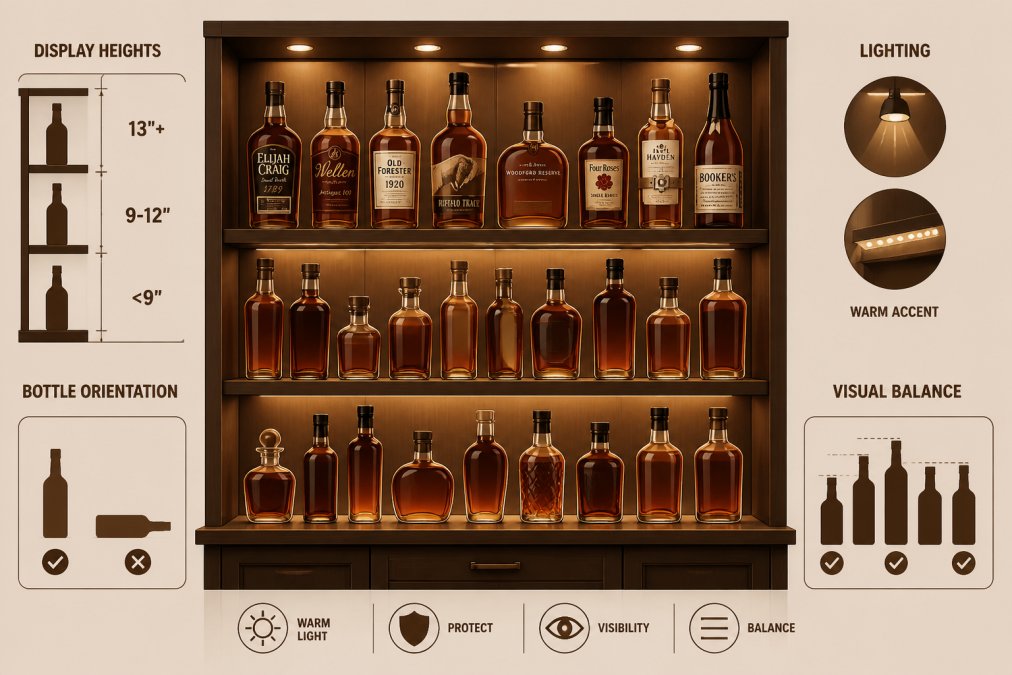
Use a cabinet with glass doors and interior lighting. This protects bottles from dust and light while keeping them visible. Avoid direct sunlight and position the cabinet away from heat sources that cause temperature fluctuations.
Arrange bottles by your chosen organization system while considering visual balance. Vary bottle heights and colors. Position bottles so you can read labels without turning them. Keep your most-reached-for bottles at eye level; rare or special bottles can go higher or lower.
Step 5: Set Up the Best Bourbon Inventory App for Your Collection
A digital inventory system transforms your collection from a physical arrangement into a searchable database. Bourbon Tracker™ is purpose-built for this. It's a free platform with no download required, designed specifically for bourbon and whiskey collectors. You log your bottles once, and the platform handles organizing by distillery, proof, age, or any custom category. It integrates tasting notes, batch information, and recommends new bottles based on your preferences.
What to Log in Your Digital Inventory
Capture these core details: distillery, expression name, proof, age statement, and purchase date. Log the batch number if tracking limited releases, as bourbon varies between batches. Add the price you paid for insurance purposes and to understand your collecting patterns.
Tracking Tasting Notes and Batch Information
After you open a bottle, log your impressions: the nose, the palate, the finish, and overall rating. These notes create a searchable database of your palate preferences. Over time, your tasting notes reveal patterns about your preferences.
Bourbon Tracker™ analyzes your tasting notes and ratings, then suggests new bottles you're likely to enjoy based on distillery, proof, mash bill, and flavor profile. Batch information adds another layer; if you've tried multiple batches of the same expression, your notes reveal how batch variations affect taste.
Step 6: Add Security and Valuation Tracking
As your collection grows in size and value, security and insurance become real concerns. Store your collection in a locked cabinet or closet. For larger collections, consider a dedicated locked cabinet or safe.
Log the market value of each bottle when you acquire it. This creates a snapshot of your collection's total value at any point in time. Photograph your collection and store photos separately from your home for insurance documentation.
Update valuations periodically. Bourbon prices fluctuate; tracking these changes helps you understand market trends and make better purchasing decisions. Bourbon Tracker™ integrates valuation tracking directly into your inventory, giving you a real-time picture of your collection's total value.
Common Mistakes to Avoid When Organizing Bourbon
The biggest mistake is organizing without a system. Start with a clear organizational method before arranging bottles. Ignoring storage conditions is the second mistake; prioritize preservation over aesthetics. Many collectors fail to track opened bottles and forget their impressions. Overcomplicating the organization system is another trap; the best system is one you'll actually maintain. Finally, treat your inventory system as an ongoing process, not a one-time setup. Add new bottles as you acquire them and update tasting notes as you drink.
Organizing your bourbon collection transforms it from a random assortment of bottles into a curated asset you can understand, track, and enjoy strategically. The physical organization creates the foundation; the digital layer turns that collection into a tool for discovery and decision-making.
Bourbon Tracker™ handles the digital layer for you. It's designed specifically for collectors who want to track their bottles without the complexity of spreadsheets or the friction of downloads. Start organizing your bourbon collection now with a free account, log your bottles once, and let the platform handle recommendations, inventory management, and community connection. [CTA: Track My Collection]
Frequently Asked Questions
What's the best way to organize my bourbon collection if I have over 150 bottles?
With a large collection, choose one primary organization method (distillery, proof, or tasting profile) and stick with it consistently. Use a best bourbon inventory app to track your bottles digitally, this is essential at scale. Divide your physical storage into sections by your chosen method, then use the app to cross-reference bottles, batch numbers, and tasting notes. Many collectors find that categorizing by distillery first, then proof within each distillery, prevents confusion and makes rotation easier as you add new bottles.
Should I store my bourbon bottles upright or on their side?
Store sealed bottles upright. Unlike wine, bourbon's high alcohol content won't degrade the cork over time, and vertical storage saves space and makes labeling easier. Open bottles should also stay upright to minimize oxidation and prevent cork deterioration. Horizontal storage is unnecessary and wastes valuable shelf space in your collection display.
How do I keep my bourbon collection organized as it grows?
Start with a digital inventory system now, before your collection expands further. Log each bottle with distillery, proof, age statement, batch number, and purchase date. Use a best bourbon inventory app that allows you to add tasting notes and set reminders for bottles you want to try. Review your physical arrangement quarterly and adjust labeling as needed. This prevents duplicate purchases and keeps your curated collection intentional rather than chaotic.
What environmental factors matter most for long-term bourbon preservation?
Temperature stability is critical, aim for 55-65°F with minimal fluctuation. Humidity should stay between 40-60% to prevent cork degradation and label damage. Keep bottles away from direct UV light, which causes oxidation and fading. Store in a dark cabinet or display case if possible. Avoid basements prone to moisture or attics with temperature swings. Proper storage extends shelf life significantly and protects your investment in rare or aged bottles.
This article was written using GrandRanker