 how-to
How to Identify Authentic Vintage Bourbon Labels
Table of Contents
- Why Authentic Vintage Bourbon Labels Matter to Collectors
- How to Date Old Whiskey Bottles Using Label Clues
- Authentic vs. Reproduction Whiskey Labels: Spotting the Difference
- Vintage Bourbon Label Examples That Show Key Details
- Physical Inspection: Paper, Ink, and Bottle Consistency
- How Collectible Bourbon Bottle Value Ties to Label Authenticity
- Conclusion: Building Confidence in Your Vintage Finds
- Frequently Asked Questions
Last Updated: October 8, 2026
Why Authentic Vintage Bourbon Labels Matter to Collectors
A vintage bourbon label is the closest thing a bottle has to a birth certificate. It records who made the whiskey, where it was distilled, how strong it was, and roughly when it left the warehouse.
This guide walks through how to read those clues. We'll cover dating bottles, spotting reproductions, and checking a label against the bottle it sits on.
The stakes are real. A faded label can add serious value to a bottle, and a fake one can wipe that value out overnight. Most guides focus on terminology. Fewer explain how to prove a label is genuine.
That gap is the whole point here.
How to Date Old Whiskey Bottles Using Label Clues
Dating old whiskey bottles means reading the label like a document, not decoration. Every stamp, phrase, and font choice reflects the rules and design trends of its era. The goal is to bracket a bottle into a date range using verifiable regulatory clues, then narrow it with design evidence.
Start with the three clues that narrow a date fastest:
- Tax stamps on the cap or neck
- Government warning text on the back label
- Typography and logos that match a known design period
Get one of these right and you've usually cut decades off your estimate. Get two and you can often pin a bottle to a five-year window.
Tax Stamps and Government Warnings
Tax stamps are often the single most useful dating tool on a vintage bottle. The TTB distilled spirits labeling guidance explains how modern labels are regulated; older stamps followed earlier rules, and the wording, color, and placement shifted with each update.
Use these milestones as brackets, not exact dates:
- Pre-1920 (pre-Prohibition): Many bottles carry no federal tax stamp at all. State and local stamps, if present, vary widely. Labels lean on ornate type and distillery seals.
- 1933 to mid-1930s (post-Repeption): Federal tax stamps reappear quickly after Repeal. Early stamps often show the bottler's name, the distilled spirits plant (DSP) number, and a serial number.
- 1940s to 1960s: Stamp formats stabilize. Look for "Series" designations, the DSP number printed on the stamp, and the phrase "Bottled by" paired with a city and state.
- 1970s to mid-1980s: Stamps become less common as the federal government shifted enforcement. Many bottles in this window rely on label wording alone for dating.
- Late 1980s onward: The government warning statement becomes mandatory on all alcohol beverage labels. Its exact wording and capitalization are fixed, and any deviation is a red flag.
The government warning is the other anchor. Its exact wording and placement became mandatory in the late 1980s. A bottle with no warning and no stamp usually points to an earlier era, but confirm with typography before committing to a date.
Typography, Logos, and Design Shifts
Font styles and logo marks change on a schedule. Distilleries rebranded after Prohibition, again in the mid-century, and again in the 1970s and 80s. Treat typography as a second, independent dating clock.
Look for these shifts:
- Serif fonts and ornate borders on pre-Prohibition labels
- Simpler, blockier type in the post-Prohibition decades
- Registered trademark symbols that match a company's known filing dates
- Brand names spelled in ways the distillery later dropped
- Paper stock and printing method (letterpress, lithography, offset) that match the era
A label that mixes eras is a red flag. So is a font that didn't exist when the whiskey was made. Cross-check the type against a known design reference for the decade before you trust it.
Building a Dating Timeline You Can Defend
A single clue is a guess. Three clues that agree are a defensible date range. Use this sequence:
- Bracket with regulation. Tax stamp presence, stamp format, and government warning wording give you a hard outer range.
- Narrow with typography. Match the font, logo, and layout to a known design period inside that bracket.
- Confirm with content. Check the proof statement, age statement, and bottler wording against what the distillery actually used in that window.
- Cross-check with the bottle. Glass color, embossing, closure type, and any mold seams should fit the same window.
If two of the four steps disagree, treat the date as unresolved and note the conflict. A confident date range with documented reasoning is worth more than a precise date you can't support.
Authentic vs. Reproduction Whiskey Labels: Spotting the Difference
Reproduction whiskey labels usually fail on paper and print quality, not on wording. Fakes often get the text right and the materials wrong.
Here's what separates the two:
| Clue | Authentic Label | Reproduction Label |
|---|---|---|
| Paper | Aged, uneven tone | Uniform, bright, or artificially stained |
| Ink | Slight fade, matte finish | Glossy, crisp, modern print |
| Edges | Worn, glued, lifting | Sharp, machine-cut, flat |
| Typography | Period-correct fonts | Slightly off spacing or weight |
| Adhesive | Old glue residue | Fresh, clean backing |
The table above is your first pass. Physical inspection confirms it.
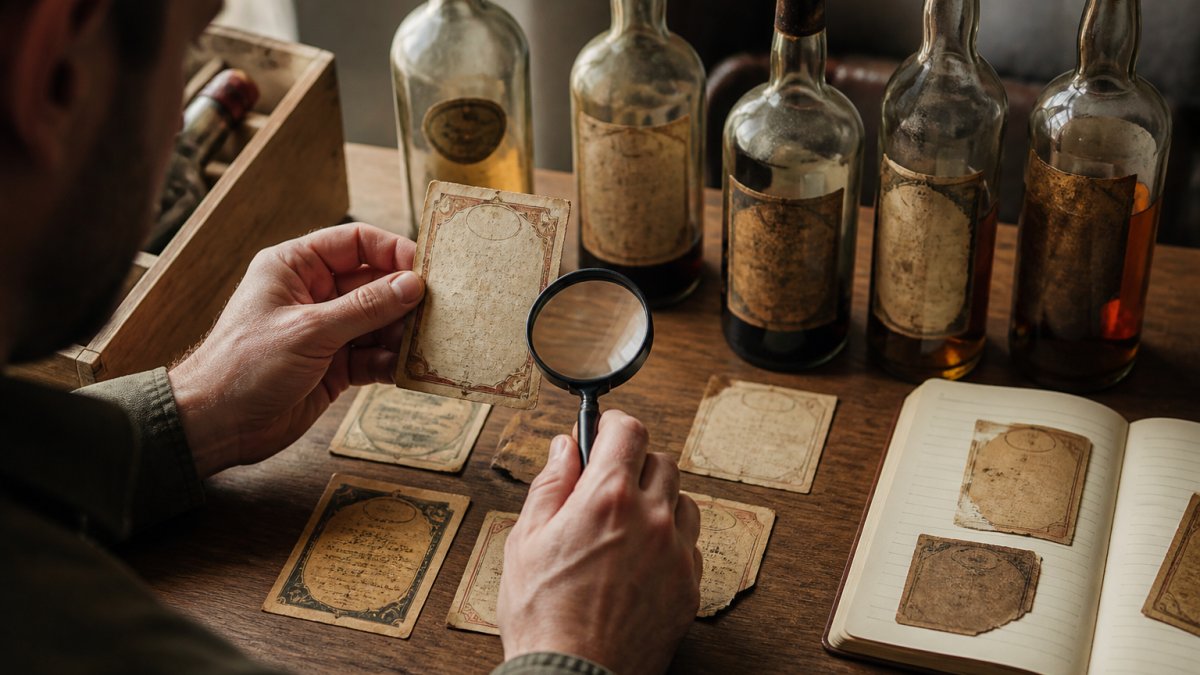
Vintage Bourbon Label Examples That Show Key Details
Real vintage bourbon label examples teach faster than any checklist. Look at how a genuine label handles three things at once: the proof statement, the age statement, and the producer name.
On an authentic label, these details line up:
- The proof statement matches the era's standard strengths
- The age statement uses wording the distillery actually used
- The producer and bottler names are consistent with known company history
When one detail drifts, the whole label deserves a second look. A proof number that doesn't fit the period is often the first crack.
Physical Inspection: Paper, Ink, and Bottle Consistency
Physical inspection is where most reproductions fall apart. Paper, ink, and glass don't age the same way, and fakes rarely match all three. The goal is to gather independent evidence from each material and see whether the stories agree.
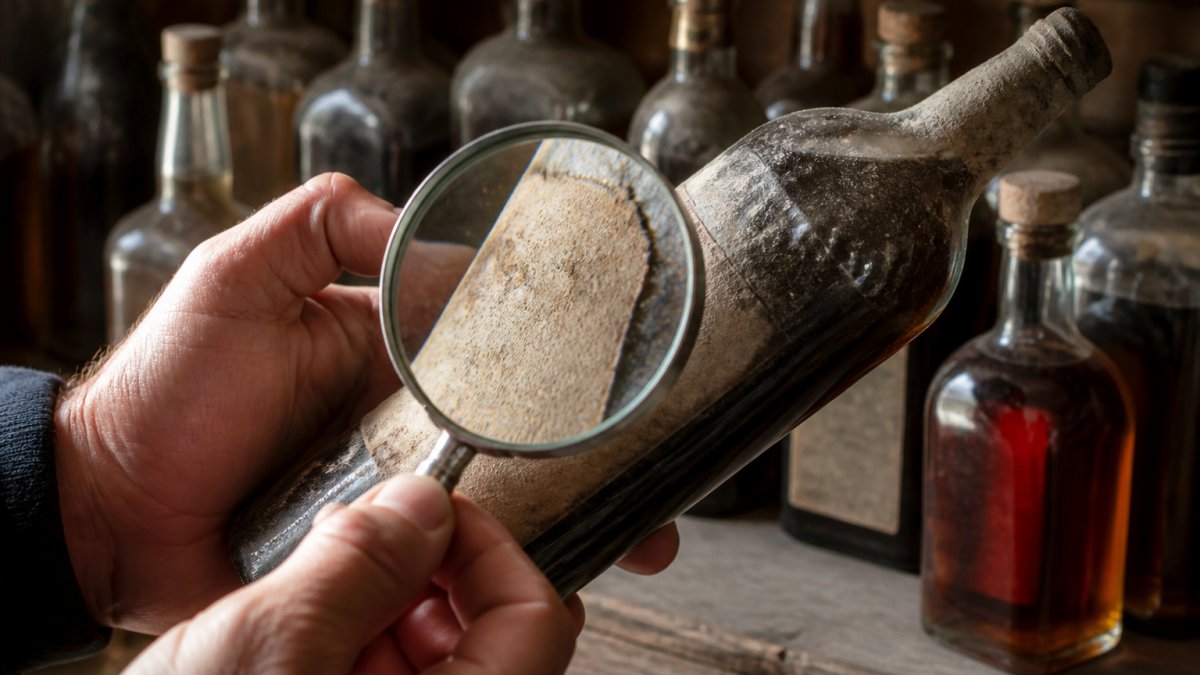
Run through these checks in order, and record what you see at each step.
- Feel the paper. Old paper is brittle and slightly rough, and it often shows foxing, small brown spots from age-related oxidation. New paper feels smooth and flexible. Artificially aged paper often feels uniformly stiff or has been stained with tea or coffee, which leaves an even tone instead of the uneven, edge-heavy yellowing real age produces.
- Check the ink under light. Vintage inks sit on the surface with a matte finish and often show slight haloing or feathering at the edges. Modern inks look flat and even, and laser-printed reproductions can show a faint sheen or toner speckle under raking light. Hold the label at an angle to a lamp and look for the difference.
- Inspect the edges. Genuine labels show glue lines, lifting corners, and small tears that follow the grain of the paper. Machine-cut reproductions have sharp, uniform edges with no glue residue. Look at the underside of a lifted corner, old adhesive is usually yellowed and brittle, not clean and tacky.
- Match label to bottle. The label's era should fit the bottle shape, glass color, and embossing. A pre-Prohibition label on a mid-century bottle is a mismatch. Check mold seams, base embossing, and closure type against the same date range you built from the label.
- Look for mismatched wear. A worn bottle with a perfect label is a warning sign. Wear should be consistent: if the glass is scuffed and the label is pristine, one of them is not original.
Label-to-Bottle Consistency Checks
Label-to-bottle consistency is the step most buyers skip. It's also the one that catches the most fakes. Compare these features side by side:
- Bottle shape and capacity. Bourbon bottles changed shape and size with each era. A label that claims a pre-Prohibition date on a bottle with a mid-century silhouette deserves scrutiny.
- Glass color and embossing. Embossed distillery names, DSP numbers, and capacity marks should match the label's claimed producer and era.
- Closure type. Cork, screw cap, and crown cap each dominated different decades. A cork-finished bottle with a 1970s label is possible but worth verifying.
- Tax seal or strip. If the label implies a tax stamp era, the bottle should show evidence of one, residue, a partial stamp, or a clean patch where one was removed.
- Known production history. Cross-check the producer and brand against public distillery records. If the company didn't exist in the claimed year, the label is wrong regardless of how good the paper looks.
Confidence Levels and Limits of Identification
Not every bottle can be confirmed. Separate what you know from what you're estimating:
- Confirmed: Regulatory clues, bottle markings, and production records all agree.
- Probable: Two of three agree, with one ambiguous clue.
- Possible: Only one clue supports the date, or the label is damaged.
- Unresolved: Clues conflict, or the label is detached and cannot be tied to the bottle.
State your confidence level when you document a bottle. A probable date with clear reasoning is more useful to a future buyer or insurer than an overclaimed certainty.
Safe Handling and Documentation
Fragile labels lose evidence every time they're handled. Before you inspect further:
- Photograph the label, tax stamp, bottle base, and closure together in one frame, then in close-ups.
- Use cotton gloves and support the bottle from the base, not the neck.
- Store bottles upright, out of direct light, in stable temperature and humidity.
- Keep a written log of where and when you acquired the bottle, and any prior owner information.
That record is what turns a bottle into a documented collectible, and it's what supports later verification if you sell or insure it.
How Collectible Bourbon Bottle Value Ties to Label Authenticity
Collectible bourbon bottle value depends on more than the whiskey inside. Provenance, condition, and label authenticity drive the price as much as age.
A verified label does three things:
- Confirms the bottle's production history
- Supports its provenance when you sell or insure it
- Protects resale value if the market shifts
Document everything. Photograph the label, stamp, and bottle together. Keep notes on where and when you bought it. This record is what turns a bottle into a collectible.
Conclusion: Building Confidence in Your Vintage Finds
Identifying authentic vintage bourbon labels takes patience, but the process is repeatable. Date the bottle, check the paper and ink, and confirm the label matches the glass.
That's where a system helps. Bourbon Tracker™ is a free, no-download platform built for collectors who want to log every bottle, store tasting notes, and track a wishlist in one place. Our AI-powered recommendations help you discover new bottles for your palate, and community features let you compare notes with other collectors.
Get started with Bourbon Tracker™ and keep every bottle, note, and label detail organized from day one.
Frequently Asked Questions
How do you tell how old a bottle of bourbon is?
Check the label for a tax stamp, which was required until 1985, and note its design. Look for an age statement, proof, and the DSP number. Bottle shape, glass color, and embossing also help date it. Cross-reference with known distillery production years and label design changes.
Can you tell if a bourbon label is authentic or a reproduction?
Authentic labels show age-appropriate paper yellowing, ink fading, and printing methods like letterpress. Reproductions often have sharp, modern printing, uniform coloring, and incorrect historical details. Check for misspellings, wrong fonts, or anachronistic logos. Physical wear on the bottle should match the label's condition.
Do tax stamps help date vintage bourbon bottles?
Yes. Tax stamps were mandatory on distilled spirits from 1868 until 1985. The stamp's design, color, and wording changed over time, providing a reliable date range. For example, stamps with 'Series 112' were used from 1944 to 1960. Always verify the stamp against known reference guides.
How much is a 50-year-old bottle of whiskey worth?
Value depends on brand, rarity, condition, and provenance. A sealed bottle from a closed distillery can fetch hundreds or thousands. Check auction results for similar bottles, but note that label authenticity and fill level greatly affect price. Consult a professional appraiser for high-value items.