 how-to
How to Properly Store Open Bourbon Bottles: 2026 Guide
Table of Contents
- Why Storing Open Bourbon Correctly Matters
- Bourbon Oxidation Explained: What Happens After You Open the Bottle
- How Long Does Bourbon Last Once Opened?
- Step-by-Step: How to Properly Store Open Bourbon Bottles
- Best Whiskey Preservation Tools and Sealing Techniques
- Travel and Temporary Storage: Keeping Bourbon Safe on the Move
- Common Mistakes to Avoid When Storing Open Bourbon
- Frequently Asked Questions
Last Updated: September 16, 2026
Why Storing Open Bourbon Correctly Matters
Once you crack the seal on a bottle of bourbon, the clock starts ticking. This guide from Bourbon Tracker™ covers how to properly store open bourbon bottles so the last pour tastes as good as the first. Bourbon is a distilled spirit, but it is not indestructible. Oxygen, light, and heat all work against the volatile compounds that give a whiskey its character.
The mistake most collectors make is treating an open bottle like a sealed one. A sealed bottle can sit for years with minimal change. An open bottle begins interacting with its environment the moment air enters. According to the TTB's distilled spirits labeling guidance, bourbon must be stored at no less than 40% alcohol by volume to retain its designation, which hints at how much the spirit depends on its chemical makeup staying intact.
Bourbon Oxidation Explained: What Happens After You Open the Bottle
Bourbon oxidation is the chemical reaction between oxygen and the volatile compounds in the spirit. It softens sharp edges at first, then gradually strips away the aromas that define a good pour. Understanding the sequence matters, because the changes are not uniform, some notes vanish while others take over.
The Chemistry, in Plain Terms
Bourbon is roughly 60% water and 40% ethanol by volume at bottling strength, plus a small fraction of congeners, the flavor compounds pulled from the barrel. The key players:
- Ethanol evaporates faster than water. Over months, an open bottle slowly loses proof. A 100-proof bourbon can drop several points over a year in a warm, poorly sealed bottle.
- Vanillin (the vanilla note from toasted oak) is relatively stable but degrades with prolonged oxygen exposure.
- Oak lactones (the coconut and dill notes common in bourbon) are among the first to fade.
- Fruity esters, the apple, banana, and cherry notes, are highly volatile and disappear fastest.
- Tannins and wood sugars oxidize into heavier, flatter compounds that read as cardboard or stale tea.
What Fades First vs. What Intensifies
In practice, most tasters notice a predictable arc:
- Weeks 1-4: The pour often improves. A little oxygen rounds off harsh ethanol edges and opens up aromatics. This is why some drinkers decant a pour and let it sit before tasting.
- Months 2-6: Bright fruit esters and delicate floral notes start to mute. The whiskey tastes narrower.
- Months 6-12: Oak lactones fade, vanillin softens, and the finish shortens. What remains is often a heavier, sweeter, flatter profile dominated by caramel and wood tannins.
- Beyond 12 months: The spirit is still safe to drink but reads as dull and one-dimensional. In extreme cases, oxidation produces a faint sherry-like or vinegar-adjacent note from acetaldehyde buildup.
Temperature swings accelerate every stage, because thermal expansion pushes air in and out through a compromised seal. A bottle stored near a kitchen window can age the equivalent of a year in a few months.
Why Proof Matters
Higher-proof bourbons resist oxidation slightly better because ethanol is a preservative and the higher alcohol concentration slows microbial and chemical degradation. Lower-proof bottles, especially those bottled at 80 proof, tend to flatten faster. This is one reason a cask-strength bottle can sit open longer than a standard 80-proof expression without tasting tired.
How Long Does Bourbon Last Once Opened?
An open bottle of bourbon stays drinkable for years, but peak flavor fades within six to twelve months. The spirit will not spoil like wine, but it will taste flatter and less complex.
Several factors shift that timeline:
- Fill level: A bottle that is two-thirds full holds up far better than one with an inch left.
- Seal quality: A tight cork slows evaporation; a loose one speeds it up.
- Storage conditions: Cool, dark, and stable beats warm and bright every time.
- Bottle material: Glass is inert; some decanters are not.
For most collectors, a bottle opened and stored well tastes close to its original self for about a year. Past that, expect muted aromatics.
Step-by-Step: How to Properly Store Open Bourbon Bottles
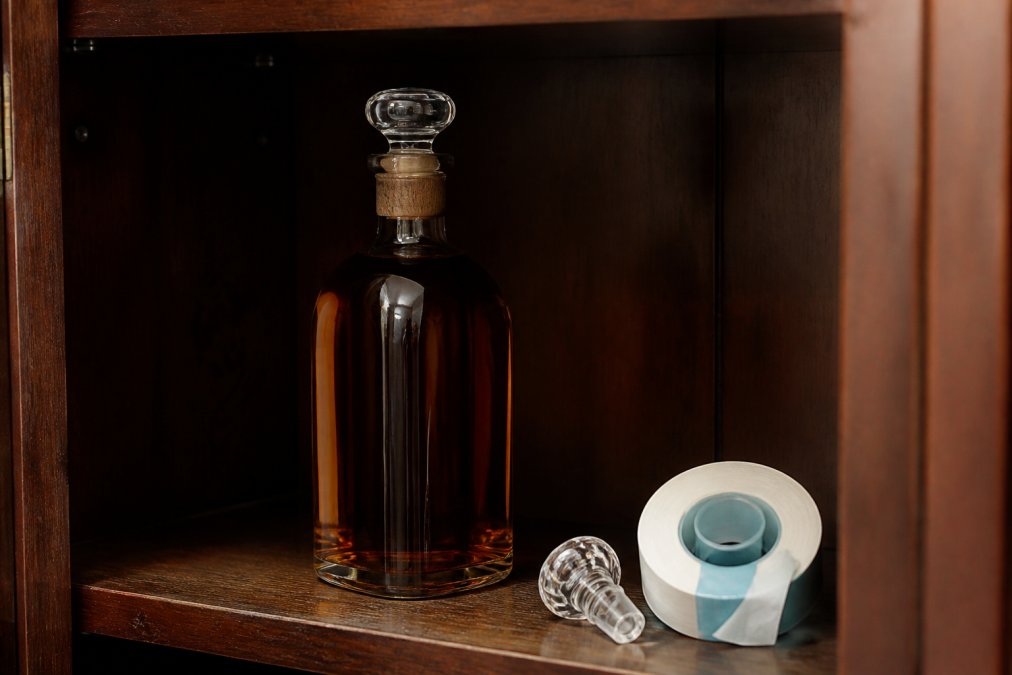
Follow these three steps and you will protect the flavor of every open bottle in your collection.
Step 1: Keep Bottles Upright and Out of Direct Sunlight
Store bottles in an upright orientation at all times. Laying a bottle on its side exposes the liquid to the cork for extended periods, which accelerates cork degradation and can leach off-flavors into the spirit.
UV light exposure is the other enemy here. Sunlight breaks down the organic compounds in bourbon and can turn a bright, oaky pour into something dull and cardboard-like. Keep bottles in a cabinet, closet, or dark shelf away from windows.
Step 2: Control Temperature and Minimize Fluctuations
Aim for a stable ambient temperature between 60 and 70°F. Consistency matters more than the exact number.
Every temperature swing causes thermal expansion inside the bottle. The liquid expands, pushes air out, then contracts and pulls fresh air back in through the seal. That cycle speeds up oxidation and drives off aromatics. Basements, interior closets, and lower cabinets are ideal because they hold temperature well.
Step 3: Reduce Headspace and Seal the Bottle
Headspace is the air gap between the liquid and the cork. The more headspace, the faster oxidation proceeds.
When a bottle drops below half full, consider moving the remaining whiskey into a smaller vessel. A clean 375ml bottle or a properly sealed decanter limits the air the spirit is exposed to. Always check seal integrity before shelving a bottle. If the cork feels loose, replace it or add a sealing layer.
Best Whiskey Preservation Tools and Sealing Techniques
The best whiskey preservation tools do one thing well: they keep air and light away from the spirit. Here is how the main options compare.
| Tool | What It Does | Best For | Limitation |
|---|---|---|---|
| Parafilm | Wraps the neck and cap to block air | Short-term sealing | Not reusable after removal |
| Glass stopper | Replaces a worn cork | Bottles with degraded corks | Must fit the neck precisely |
| Inert gas spray | Displaces oxygen with argon | Bottles under half full | Needs reapplication |
| Smaller decanter | Cuts headspace volume | Long-term storage | Some decanters leach lead |
Parafilm, Decanters, and Inert Gas: What Actually Works
Parafilm is a stretchable laboratory film that wraps tightly around a bottle neck and cap. It creates an airtight barrier that slows evaporation and blocks oxygen. It is cheap, fast, and effective for bottles you plan to revisit within a few months.
Decanting into smaller vessels is the most underused technique in home storage. Moving whiskey into a 375ml bottle cuts headspace dramatically. The catch: choose lead-free glass. Some older or decorative decanters can leach lead into the spirit over time, especially with high-proof whiskey.
Travel and Temporary Storage: Keeping Bourbon Safe on the Move
Moving a bottle or packing one for a trip requires different handling than shelf storage. The goal is to prevent leaks, light exposure, and temperature shock.
Common Mistakes to Avoid When Storing Open Bourbon
Most storage failures come down to a handful of avoidable errors. Here are the ones that cost collectors the most.
- Storing bottles on their side. This keeps liquid against the cork, which degrades it and can taint the whiskey.
- Leaving bottles in direct sunlight. UV light destroys aromatics faster than almost anything else.
- Keeping whiskey above the stove or fridge. Heat and vibration both accelerate oxidation.
- Ignoring a loose cork. A worn cork lets air in constantly. Replace it or seal over it.
- Using a reactive decanter. Leaded crystal can leach into the spirit over months of contact.
- Forgetting to log what you opened. Without a record, bottles sit half-empty for years.
Frequently Asked Questions
Should I refrigerate bourbon after opening?
No. Refrigeration slows oxidation slightly but causes the bourbon to cloud and mutes the volatile compounds that carry aroma and flavor. A cool, dark cabinet between 60-70°F is better. Only chill bourbon right before drinking if you prefer it that way, then return the bottle to its normal storage spot.
How long does bourbon last once opened?
An open bottle keeps its best flavor for about 6 to 12 months if it is more than half full. Once the fill level drops below a quarter, oxidation accelerates and you have roughly 3 to 6 months before the flavor profile flattens. Higher-proof bottles hold up longer because alcohol is a natural preservative.
Does sunlight affect the quality of open bourbon?
Yes. UV light exposure breaks down volatile compounds and can make bourbon taste dull or cardboard-like over time. Store bottles in a cool dark place such as a closed cabinet, closet, or basement shelf. Amber glass slows UV damage but does not stop it, so direct sun is never a good idea.
Should bourbon bottles be stored upright or on their side?
Always store bourbon upright. High-proof spirit contacts the cork and can degrade it, and cork particles can leach into the liquid. Upright orientation also limits the surface area exposed to oxygen in the headspace, which slows oxidation and helps preserve the flavor profile.
Storing open bourbon well comes down to three habits: keep it upright and dark, hold the temperature steady, and limit the air it touches. Bourbon Tracker™ helps you stay on top of every open bottle with AI-powered recommendations, organized tasting notes, and a wishlist you can manage from any device. Get started with Bourbon Tracker™ and keep every pour tasting the way it should.