 how-to
Easy Ways to Categorize Whiskey: A Practical Guide
Table of Contents
- Why Categorizing Your Whiskey Collection Matters
- Categorize Whiskey by Geographic Region
- Organize by Ingredients and Mash Bill
- Distillation Techniques and Spirit Character
- Best Tools for Whiskey Collectors to Track Your System
- Whiskey Tasting Notes Template for Your Collection
- Whiskey Storage Best Practices to Preserve Your Bottles
- Categorize by Flavor Profile and Sensory Experience
Last Updated: August 17, 2026
Why Categorizing Your Whiskey Collection Matters
Without a system, you'll lose track of what you own, forget tasting notes on bottles you loved, and struggle to remember why you bought that particular expression. Categorizing your whiskey collection transforms it from a random assortment into an organized resource that enhances your tasting experience.
When you categorize whiskey by geography, flavor profile, production method, or price point, you create a framework for understanding your palate. You start to see patterns: maybe you consistently prefer heavily peated Scotch over lighter expressions, or perhaps bourbon with higher rye content appeals to you more than wheated versions. These insights let you make smarter purchasing decisions and discover new bottles you'll actually enjoy.
Without a system, your collection becomes a source of frustration. You can't remember which bottles are worth opening versus which should age longer. You duplicate purchases because you forgot you already owned something similar. Collectors with organized systems enjoy their collections far more and spend less money on regrettable purchases.
Categorize Whiskey by Geographic Region
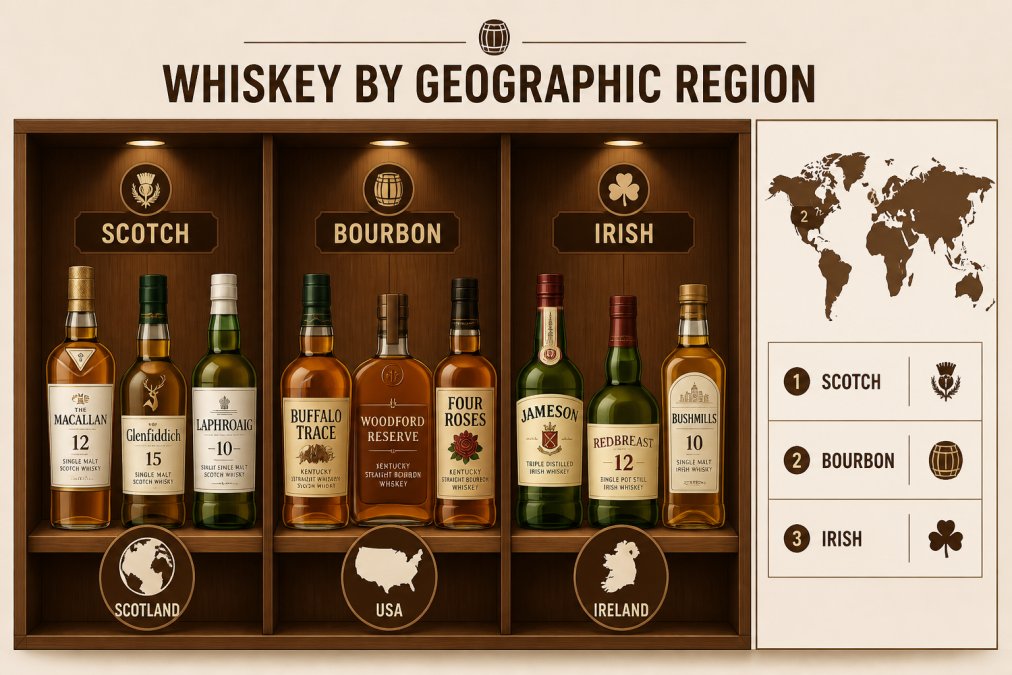
Geography matters in whiskey production. Different regions have distinct regulations, water sources, peat availability, and production traditions that shape the final product. Organizing by region is the most common approach because it reflects how the industry itself is structured.
Scotch Whisky Overview
Scotch whisky must be produced in Scotland, aged for at least three years in oak casks, and distilled from malted barley. Scotch varies dramatically by region. Highland Scotch tends toward fuller body and sometimes peat smoke. Speyside Scotch typically emphasizes fruit and spice notes with lighter body. Islay Scotch is famous for intense peat smoke and briny, medicinal character. The Lowlands produce lighter, more delicate Scotch, while Campbeltown produces full-bodied Scotch with fruity and slightly funky characteristics. Organizing your Scotch collection by sub-region helps you identify flavor patterns and preferences quickly.
Bourbon Whiskey Characteristics
Bourbon must be produced in the United States, made from a mash bill that's at least 51% corn, aged in new charred oak barrels, and bottled at no less than 80 proof. The heavy corn content gives bourbon its characteristic sweetness, vanilla, caramel, and oak flavors. Unlike Scotch, bourbon doesn't have strict regional classifications, though Kentucky bourbon is most common.
Straight bourbon must age for at least two years (four years if the age isn't stated on the label). Blended bourbon can include neutral grain spirits and other whiskeys. For collection purposes, straight bourbon typically commands more interest and value among serious collectors. Rye content in the mash bill significantly impacts flavor. High-rye bourbons taste spicier and drier, while wheated bourbons taste softer and more approachable.
Irish Whiskey Profiles
Irish whiskey is typically triple-distilled, which creates lighter, smoother spirit. Irish whiskey regulations require at least three years of aging in wood casks but don't mandate peat or specific grain types. Single pot still Irish whiskey, made from a mix of malted and unmalted barley, is uniquely Irish. Single malt Irish whiskey uses only malted barley. Most Irish whiskey is unpeated or lightly peated, creating approachable profiles with honey, fruit, and spice notes. For collectors, organizing by producer often matters more than region, since the category is still defining itself.
Organize by Ingredients and Mash Bill
What goes into the bottle shapes what comes out. For bourbon and American whiskey, the mash bill is the primary determinant of flavor profile.
Bourbon mash bills typically break into three categories: high-rye bourbons (rye content 20-35%), wheated bourbons (wheat replaces rye), and high-corn bourbons (corn content 80%+). High-rye bourbons taste spicy, peppery, and dry. Wheated bourbons taste softer, creamier, and more approachable. High-corn bourbons emphasize sweetness and vanilla. Many collectors organize their bourbon section by mash bill type because it's a reliable predictor of flavor.
Rye whiskey must be at least 51% rye grain and tastes distinctly spicy and dry compared to bourbon. Corn whiskey must be at least 80% corn and is rarely aged, so it's uncommon in serious collections.
For Scotch, the ingredient question centers on peat. Peated Scotch uses peat smoke during malting, creating distinctive smoky, earthy, sometimes medicinal flavors. Non-peated Scotch emphasizes the grain's natural sweetness and the oak aging's contributions. Collectors often separate peated and non-peated Scotch into different sections because the flavor profiles appeal to different moods and food pairings.
Distillation Techniques and Spirit Character
How whiskey is made shapes its character as much as what's in it. Pot still distillation uses traditional copper pot stills and typically involves two or three distillations, producing heavier, more flavorful spirit. Most premium Scotch and all Irish whiskey is pot still distilled. Column still distillation produces lighter, more neutral spirit and is used for grain whiskey and bourbon.
The number of distillations matters. Double distillation (Scotch standard) produces spirit with more flavor than triple distillation (Irish standard), but triple distillation creates lighter, smoother spirit.
Cask strength whiskey is bottled directly from the barrel without dilution, typically at 100-130 proof, preserving more flavor intensity and complexity. Bottling strength whiskey is diluted with water to a standard proof (usually 80-100 proof). For collectors, cask strength expressions are often considered more serious and command higher prices.
Non-chill filtered whiskey retains all the fatty acids and compounds that develop during aging, creating richer mouthfeel and more complex flavor. Chill filtered whiskey removes these compounds for clarity and consistency, creating a cleaner profile. Many craft and premium producers now emphasize non-chill filtering as a quality marker.
Best Tools for Whiskey Collectors to Track Your System
Digital tools let you log bottles, add tasting notes, track pricing, and organize by multiple categories simultaneously.
Bourbon Tracker™ is a comprehensive, free digital platform designed for enthusiasts to manage their bourbon and whiskey collections with ease. The app allows you to log tasting notes, curate your personal wishlist, and receive intelligent, AI-powered recommendations tailored to your palate. By connecting you with the broader bourbon community, it serves as an essential tool for tracking your bottles and enhancing your overall tasting experience without the need for any downloads. You can log each bottle in your collection, add detailed tasting notes and personal ratings, and organize by geographic region, mash bill, flavor profile, or any custom category you create. The platform includes AI-powered recommendations that suggest new bottles based on your tasting preferences and collection history. If you consistently rate peated Scotch highly and prefer high-rye bourbons, the system learns your palate and recommends bottles you'll actually want to buy.
Bourbon Tracker™ connects you with the broader bourbon community. You can see what other collectors are drinking, compare your tasting notes with theirs, and build a personal wishlist of bottles you want to acquire. The platform handles large collections efficiently, whether you have 50 bottles or 300. Since there's no download required, you can access your collection from any device with a web browser.
Whiskey Tasting Notes Template for Your Collection
Tasting notes transform a collection from a list of bottles into a learning resource. A useful tasting note captures four elements: appearance, nose (aroma), palate (taste), and finish.
For appearance, note the color, is it pale gold, deep amber, or dark brown? Color hints at aging length and cask type. For nose, describe what you smell in simple terms: vanilla, caramel, smoke, fruit, spice, or leather. For palate, describe the mouthfeel (light, medium, full body) and primary flavors. Does it taste sweet, spicy, smoky, fruity, or earthy? Finish notes describe how long the flavors persist and what they taste like as they fade.
Beyond basic sensory notes, capture context: what was the proof, age statement, and price? When did you taste it? Did you drink it neat, with water, or in a cocktail? How did it pair with food? Would you buy it again, and at what price point? These contextual notes help you make smarter purchasing decisions in the future.

Whiskey Storage Best Practices to Preserve Your Bottles
Store bottles upright, not on their side. Whiskey doesn't benefit from cork contact the way wine does, and storing bottles on their side can cause the cork to dry out or the whiskey to seep past the seal.
Temperature stability matters more than the absolute temperature. Ideally, store whiskey in a cool location (50-65°F is ideal, though room temperature works fine) where the temperature doesn't fluctuate dramatically. Extreme heat speeds up aging and can cause whiskey to expand and leak past the seal.
Light exposure degrades whiskey over time. Store bottles away from direct sunlight and UV light, which breaks down color compounds and can create off-flavors. A dark cabinet or closet is ideal.
Once you open a bottle, the clock starts ticking. Opened whiskey oxidizes and can develop off-flavors if exposed to air for extended periods. Some collectors transfer opened bottles to smaller bottles to minimize headspace. Most opened whiskey stays in good condition for 6-12 months before noticeable degradation occurs.
For bottles you plan to keep long-term without opening, consider storing them in their original boxes, which provide additional light and temperature protection.
Categorize by Flavor Profile and Sensory Experience
The most personal categorization method organizes whiskey by how it tastes and how it makes you feel. Create categories based on flavor families: fruity whiskeys (emphasizing apple, pear, stone fruit), spicy whiskeys (rye-forward, peppery), smoky whiskeys (peated Scotch), sweet whiskeys (vanilla-forward bourbon), or savory whiskeys (earthy, leather, tobacco notes).
Some collectors organize by occasion or mood. Morning whiskeys might be lighter, fruitier expressions. Evening whiskeys might be fuller-bodied and more complex. Cocktail whiskeys might be those that work well in mixed drinks.
Mouthfeel provides another categorization dimension. Creamy, oily whiskeys feel different in your mouth than dry, spicy ones. Some people prefer full-bodied whiskeys that coat the palate, while others prefer lighter, more delicate expressions.
Proof and alcohol content affect how whiskey tastes and feels. Higher proof whiskey (100+ proof) tastes more intense and warming. Lower proof whiskey (80-90 proof) tastes smoother and less intense.
A practical approach combines multiple categorization methods. You might organize your main collection by geography (Scotch, bourbon, Irish, other), then sub-organize each section by flavor profile or mash bill. This hybrid approach gives you the structure of geographic organization with the usability of flavor-based searching.
Organizing a whiskey collection is the foundation of enjoying what you've built. Without a system, you're flying blind, making duplicate purchases, forgetting why you bought certain bottles, and missing the patterns that would help you discover new whiskeys you'll love.
The most effective approach combines multiple categorization methods: organize your primary collection by geography or ingredient, then layer in flavor-based organization for quick discovery. Use a tool like Bourbon Tracker™ to centralize your inventory and tasting notes, which lets you search and filter across all your categories simultaneously. Over time, your organized collection becomes a personalized reference library that guides your future purchases and deepens your appreciation for the nuances that distinguish one whiskey from another.
Frequently Asked Questions
What are the main ways to categorize whiskey?
The easiest ways to categorize whiskey include geographic region (Scotch, bourbon, Irish), ingredients (mash bill composition), distillation method (pot still vs. column still), aging in different cask types, and flavor profile. Most collectors use a combination of these methods. Starting with region is simplest for beginners, then adding flavor notes as you taste more bottles. Your categorization system should match how you actually drink and enjoy whiskey.
How do I organize a whiskey collection using tasting notes?
Create a whiskey tasting notes template that captures aroma, flavor, mouthfeel, and finish for each bottle. Record proof, ABV, and cask type alongside sensory observations. Use consistent terminology (fruity, spicy, smoky, sweet) so you can compare bottles later. Digital platforms like Bourbon Tracker™ let you store these notes alongside your inventory, making it easy to group bottles by similar flavor profiles and discover patterns in what you enjoy most.
What's the difference between whiskey and whisky spelling?
Whiskey (with an 'e') typically refers to spirits produced in the United States and Ireland, while whisky (without an 'e') refers to Scotch and Canadian products. This distinction matters when categorizing your collection by region. Some distillers use non-standard spelling, so check the label. For organizational purposes, you can use this spelling difference as a quick visual cue for region-based sorting.
Should I categorize my whiskey by proof or age?
Both matter, but for different reasons. Proof and ABV affect flavor intensity and mouthfeel, while age indicates time spent in cask maturation and influences spirit character. Many collectors organize by age first (young, mid-range, aged), then note proof within each tier. Cask strength bottles (bottled at barrel proof without dilution) deserve their own category since they taste noticeably different. Choose the system that matches how you actually compare and enjoy your bottles.
This article was written using GrandRanker