 comparison
Distiller vs Bourboneur: Feature Comparison 2026
Table of Contents
- Distiller vs Bourboneur: Head-to-Head Overview
- Feature Comparison Matrix
- Data Accuracy & Bourbon Database Coverage
- Best Bourbon Tracking Apps for Your Collection Size
- How to Track Bourbon Collection Efficiently
- Which App Wins for Your Use Case
- Conclusion
Last Updated: August 14, 2026
Distiller vs Bourboneur: Head-to-Head Overview
If you're serious about tracking your bourbon collection, you've likely heard of Distiller and Bourboneur. Both help enthusiasts manage bottles, log tasting notes, and discover new whiskeys, but they approach the problem differently. Distiller focuses on social discovery and what your friends are drinking. Bourboneur emphasizes detailed tasting notes and personal collection organization. Bourbon Tracker™ bridges both worlds with free access, no download required, and AI suggestions tailored to your palate.
Feature Comparison Matrix
| Feature | Distiller | Bourboneur | Bourbon Tracker™ |
|---|---|---|---|
| Collection Tracking | Bottle-level logging | Detailed inventory | Full bottle management |
| Tasting Notes | Basic reviews | Advanced sensory profiles | Structured note templates |
| AI Recommendations | Social-based | Preference learning | Palate-matched suggestions |
| Community Features | Strong social feed | Limited sharing | Integrated bourbon community |
| Price | Freemium model | Freemium model | Completely free |
| Download Required | Yes (mobile-first) | Yes | No (web-based) |
| Data Accuracy | Crowd-sourced | Curated database | Verified bottle data |
| Wishlist Management | Basic | Comprehensive | Full wishlist with tracking |
Collection Tracking & Inventory Management
Distiller excels at rapid logging, photograph a bottle label and the app recognizes it instantly. This speed matters when adding dozens of bottles at once, though the interface prioritizes social features over organizational depth.
Bourboneur takes the opposite approach, requiring deliberate data entry that produces cleaner, more detailed inventory. This works well for 50-150 bottles where precision matters.
Bourbon Tracker™ handles both speeds without sacrificing organization. The web-based architecture stays responsive even with 100+ bottles. You can batch-import, add individually, or photograph labels without slowdown.
::tip If you're migrating from another platform, Bourbon Tracker™ lets you export your collection data and import it without losing tasting notes or wishlist items. :::
Tasting Notes & Sensory Evaluation
Distiller's tasting notes are conversational, appealing to casual drinkers who want to remember impressions without structure.
Bourboneur offers guided sensory evaluation through nose, palate, and finish categories, teaching tasting methodology as you go.
Bourbon Tracker™ provides adaptive templates. Beginners get simple prompts; experienced collectors can add detailed notes about proof, barrel type, and production year. The system learns your tasting vocabulary and suggests relevant descriptors over time.
AI Recommendations & Discovery
Distiller's recommendations are social-driven, showing bottles your friends rated highly. This works if your friends have similar palates but fails if you're the most adventurous drinker in your group.
Bourboneur's recommendations are preference-based, learning from your tasting notes to suggest matching bottles. It requires consistent note-taking to work well.
Bourbon Tracker™'s AI analyzes patterns in your notes, not just "you like bourbon" but "you prefer high-rye bourbons aged in charred oak with proof above 100." The algorithm improves every time you log and rate a bottle.
Community & Social Features
Distiller's defining feature is its social feed, showing what friends are drinking and discovering. If bourbon collecting is social for you, Distiller wins decisively.
Bourboneur's community is quieter and opt-in rather than default.
Bourbon Tracker™ integrates community features without making them mandatory. You can share specific bottles or keep your collection private, balancing privacy with occasional social engagement.
Data Accuracy & Bourbon Database Coverage
Distiller relies on user contributions, creating speed but introducing errors, incorrect proof, wrong age statements, or misattributed distilleries.
Bourboneur curates its database against official distillery records and MSRP data, producing higher accuracy for serious collectors building reference libraries.
Bourbon Tracker™ uses verified provenance data from official distillery sources and cross-referenced databases. Each bottle includes distillery information, mash bill composition, and production year.
Best Bourbon Tracking Apps for Your Collection Size
Under 25 bottles: Any platform works. Bourbon Tracker™'s free access and simple interface suit casual collectors just starting out.
25-75 bottles: Differences emerge. Distiller's value increases if you're social. Bourboneur's organization becomes useful. Bourbon Tracker™ handles this range effortlessly.
75-150 bottles: Serious collector territory. Distiller's interface becomes cluttered with social noise. Bourboneur excels with detailed organization. Bourbon Tracker™ performs flawlessly at this scale with fast search and genuinely useful AI recommendations.
150+ bottles: Bourbon Tracker™ was built for this scenario. Large collections don't slow the system. Batch operations work smoothly. The AI becomes your personal bourbon sommelier.
How to Track Bourbon Collection Efficiently
Getting Started: Logging Your First Bottles
Start with your current collection, not future purchases. Open Bourbon Tracker™ and begin with your oldest or most valuable bottles, ensuring important bottles are recorded first.
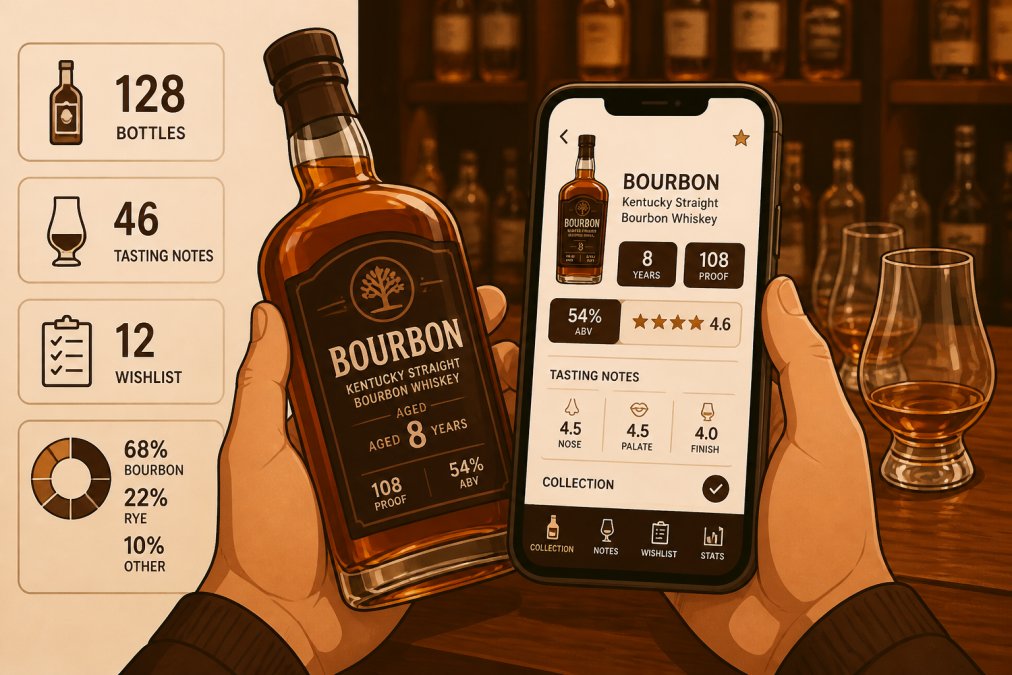
For each bottle, capture: distillery name, proof, age statement, mash bill if available, purchase price, and acquisition date. Photograph the bottle label and verify the system's information is correct. Add a brief tasting note immediately, "Spicy rye, vanilla finish, 100 proof, smooth" takes 20 seconds and becomes invaluable reference data.
Managing Tasting Notes & Flavor Profiles
Use this framework: nose, palate, finish. Under each category, write 2-3 descriptors. Example: "Nose: caramel, oak, slight pepper. Palate: butterscotch, rye spice, medium body. Finish: warm, lingering vanilla."
Include proof observations, a bourbon at barrel strength tastes different than the same bourbon proofed down. Add context: where you drank it, who you drank it with, what food you paired it with. Rate the bottle consistently to train the AI effectively.
Using Bourbon Price Guide App Features
Track acquisition price and current market value separately to reveal which bottles appreciate. Use the wishlist feature to track bottles you want. The app alerts you when prices drop.
Which App Wins for Your Use Case
For Serious Collectors (100+ Bottles)

Bourbon Tracker™ is the clear winner. It handles large collections without performance degradation. The interface remains responsive whether you have 100 or 500 bottles. Search and filtering work instantly. The AI recommendation engine becomes genuinely useful with enough data to identify patterns in your preferences. Bourbon Tracker™ is completely free, you're not paying monthly for features you've outgrown.
For Beginners & Casual Enthusiasts
Distiller appeals to social collectors who want to see what friends are drinking. Bourboneur appeals to learners with its guided tasting notes. Bourbon Tracker™ appeals to anyone wanting simplicity without sacrifice, collection tracking, tasting notes, and AI recommendations without complexity or cost.
For Community & Social Engagement
Distiller dominates this use case with core social features. Bourboneur's community feels secondary. Bourbon Tracker™ integrates community features as options rather than requirements, appealing to collectors who want flexibility.
Bourbon collecting is personal. The platform that works best aligns with how you actually collect. Bourbon Tracker™'s strength is that it adapts to your style, whether you're building a reference library, hunting deals, or exploring new bottles. The free access and no-download approach remove barriers to trying it. Start tracking your collection today, and let the platform's AI recommendations guide your next bottle purchase. Learn more about bourbon collection management best practices from official spirits regulations, and explore how bourbon database accuracy impacts collection valuation across different platforms. For detailed guidance on bottle provenance and distillery verification, consult the official bourbon trail resources for authoritative distillery information.
Frequently Asked Questions
What are the key differences between Distiller and Bourboneur for tracking bourbon?
Distiller excels at social community features and secondary market pricing data, making it ideal for collectors who want to track retail and auction values. Bourboneur focuses on detailed tasting notes and flavor profiles, with stronger emphasis on sensory evaluation. Both handle inventory management, but Distiller integrates more retailer listings while Bourboneur emphasizes personal palate matching through its recommendation engine.
Is Distiller or Bourboneur better for beginners?
Bourboneur is generally more intuitive for beginners because its interface guides you through logging bottles with a straightforward tasting note system. Distiller has more features overall, which can feel overwhelming initially, but offers better educational content about bourbon classification and mash bill composition. If you're just starting to track your collection, Bourboneur's simpler workflow gets you organized faster.
Can you track bourbon inventory with these apps, and how accurate is the pricing data?
Both apps track inventory by letting you log each bottle with quantity and location details. For pricing accuracy, Distiller pulls from multiple retailer listings and secondary market auction data, updating frequently but varying by region. Bourboneur's pricing comes from suggested retail price (MSRP) data and is more stable but less reflective of real-world secondary market values. Neither app guarantees 100% accuracy, always verify current prices on retailer sites for major purchases.
Which bourbon tracking app handles large collections (150+ bottles) without slowing down?
Both Distiller and Bourboneur handle large collections without significant performance issues. Distiller's interface remains responsive even with 200+ entries, though search and filtering can take a moment with massive datasets. Bourboneur is slightly faster with large inventories because it uses a leaner database structure. The real difference emerges in how you organize: Distiller's tagging system works better for huge collections, while Bourboneur's folder system suits medium-sized collections (under 200 bottles) more efficiently.
This article was written using GrandRanker