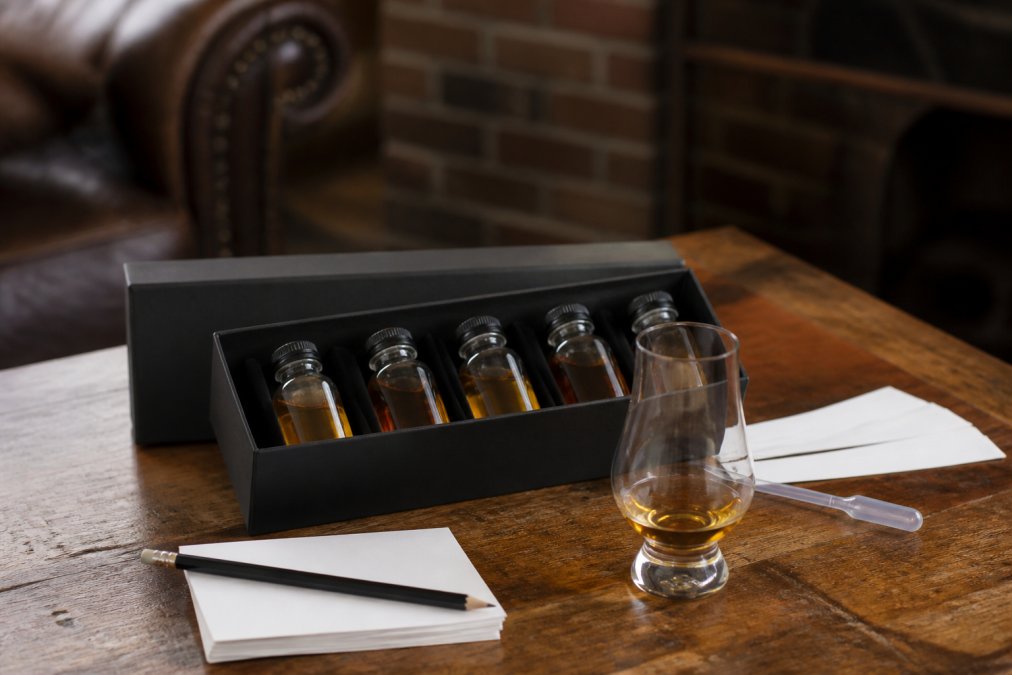
 listicle
Alternatives to Expensive Whiskey Tasting Kits
Table of Contents
- Why Expensive Whiskey Tasting Kits Don't Deliver Real Value
- Curated Tasting Services vs. Full-Bottle Purchases
- How to Host a Bourbon Tasting Party on a Budget
- DIY Whiskey Flight Ideas Using Retail Bottles
- How to Write Whiskey Tasting Notes Without a Kit
- Budget-Friendly Whiskeys That Replace Premium Alternatives
- Track Your Tastings and Build Your Collection Smarter
- Frequently Asked Questions
Last Updated: September 21, 2026
Why Expensive Whiskey Tasting Kits Don't Deliver Real Value
Expensive whiskey tasting kits promise curated experiences but lock you into recurring subscriptions and premium markups. The most engaged collectors build their own tasting experiences rather than rely on pre-packaged alternatives.
The core problem: you're paying for convenience and curation when you need flexibility and control. A $150 kit teaches you about five whiskeys, not how to evaluate whiskey on your own terms or build a collection aligned with your palate.
The real value in whiskey tasting is methodology, not the kit. Once you understand how to assess aroma, palate, and finish, you can evaluate any whiskey. The alternatives to expensive whiskey tasting kits build that skill while keeping costs low and options unlimited.
Curated Tasting Services vs. Full-Bottle Purchases
The choice between subscription services and full bottles is about sequencing and purpose. Understanding the trade-offs helps you build a collection strategy.
Curated tasting services: discovery with structure. Subscription services like Flaviar deliver themed boxes with 1.5 oz samples. This works well in the early exploration phase when you don't yet know your palate preferences. The trade-off: you're locked into their curation schedule and paying a markup for convenience.
Full-bottle purchases: control and depth. When you buy a full bottle, you own the entire tasting experience and can revisit it over time. A $45 bottle of Wilderness Trail Kentucky Straight Bourbon gives you 25 ounces for $1.80 per ounce, far lower than services. The trade-off: you're committing to a bottle without knowing if you'll like it.
The hybrid workflow: discovery into collection. Use a service for 3-6 months of initial exploration, tracking which samples impressed you. After 3-6 months, you'll have clear patterns, maybe you prefer higher-proof whiskeys or sherried finishes. Transition to full bottles: buy the whiskeys that genuinely resonated, plus similar bottles recommended by the service. You can now taste your favorite discovery repeatedly and understand how it evolves.
The tracking system: turning tastings into strategy. Log every tasting: whiskey name, aroma and palate notes, rating (1-10), and whether you'd buy a full bottle. After 6 months, you have a searchable record of 24-36 whiskeys. Bourbon Tracker™ organizes these notes by whiskey, distillery, proof, and rating, and its recommendations learn your palate over time.
Building from discovery to collection. Month 1-3: subscribe to a tasting service and log notes. Identify 3-5 whiskeys to buy full bottles of. Month 4-6: buy those full bottles and continue the subscription for new discoveries. By month 6-12, you've built a personal collection of 5-10 bottles. This hybrid approach delivers far higher confidence.
When to stay with services, when to move to bottles. If you're a serial explorer tasting 50 different whiskeys per year, a service makes sense. If you're building a collection for depth and expertise, full bottles make sense. Most serious collectors do both: maintain a small subscription for discovery and buy full bottles of whiskeys that resonate. Broadening this habit of sensory education often leads enthusiasts to explore niche discovery sets that apply similar principles of curated variety to the world of fragrance.
How to Host a Bourbon Tasting Party on a Budget
Hosting a bourbon tasting party doesn't require expensive kits. The experience is often better when guests bring their own bottles and perspectives.
Start with glassware. Standard rocks glasses work fine; just ensure enough glasses so guests can taste multiple whiskeys without rinsing between pours.
Select three to five bottles. Green River Full Proof, 1792 Full Proof, and Wilderness Trail offer excellent flavor profiles without secondary market markups. You choose the whiskeys, control the narrative, and guests taste real bottles they can buy themselves.
Pour 0.5 oz samples per whiskey, arranged from lighter to higher proof to prevent palate fatigue.
Provide simple tasting mats with columns for whiskey name, aroma, palate, finish, and rating. Encourage guests to write observations before discussing to prevent groupthink.
The conversation is where real value emerges. When guests describe different flavor notes for the same whiskey, you learn about both the whiskey and how taste perception varies, all for a fraction of kit costs.
DIY Whiskey Flight Ideas Using Retail Bottles
A whiskey flight is simply a collection of small pours arranged for side-by-side comparison. You don't need a kit, just retail bottles and a little structure. But structure matters, the difference between casual tasting and methodical evaluation is a system.
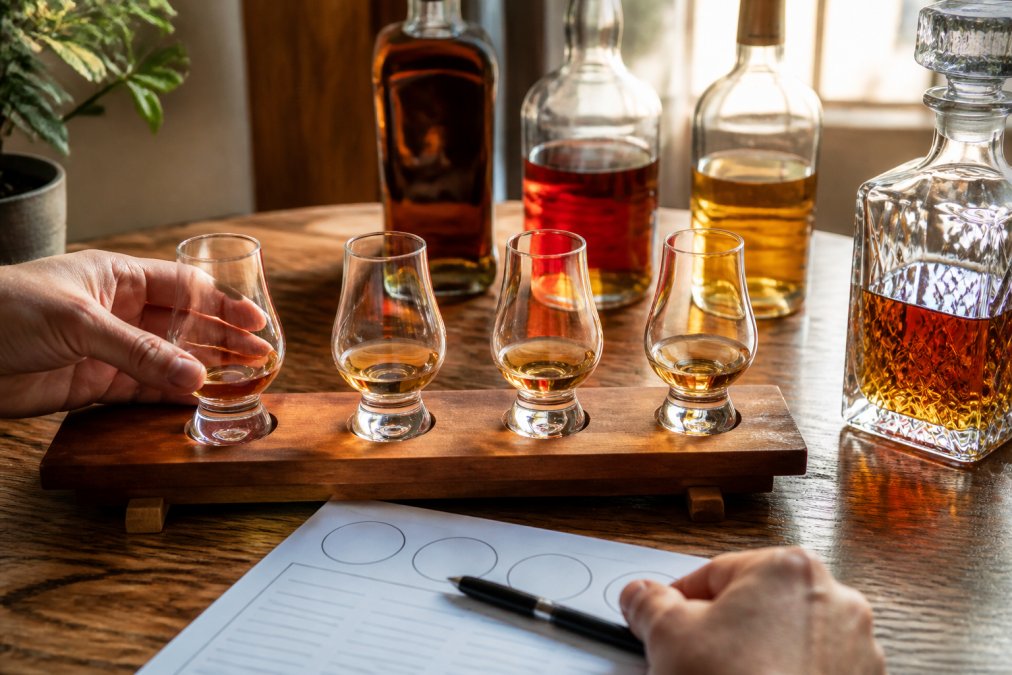
The blind-tasting framework. Most home tastings fail because you know what you're drinking. Eliminate this bias by pouring whiskeys into identical glasses, numbering them, and tasting blind. Write notes before unmasking. This transforms a casual pour into a defensible evaluation and reveals that budget bottles sometimes outperform premium ones.
Structured tasting scorecard. Create a form with columns: Glass Number, Aroma (initial and after swirl), Palate (texture and flavor), Finish, Overall Rating (1-10), Notes. Use the same form for every flight so ratings become comparable over time.
Regional flight. Select a Kentucky bourbon, a rye, and an Irish single malt. Pour blind and evaluate using your scorecard before revealing identities. This teaches how terroir, production methods, and cask type shape flavor. After unmasking, discuss: Did the origin match expectations? What surprised you?
Proof progression flight. Buy three whiskeys at 80, 100, and 120+ proof. Pour blind, lowest proof first. This isolates how alcohol content affects perception. Higher proof amplifies spice, oak, and heat while sometimes muting delicate notes. Blind tasting separates the psychological effect of "higher proof = stronger" from actual sensory reality.
Price comparison flight. Select whiskeys under $30, $40-$60, and $75+. Pour blind and rate using your scorecard. This cuts through marketing and shows what you're paying for as prices climb. The blind format prevents anchoring bias and forces merit-based evaluation.
Budget flight for learning. Use Wilderness Trail, The Sexton, and Green River Full Proof, all under $65. Wilderness Trail's sweet mash produces a smooth profile. The Sexton's triple distillation and sherry cask aging create different texture. Green River's high proof delivers bold, complex notes. Tasting blind teaches how production decisions cascade into flavor differences.
The key principle: intentionality and repeatability. Each flight should answer a specific question: How does region matter? How does proof change perception? When you structure tastings around questions and use a consistent scorecard, you build tasting methodology. Over time, your scorecards reveal patterns, you prefer higher-proof whiskeys, sherried finishes, or certain distilleries, that guide purchases far more reliably than marketing.
How to Write Whiskey Tasting Notes Without a Kit
Professional tasting notes follow a simple structure: aroma, palate, finish, and overall impression. You need a system and practice, not a kit template.
Aroma: Nose without swirling first, then swirl and nose again. Write both observations. Be specific: "vanilla extract and charred oak" trains your palate better than "sweet."
Palate: Take a small sip and let it coat your mouth. Note texture (thin, medium, viscous), flavors, and how the whiskey evolves. The evolution matters, some open up, others flatten.
Finish: Notice what lingers after swallowing. Is it warm, spicy, smooth, or dry? How long does it last?
Overall impression: Rate it on a consistent scale (1-10 or categories like "everyday pour," "special occasion," "not for me").
Budget-Friendly Whiskeys That Replace Premium Alternatives
Excellent alternatives to secondary-market whiskeys exist at retail prices.
Wilderness Trail Kentucky Straight Bourbon delivers small-batch quality without the hype markup. The sweet mash distillation technique produces a smooth, approachable whiskey with genuine complexity. It's widely available and consistently good, exactly what you want when building a collection on a budget.
Kentucky Distillers Association resources on bourbon production
Track Your Tastings and Build Your Collection Smarter
The difference between casual drinkers and serious collectors is simple: collectors track what they taste and why.
American Bourbon Association guidelines on whiskey classification
Scotch Whisky Association technical standards on production
Frequently Asked Questions
What are the best budget-friendly whiskeys for a tasting flight?
Wilderness Trail Kentucky Straight Bourbon, The Sexton Irish Whiskey, Green River Full Proof, and 1792 Full Proof all deliver strong flavor profiles without premium pricing. These small-batch and craft options work well in comparative tastings because they offer distinct flavor characteristics, from sweet mash techniques to sherry cask maturation, that help you develop your palate without spending $100+ per bottle.
How can I create a DIY whiskey flight at home without buying an expensive kit?
Purchase individual bottles from your local retailer, pour 0.5 to 1 ounce samples into small nosing glasses, and arrange them on a wooden board or tasting mat. Order them by proof or region, lighter to bolder, or by geography. Include a water pitcher and palate cleanser (crackers or bread). This approach costs less than pre-packaged flights and lets you choose exactly which whiskeys you want to compare.
Can Bourbon Tracker™ help me organize my tasting notes and collection?
Yes. Bourbon Tracker™ is a free, no-download platform that lets you log tasting notes, track your bottles, and organize your palate preferences. You can curate a personal wishlist and receive AI-powered recommendations based on your tasting history. The integrated community features also let you share reviews with other enthusiasts, making it easier to compare notes and discover new bottles without paying for a subscription service.
Are whiskey subscription boxes worth the cost compared to buying individual bottles?
Subscription boxes work best if you value guided education and convenience over cost control. If you prefer flexibility and lower total spend, buying individual bottles from retailers and hosting your own tastings typically costs less while giving you complete control over which whiskeys you explore.