 how-to
Analyzing Whiskey Market Trends for Collectors
Table of Contents
- Understanding the Whiskey Market Size and Growth
- Whiskey Price Trends: What Collectors Need to Track
- Whiskey Auction Prices and Secondary Market Dynamics
- Evaluating Collectible Whiskey Value: Beyond Market Hype
- Using a Whiskey Collection Tracking App to Monitor Trends
- Market Segmentation: Premium, Super-Premium, and Limited Editions
- Separating Collectible Demand from Broader Market Growth
- Risk, Liquidity, and the True Cost of Collecting
- Frequently Asked Questions
Last Updated: October 6, 2026
Understanding the Whiskey Market Size and Growth
Understanding whiskey market trends is essential as the market continues to expand globally, driven by rising consumer demand for premium spirits and collectible bottles.
The global whiskey market reflects strong growth across multiple categories. Consumer preferences have shifted noticeably toward premium and super-premium offerings over standard expressions. This premiumization trend creates opportunities for collectors who focus on bottles with genuine scarcity or brand recognition.
However, not all whiskey market growth translates to collectible bottle appreciation. A key distinction exists between overall market expansion and secondary-market price appreciation for specific bottles. Many collectors confuse broad industry growth with individual bottle value trajectories. At Bourbon Tracker™, we help collectors separate these signals.
Market segmentation matters enormously. Limited editions, cask-strength releases, and discontinued expressions typically outpace standard production bottles in price appreciation. Younger drinkers entering the whiskey category tend to favor approachable, flavored, or lower-proof expressions. Meanwhile, established collectors pursue rare, aged, and single-barrel offerings.
The forecast period ahead suggests continued growth, though the pace varies by segment. Understanding these dynamics helps you avoid overpaying for bottles riding temporary hype cycles.
Whiskey Price Trends: What Collectors Need to Track
Whiskey price trends reflect supply constraints, brand reputation, and collector sentiment more than overall market size. Tracking these trends requires attention to specific data points rather than general industry reports.
Primary factors influencing whiskey price trends include:
- Bottle age and rarity: Older releases and limited production runs command premium prices
- Discontinuation status: Bottles no longer in production typically appreciate faster
- Brand prestige: Established distilleries with strong collector followings hold value better
- Proof and cask type: Cask-strength and single-barrel expressions attract serious collectors
- Condition and provenance: Full bottles with intact seals and documented history sell for significantly more
Most collectors make a critical mistake here: they assume that if the whiskey market is growing, their bottles will appreciate. Price trends tell a different story. Some bottles stagnate for years while others jump 20-30% annually. The difference comes down to specific characteristics, not category membership.
Track prices over 12-24 month periods rather than checking sporadically. Short-term fluctuations create noise. Real trends emerge when you compare consistent data points across seasons.
Whiskey Auction Prices and Secondary Market Dynamics
Whiskey auction prices reveal true collector demand and serve as the most reliable indicator of bottle-level valuation. Unlike retail pricing, auction results reflect what informed buyers actually pay when competing for specific bottles.
Secondary market dynamics work differently than primary sales. Auctions capture genuine scarcity signals. When a discontinued bottle sells for three times its original retail price, that's real demand. When a current-production release struggles to meet its opening bid, that's a warning sign.
Key auction insights:
- Hammer prices often exceed estimates for genuinely rare bottles, signaling strong collector demand
- Unsold lots indicate weak demand, suggesting overpriced bottles or category fatigue
- Seasonal patterns exist: spring and fall auctions typically see stronger participation
- Lot size matters: single bottles command different per-bottle prices than collection lots
- Provenance documentation increases final prices by 10-20% on average
Watch auction results for bottles similar to ones you own or considering purchasing. Track the same expression across multiple auctions to identify price floors and ceilings. This data becomes your baseline for evaluating private sales and market opportunities.
The secondary market moves faster than retail channels. Serious collectors monitor auction houses weekly to catch emerging trends before they become common knowledge.
Evaluating Collectible Whiskey Value: Beyond Market Hype
Collectible whiskey value depends on factors that generic market reports never address. Separating genuine collectibility from temporary hype requires a systematic evaluation approach.
Bottle-Level Valuation Fundamentals
Start with comparable sales analysis. Find recent auction results for identical or nearly identical bottles. Look for:
- Same distillery, expression, and vintage
- Matching bottle condition and fill level
- Similar provenance documentation
- Recent sales within the last 6-12 months
Compare at least three comparable sales to establish a realistic price range. A single high sale doesn't establish value. Multiple data points reveal whether a bottle commands consistent premium pricing or benefited from one collector's enthusiasm.
Calculate price per milliliter for bottles at different fill levels. A bottle at 85% fill shouldn't command the same price as a full bottle, but the adjustment varies by rarity. Extremely rare bottles lose less percentage value for partial fill than common expressions.
Research discontinued status. If a bottle remains in production, its collectible premium stays limited. Once a distillery discontinues an expression, scarcity increases and appreciation typically accelerates. Timing matters here, early discontinuation often creates the strongest collector demand.
Condition, Provenance, and Authenticity Impact
Condition assessment directly affects valuation. Full, sealed bottles command the highest prices. Partially consumed bottles sell at steep discounts. The discount percentage depends on rarity, a rare bottle at 60% fill might sell for 70% of full-bottle price, while a common expression might fetch only 40%.
Examine the bottle itself for damage. Labels should be intact and legible. Capsules should show minimal wear. Liquid color should match expected characteristics for age and storage. Any leakage history dramatically reduces value.
Provenance documentation strengthens valuation significantly. Bottles with clear ownership history, auction house records, or distillery provenance certificates command premiums. Mystery bottles with unknown storage history sell at discounts, even if condition appears excellent. Collectors pay for confidence.
Authenticity verification matters increasingly as secondary market prices rise. Counterfeit bottles exist, particularly for highly valued expressions. Request authentication details before purchasing high-value bottles. Legitimate sellers provide documentation supporting authenticity claims.
Using a Whiskey Collection Tracking App to Monitor Trends
Managing a serious collection requires systematic tracking. Spreadsheets work initially, but dedicated platforms scale better as your collection grows. A whiskey collection tracking app centralizes bottle data, tasting notes, and valuation information in one accessible location.
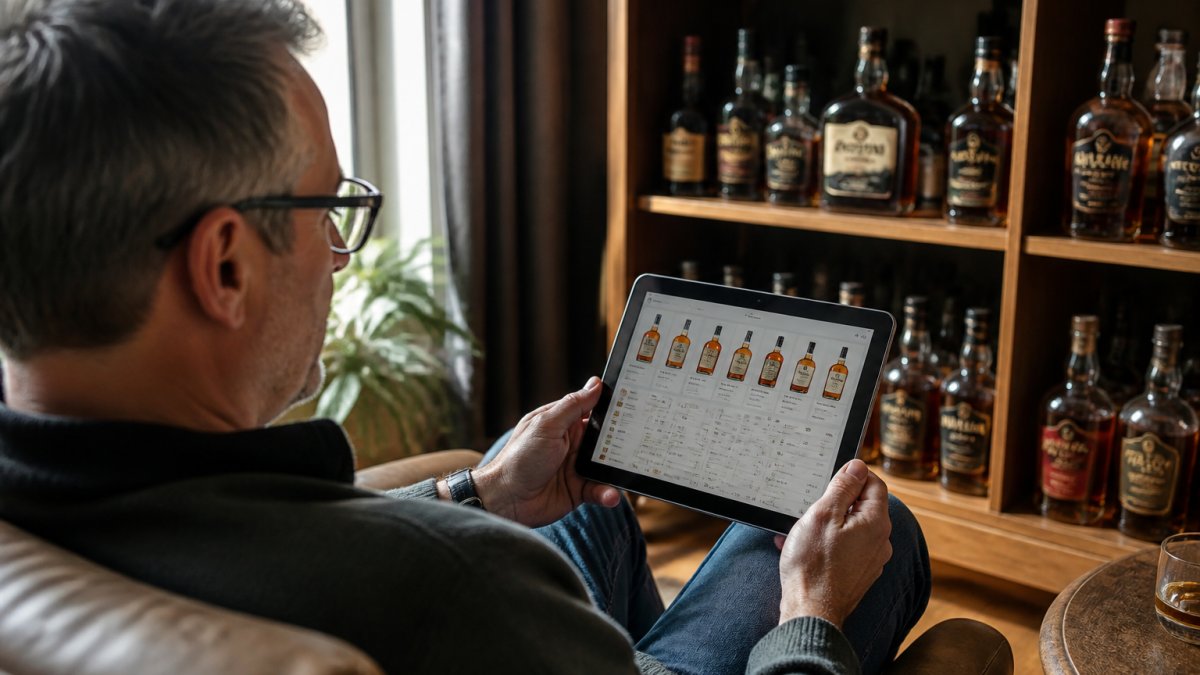
Effective tracking platforms capture essential data points:
- Bottle identification (distillery, expression, vintage, proof)
- Purchase date and price paid
- Current estimated value based on comparable sales
- Tasting notes and personal ratings
- Storage location and condition notes
- Acquisition source (retail, auction, private sale)
This data allows you to monitor your collection's performance over time. You'll identify which bottles appreciate steadily versus which stagnate. You'll spot opportunities to sell high and purchase undervalued bottles.
Bourbon Tracker™ enables collectors to log detailed tasting notes and receive AI-powered recommendations tailored to their palate preferences. The platform connects you with the broader collector community, helping you discover bottles aligned with your collecting goals.
Beyond personal tracking, collection apps reveal market patterns. When multiple collectors log purchase prices for the same bottle across different dates, you see real price movement. Aggregated data from active collectors provides early signals about emerging trends before they appear in formal market reports.
Market Segmentation: Premium, Super-Premium, and Limited Editions
Whiskey market segmentation reveals distinct demand patterns and price appreciation trajectories across categories. Understanding these segments helps you focus your collecting strategy.
Premium whiskey typically ranges from $50-$150 per bottle at retail. These expressions show consistent quality and brand recognition. Price appreciation occurs gradually, usually 5-10% annually for discontinued bottles.
Super-premium whiskey spans $150-$500+ retail price points. These bottles attract serious collectors and investors. Rarity, age statements, and limited production runs define this segment. Price appreciation accelerates here, discontinued super-premium bottles often appreciate 15-25% annually.
Limited editions and special releases create the most volatile pricing. These bottles often sell out quickly at retail, then jump significantly on secondary markets. Some limited releases appreciate 50-100% within 12 months.
Younger drinkers and casual enthusiasts concentrate in the premium segment. Established collectors focus on super-premium and limited editions. Institutional investors increasingly target ultra-rare bottles above $1,000. Each segment responds to different market forces.
The growth trajectory differs across segments. Premium whiskey grows steadily as the overall category expands. Super-premium growth outpaces the broader market. Limited editions experience boom-and-bust cycles tied to specific releases and collector sentiment.
Separating Collectible Demand from Broader Market Growth
This distinction separates successful collectors from those chasing false signals. Overall whiskey market growth doesn't guarantee individual bottle appreciation. Many collectors make this fundamental error.
The whiskey market might grow 8-12% annually overall, driven by new consumer adoption and premiumization trends. Yet a specific bottle might appreciate 2% while another jumps 40%. The difference comes from collectible demand, not category growth.
Collectible demand emerges from scarcity, brand prestige, and community recognition. A bottle becomes collectible when:
- Production ended or remains extremely limited
- Collector community actively seeks the bottle
- Secondary market prices consistently exceed retail equivalents
- Bottle appears regularly in auctions and private sales
- Authentication and provenance documentation exists
Bottles lacking these characteristics may benefit from category growth without becoming true collectibles. They'll appreciate modestly as the broader market expands, but won't experience the acceleration that genuine collectibles enjoy.
Watch for hype cycles. Social media attention and influencer mentions can create temporary demand spikes. These bubbles often deflate when attention moves elsewhere. True collectible demand sustains across years and remains supported by limited supply.
Compare bottle-specific data to category trends. If the whiskey market grows 10% but your bottle only appreciates 3%, that's underperformance. If your bottle appreciates 25% while the market grows 10%, that's genuine collectible demand. This analysis reveals whether you're holding collectibles or merely riding category tailwinds.
Risk, Liquidity, and the True Cost of Collecting
Understanding collecting economics requires honest assessment of risk and liquidity. Bottles don't appreciate automatically, and secondary market sales involve real costs.
Liquidity risk matters significantly. Premium bottles sell relatively quickly when you decide to liquidate. Super-premium bottles take longer to find buyers.
Price volatility characterizes the secondary market. A bottle worth $500 six months ago might command $450 today or $650 tomorrow.
Transaction costs reduce returns substantially. Auction house commissions typically run 15-20%. Private sales involve authentication costs, shipping, and insurance.
Storage and insurance costs accumulate over time. Proper storage requires temperature control and humidity management. Insurance protects against loss but reduces net returns.
Opportunity costs deserve consideration. Capital tied up in bottles could generate returns elsewhere. If a bottle appreciates 8% annually but you could earn 10% in alternative investments, you're underperforming.
Calculate true returns by accounting for all costs. A bottle purchased for $400 that sells for $600 appears to show 50% appreciation.
Risk assessment requires honest evaluation. Some bottles appreciate reliably. Others stagnate or decline. Diversification across price points, distilleries, and bottle types reduces risk.
Tracking whiskey market trends requires moving beyond broad category reports and focusing on bottle-level data.
Frequently Asked Questions
How do collectors analyze whiskey market trends?
Collectors track whiskey market trends by monitoring auction results, comparing historical pricing data across multiple sales, and using collection tracking apps to log bottle acquisitions and condition changes over time. Key metrics include price appreciation rates for specific distilleries and bottlings, regional demand shifts, and secondary market liquidity. Cross-referencing auction house sales records with retail pricing reveals gaps between collector demand and broader market growth, helping you identify whether a bottle's value is driven by genuine scarcity or temporary hype.
What factors affect the value of collectible whiskey?
Collectible whiskey value depends on distillery reputation, age statement, rarity, condition of the bottle and label, provenance documentation, and current collector demand. Limited editions and discontinued expressions typically command premiums. Market conditions also matter: economic downturns reduce discretionary spending on premium bottles, while emerging collector interest in specific regions or styles can drive rapid appreciation. Bottles with damaged seals, low fill levels, or missing documentation trade at significant discounts regardless of the whiskey's quality or age.
How can I tell whether a whiskey bottle is increasing in value?
Track comparable sales over 12-24 months using auction results and secondary market listings. Document the bottle's condition, bottle code, and proof at purchase, then compare recent sales of identical or very similar bottlings. Price appreciation of 5-10% annually is typical for well-regarded bottles; faster gains often signal temporary collector enthusiasm rather than sustainable value growth. Use a whiskey collection tracking app to maintain consistent records and spot trends across your portfolio. Be skeptical of single outlier sales; look for patterns across multiple transactions before concluding a bottle is appreciating.
Where can collectors track whiskey prices and market data?
Auction house catalogs (Christie's, Sotheby's, Heritage Auctions) provide transparent sales data and realized prices. Secondary market platforms and online retailers publish current asking prices, though actual transaction prices often differ. Dedicated whiskey collection tracking apps consolidate pricing data and let you monitor your own bottles' estimated values over time. Collector forums and communities share transaction details that help you understand regional price variations. Cross-check multiple sources before making investment decisions, as published asking prices frequently exceed what buyers actually pay.